






Ethereum 2.0 solves congestion? They said: you misunderstood



The Blockchain Week in 2020 is coming as scheduled, and exciting activities are staged every day. Having personally experienced the "running meeting" in the past few days, the editor and colleagues shouted "too much".
HashQuark also joined forces with Flow, Avalanche, BlockStack, and Republic to hold the themed event "It's Time - New Infrastructure on the Wind", aiming to discuss the topics of construction and development of many public chains. Among them, in the round table discussion on ETH2.0 around the overlord of the public chain, Ethereum, the ETH2.0 leaders of HashQuark, imToken, Spark Mining Pool, and InfStones have thrown out wonderful opinions and launched a heated discussion on ETH2.0 ( and Tucao).

At the beginning of the event, HashQuark CEO Li Chen brought everyone a preview of the EtherPocket product developed by HashQuark based on ETH2.0:
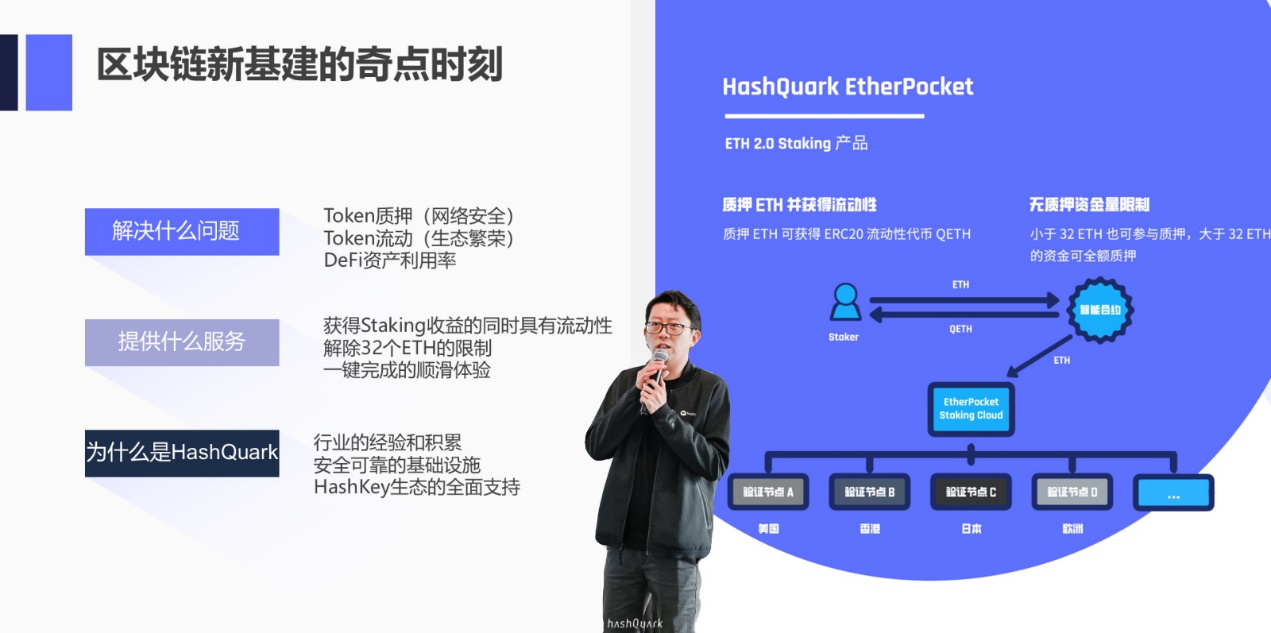
EtherPocket can not only create income for users under the premise of ensuring security, but also lower the capital threshold for users to participate in Staking, so that users with less than or greater than 32 ETH can participate in the pledge. More importantly, the QETH certificate in EtherPocket provides a solution for ETH2.0 liquidity.
In the "Fairy Round Table" about ETH2.0, all the guests talked quickly and their thinking was stirring. Lianwen Liu Feng asked the guests questions on topics such as the development progress of Ethereum 2.0, the challenges of 2.0 ecological diversity, PoS oligarchy and decentralization, and the possibility of breaking through the public chain.
Mako: "For the performance improvement of Ethereum, don't just hope for Ethereum 2.0, layer2 is also worthy of attention. The role of Ethereum is also changing to an industry standard setter."
Uncle Meow: “Currently Ethereum miners don’t care about the Ethereum ecology, but they can better maintain the safe operation of the network; node operators pay more attention to the ecology, but they are also more speculative; after switching to PoS, how can ETH 2.0 do well? Decentralization is a challenge."
Rudy: "The diversity and ability of "thinking and thinking" of the Ethereum community are beyond the reach of most project communities. If other public chains want to overtake, it depends on whether the ecology can support the vision."
Tony: "The launch condition of the 2.0 mainnet is 520,000 ETH to participate in the 2.0 network, but it seems that Ethereum 2.0 can only participate in the form of Staking, which is not attractive enough. The ecological prosperity and high returns of Ethereum 1.0 (DeFi products) It will bring enormous pressure to Ethereum 2.0, prompting the foundation to speed up the development and ecological construction of Ethereum 2.0.”
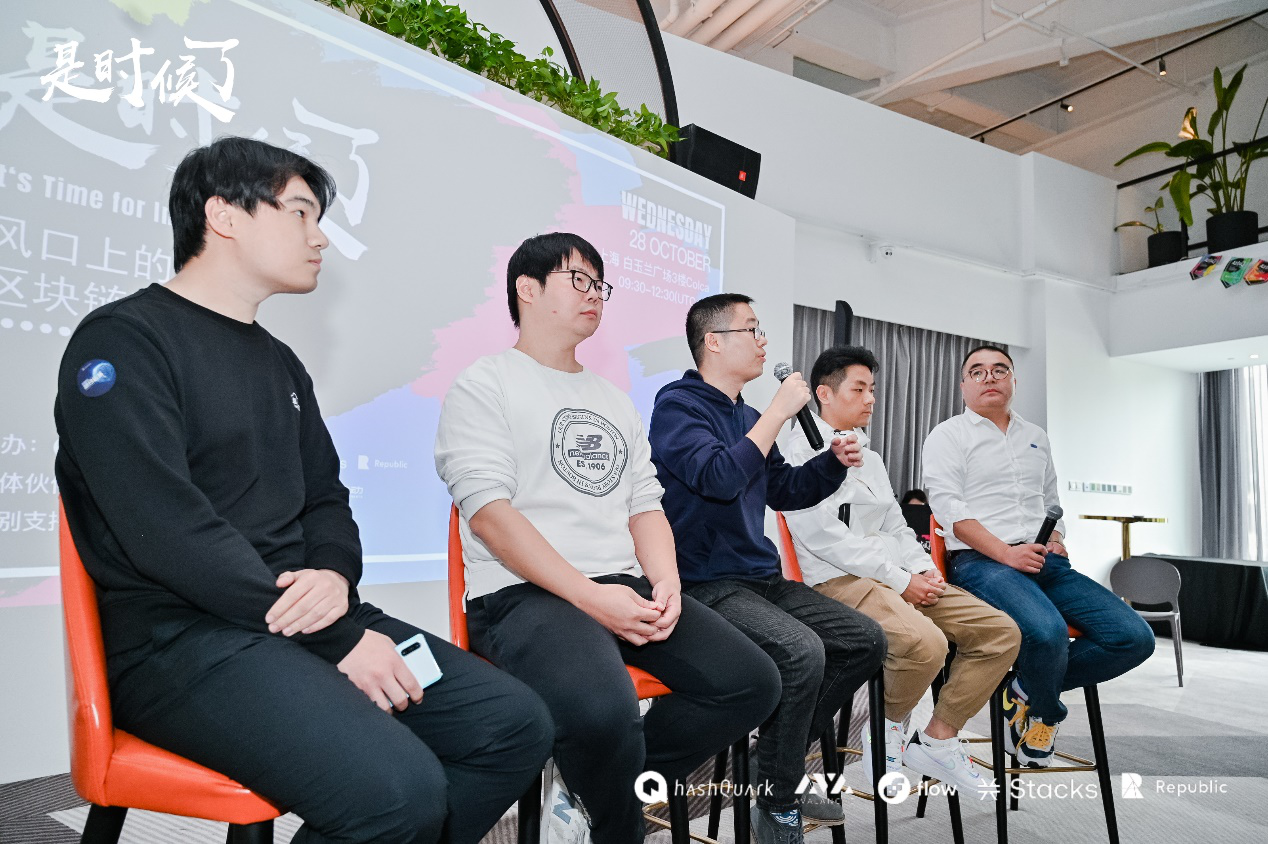
High-quality public chains are indispensable in the discussion of new infrastructure. Representatives from Avalanche, Republic, Flow, and BlockStack also shared their wonderful views and introduced the latest progress of their projects:
PlatON CTO James Qu said that with the launch of Alaya, PlatON's Giskard consensus algorithm, dual virtual machines, and basic capabilities to support complex ecosystems such as DeFi and NFT will be verified by the community, and the veil of privacy computing will be gradually lifted.
John Wu, president of Avalanche, revealed at the event that the basic performance of Avalanche (Avalanche Protocol) has attracted the attention of many high-quality ecological projects. At present, a top three stablecoin in terms of volume is communicating with it and will issue stablecoins on Avalanche. currency.
Cao Zhen, head of the Asia-Pacific region of Republic, made a point of view - the "28th principle" leads to the fact that the probability of leading institutions to obtain high-quality project investment opportunities is much higher than that of ordinary people. The emergence of Republic is to bridge this gap. You can even participate in the investment of SpaceX on Republic (a space technology company founded by Tesla founder Elon Musk, which has launched and recovered rockets into space many times), which is currently It is difficult for other blockchain companies to do.
Roham, CEO of Dapper Labs, introduced Flow to everyone. Dapper Labs once produced the popular CryptoKitties (encrypted cats), but the NFT boom driven by Ethereum also exposed high fees, small storage capacity, and slow transactions. question. NFT needs a more economical and applicable infrastructure, and Flow will be the best choice. Dapper Labs will let Flow meet you when more encrypted assets appear.
Muneeb, the founder of BlockStack, even brought you the news that Stacks2.0 is about to be launched - Muneeb payment. Although the Bitcoin network has high security, due to the lack of application, investors can only hold it, which is a passive asset. Stacks2.0 can combine smart contracts with the Bitcoin network to unleash the huge potential of the Bitcoin network. Stacks 2.0 is expected to be released in December.
The following is the full text of the "It's time, let's talk about Ethereum 2.0" roundtable discussion, let's take a look~
Specially invited host: Lianwen Liu Feng (hereinafter referred to as "Ms. Liu")
Round table guests: HashQuark Hu Zhixiang (Tony Zhixiang)
imToken Mako (Mako)
Spark Mine Pool Uncle Meow (Uncle Meow)
InfStones Rudy (Rudy)
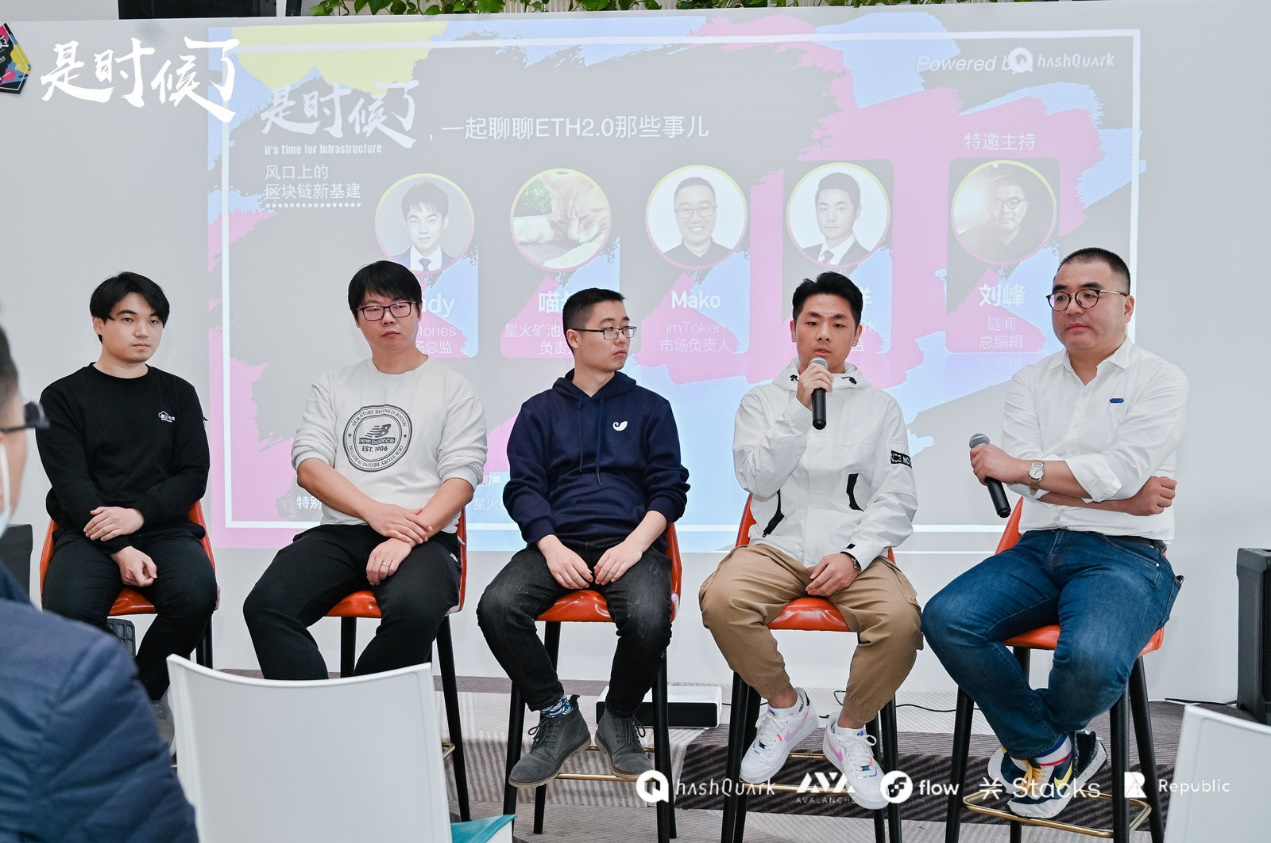
Mr. Liu: The guests here believe that friends who are interested in ETH2.0 are no strangers, so I will not invite you to introduce yourself individually. The first question is about the progress of ETH2.0 - the specific launch time has been pushed back and forth. Based on your observation and understanding, what do you think about the progress of ETH2.0?
Mako: Many people don’t know the latest progress of ETH2.0, mainly because the official channels are scattered. I have been following up the development of ETH2.0 through different channels. The latest information was mentioned by Danny Ryan in the Bankless AMA live broadcast. Currently An important cryptographic library that BLS relies on is still being audited. This library is very important to the security of the entire network because it is related to the private key generation and signature of ETH2.0; this library is still being audited. It is expected to be completed in two weeks, and at the same time there are some other problems with the network....
Ms. Liu: Let me add that the two weeks you mentioned were said by Danny Ryan (the person in charge of ETH 2.0). few weeks"..."In few weeks"..and then "In few weeks" again and again. So I don't really trust him anymore...
Mako: Yes, actually this question... No matter who said it will come in two weeks, including Vitalik himself said at the Wanxiang Summit that it will come in November, but I feel that there is no official channel for Ethereum to come. Sure. According to my observation, the official has completed all the codes and preparations for Phase0.
Teacher Liu: Anyway, you are especially the most loyal supporters of (Ethereum 2.0), but as the editor-in-chief of Lianwen, I told our reporters not to publish these news. Some other people posted these news and said that the market is pulling the market. I think it is actually irresponsible. Because they said it too much, like a wolf story. Of course, if you (to all Panel guests) have different opinions, you can complain about me~
Uncle Meow: That’s actually the case. Why is 2.0 always delayed? A big reason comes from some communities or the way this project is promoted-now the Ethereum Foundation is not developing its own client, but handing over the 2.0 client to multiple teams to do it at the same time, and each team is actually working on it. Evolve forward based on the same standard. Just like what Mako said just now, the work on the basic library BLS has been done for a year. Because our Spark has been working on the 2.0-related product line since last year, and I was quite optimistic at the time, so we finished the whole thing in three months, and then began to wait... It turned out that the wait was more than a year.
So what does the whole progress look like in the end? From a positive point of view, in fact, about 2-3 weeks ago, it can be found that the PR (Pull Request) of a document of the entire standard of phase 0 has been merged. This is actually a milestone. At least it shows that the phase 0 of 2.0 will not make any changes from the standard. Then the rest of the work actually lies in the specific follow-up and implementation of client development teams such as light house and prysmlabs, and joint debugging of multiple clients on the test network to ensure that everyone's implementation is consistent.
Why keep procrastinating? I don't think anyone knows what's wrong with implementing it. Because we followed up many testnets along the way and ran down, there were some problems in the middle testnet, and even the entire testnet crashed, and it took us another week to restore the nodes. In the end, it was found that many of them were actually engineering implementation problems, not that there were problems with the 2.0 standards and definitions. Therefore, it should be said that the foundation is still relatively cautious, and hopes to complete (re-release) all the content that can be audited, because after all, 1.0 to 2.0 is a one-way process, and asset security is very important.
HashQuark Tom: I personally think that the Deposit contract that the official said can be deployed within 6 weeks is entirely possible, because the code of the contract has been audited, and I have also read the code of the currency exchange contract, and it should be feasible. But it should be noted that "the ability to deploy smart contracts" and "mainnet launch" are still two different things, because there are two trigger conditions for the mainnet launch, one is that 520,000 ETHs participate in 2.0, and the second is the launch time. Not sure. But overall, I am quite optimistic about the follow-up progress.
Ms. Liu: I think the 2.0 progress and status quo have been explained very clearly just now. Let me ask Rudy a new question—many people are saying that a big challenge of 2.0 also comes from the diversity of its clients. Do you currently see this as a problem?
Rudy: It's definitely a challenge. Because there was a famous accident in the Medalla test network before, a certain client had a problem, and as a result, a large area of nodes went offline and could not be brought back online. At that time, there were 4 clients, but in fact, it could not provide enough diversity. If there is a problem with a client that is mainly used, it cannot be guaranteed that at least 2/3 of the verifiers will not have problems, and the block cannot be guaranteed. finalization and normal operation of the network.
After many nodes went offline in this accident, in fact, many small nodes or individual nodes have lost the motivation to return to the test network to build nodes. This will also be a problem. On the one hand, Ethereum 2.0 emphasizes decentralization, and on the other hand, it proposes a limitation of 2/3 online. This will lead to a large number of individual node and small node operators who are unwilling to fully participate in network operations because the threshold for running ETH2.0 nodes is not low, which will cause problems for the stability and security of network operation .
Today we saw that HashQuark also launched its own products based on Ethereum 2.0 that can be easily applied; InfStone is also an infrastructure service provider that has been following up on ETH2. Our goal is to ensure that the entire network can be more secure and decentralized Operation, reduce the difficulty and threshold of node operation through products on infrastructure services.
In line with the topic of "new infrastructure" we are discussing today, in addition to the diversity of clients, the diversity of infrastructure is also crucial. If the infrastructure is too centralized, the failure of a single entry or a single infrastructure could destabilize the entire network.
For example, many people have talked about uniswap recently. If the front-end webpage of uniswap is closed, the domain name of the website stops resolving, and the friendly trading interface is cancelled, how many people still know how to use uniswap for transactions?
Therefore, whether it is the diversity of clients, the diversity of infrastructure or the diversity of various tools, it is actually what a decentralized network like Ethereum 2.0 pursues.
Teacher Liu: Can Tony tell us about the preparations for the arrival of Ethereum 2.0 on a node service like HashQuark?
Tony: Several guests talked a lot just now, and I agree with many points of view. Like everyone, we have carried out a lot of work around Ethereum 2.0. HashQuark started to follow up the development of each test network and each client from the very early stage of the test network. We also reproduced the 2.0 test network and released the first Chinese original Ethereum 2.0 in-depth evaluation report. We also paid attention to The actual needs of many users in the market. Therefore, we decided to develop and launch the EtherPocket product, hoping to solve several major problems that you may encounter in 2.0 Staking. Consensys has done a research report before. There is a survey about how many Ethereum holders or holding addresses are willing to participate in Staking. In fact, 60% of users said that they have no willingness to staking - there are many reasons (1) not enough 32 ETH in hand (2) they do not have the ability to operate nodes (3) even if they run, they are worried about slash, if they are disconnected or accidentally Violations will not only result in no income but also deductions (4) If ETH needs to be converted to ETH 2.0 for staking, it cannot be changed to ETH after the transfer, nor can it be transferred and traded. There is no liquidity... Wait, these are when 2.0 arrives The practical problems that everyone staking may face. For the above problems, our EtherPocket products actually have corresponding solutions, even including providing liquidity for 2.0 tokens.
You can mortgage ETH on EtherPocket to obtain QETH. This QETH can be used as an ETH2.0 certificate to participate in Staking on EtherPocket, and it can also be traded on exchanges or used for transfers, DeFi and loans.
And there is no limit of 32 ETH in EtherPocket, if you have 50 ETH, you don’t have to worry that you can only be a node and 18 coins are wasted; or if you only have 1 ETH, even 0.1 ETH can come EtherPocket does 2.0 Staking, which greatly reduces the threshold for everyone to participate.
In addition, with HashQuark's rich experience in node operation and subsequent hosting solutions, it can achieve the highest rate of return on the premise of fully guaranteeing the security of users' funds. You don't have to worry about our disconnection and other illegal operations that will cause everyone to be slashed.
Teacher Liu: Speaking of which, does anyone want to complain? For example, if one or several infrastructure service providers have a particularly high market share, will there be a situation where all resources are biased towards a few oligarchs? After PoW turns to PoS, will decentralization not be guaranteed?
Uncle Meow: This question is indeed quite acute... (laughs) After Ethereum becomes PoS, whether its degree of decentralization can really be better than PoW may have to be verified by time, for example, whether there are more Many node service providers have emerged to participate in this ecosystem, the distribution situation, and who will host them, and whether these nodes are actually on Alibaba Cloud or on Amazon, because the physical machine level is a real single point Risk, no matter which operator you find for hosting, the most important thing is where the operator's machine runs. If both HashQuark's EtherPocket and our SparkPool nodes run on Alibaba Cloud, if there is a problem with Alibaba Cloud, everyone will be in a cold... This situation is very extreme, but it must be considered.
So I personally once made an assertion that in the 2.0 Phase 0 stage, you are not really participating in Staking, but choosing who you trust, or who you are willing to entrust your money to. This is essentially a trust issue. And this kind of trust will definitely concentrate on oligarchs with rich infrastructure experience, good reputation and high brand recognition. For example, in the past, you had a lot of coins stored on the exchange, so in 2.0, I still put the coins on the exchange; HashQuark has been doing Staking for many years and has HashKey and many investors as endorsers, so many people may be willing to put the coins on EtherPocket; SparkPool (Spark mining pool) has been the largest mining pool in Ethereum for 4 years, so miners may still choose Spark.
From a commercial point of view, this trend is determined by the ass (users choose convenient and trusted brand cooperation to generate benefits), but whether it is beneficial to the entire ecology needs to be verified by time-whether PoS can be decentralized enough, or PoW enough. In the longer term, as far as my understanding of the PoW ecology is concerned, PoW seems to be growing vegetables in the soil-that is to say, miners actually have their own closed-loop ecology, and they don't care much about the ecological development of Ethereum. What, only care about the income of mining, the residual value of the mining machine and so on. Precisely because they don't care about other aspects, they will continue to mine in the bear market regardless of the weather-that is to say, the security of the Ethereum network is actually handed over to a group of people who don't care about the ecology of Ethereum. Can make PoW very secure.
According to the observation of past PoS projects (including DPoS), it can be found that the node operators and the project ecology are often strongly bound. They will observe what rich applications or how many users there are on this chain, and their attention to the public chain ecology There is a strong correlation and speculation. So I am worried that if one day they become very large nodes, they will have a great say, and then they can influence the direction of the network and even shake the security of the network.
Although there will be oligarchs in business under both forms of PoW and PoS, the impact on ecological development is actually different. One is to grow vegetables in the soil. The bacteria (ecology) in the soil have nothing to do with the vegetables but are also very important; while PoS is like doing hydroponics, all the nutrients (ecology) that the vegetables need will be in the water. Although vegetables may grow better, they are actually grown in greenhouses. Whether it can be more open is actually a question mark.
Teacher Liu: Thank you, Uncle Miao. If you can speak out your thoughts more loudly and let more people hear them in the community, everyone will know that this issue is actually worth discussing. This is actually because some people, including myself, have concerns about oligarchs from the design to the actual implementation of ETH2.0. (Turning to Mako) Mako, I know that you have been doing a lot of popularization and education work on Ethereum in the community, and I am also your loyal reader. Could you please tell everyone what you have seen so far, the biggest thing you have for Ethereum 2.0? What is the misconception or the most common misconception? If the other three experts have anything to add after listening to Mako's insights later, you are welcome to add.
Mako: The biggest problem of Ethereum at present is congestion, so many people look forward to when Ethereum 2.0 will come, and many people think that there will be no congestion after Ethereum 2.0. But in fact, if there is no Rollup and no Layer 2, Ethereum 2.0 will also be blocked. (Editor's note: rollup is a layer2 expansion solution) The entire design of 2.0 may have better compatibility or a new consensus. Fragmentation can also expand the performance of Ethereum, but with the increase of Ethereum use cases, ETH2.0 There will still be congestion, and ETH 2.0 also requires a Layer 2 solution.
In addition, the recently proposed roadmap with Rollup as the core also requires sharding, and the roadmap of Ethereum has not changed. For the development process of Ethereum, first put forward a new proposal in the developer forum or initiate a discussion on cryptography issues. After everyone feels that there is no major problem, you can turn it into a Spec, and finally different clients to fulfill. Recently, Vitalik proposed the roadmap of Ethereum with rollup as the core in the developer community. Many people questioned whether the roadmap of Ethereum has changed, but in fact my understanding has not changed. He just mentioned the rollup plan more It is more obvious, that is to say, we can actually expand in 1.0 now, and I don’t have to wait until 2.0 to do it, so Uncle Meow also said just now, now PoW+ Rollup can actually expand the performance of Ethereum by 100 times. It can be said that there are very Many Layer 2 solutions are already on the way, only one step away.
In summary, bringing rollup to a higher level allows us to plan the expansion of Ethereum from the current stage. To put it more intuitively, the current Ethereum 1.0 TPS is about 30, and after rollup (performance) it will be 100 times the current level, reaching 3000 TPS, and after Phase 1, it can probably do 100,000 TPS. In this way, ETH1.0 can expand its performance through Layer2, instead of waiting for Phase 2 as originally planned.
Teacher Liu: So what Mako means is that you don’t have to put all your expectations on Ethereum 2.0. The current Layer 2 is also worthy of attention. Whether it is 1.0 or 2.0, Layer 2 is a very helpful infrastructure for Ethereum. What questions do you guys have to add? As for the most misunderstood part of the public about Ethereum 2.0?
Uncle Meow: Let me say a few more words. In fact, I have a question mark about whether we need sharding. The reason why sharding is needed is actually to split the state of a chain. Will rollup itself be a shard? For example, the rollup scheme of OVM and ZK has essentially realized fragmentation (the purpose of splitting the state). Then the next thing we have to consider is how to do cross-shard layer 2, which seems to return to some paths originally planned by Ethereum (Phase 1 said that it needs to be sharded, and Phase 2 needs to be executed across shards) as This also brings up concepts like "execution environment" and so on. But now it seems that there is actually rollup, and the execution environment for fragmentation already exists. Ethereum can also implement different implementations in non-homogeneous layer2, such as privacy-oriented and contract-oriented implementation. In fact, there are already many solutions.
So we stand at this point in time, Phase 1 sharding is necessary, but maybe half a year later, everyone may suddenly realize that rollup is already sharding; even if we don’t need Phase 1 at all, then we probably don’t need Phase 1. Will ask "do we really need PoS?"
This is actually an ultimate challenge for myself.
I have been in charge of Spark ETH2.0 since a year ago, but currently I am in charge of the entire product line of Spark. When I compared PoW and PoS horizontally and vertically, I actually had more thoughts. There are some answers that need to be handed over to time and to the entire community. The results will only be seen if the ecology and business continue to advance.
Ms. Liu: Thank you. Do you have anything to add to this question?
Mako: Uncle Meow also said just now that sharding is more of an execution level. We can put transactions on Layer 2, but in the final state (for rollup) we compress the transactions and put them on the chain, which still needs to be stored on the chain. Things, the current 1.0 just can't save a lot of things.
Uncle Meow: We can’t store many things here. This is actually an engineering problem. Why can’t we store it?
There are currently two open 1.0 clients, one is the evolution from Parity to the present called Open Ethereum, and the other is actually the Geth client, and there is actually another interesting one, that is, there is an overseas client team, they achieved a 10-fold storage expansion by modifying Geth. To put it bluntly, what does it mean-you are writing Geth in a mess now, and you are wrong to say that this messy writing cannot be expanded! We optimized it casually and it increased by 10 times, and if we optimize it again, it may reach 50 times; does that mean that we may not need sharding at all in the next five years, but only need engineering optimization. This may be a less sacrificing solution for everyone.
Rudy:
It was a very good chat, let me sum it up a bit. I think what you two are talking about is not the public's misunderstanding of Ethereum 2.0, but the current confusion of the Ethereum community about the way forward. Through the chat just now, I seem to see a possible misunderstanding of the public about 2.0, that is, they think that the road map of Ethereum 2.0 has been drawn, and that Phase0, Phase1, and Phase2 can be done step by step. Constantly exploring and reworking.
We can make an analogy to Polkadot. At first we saw that Polkadot’s positioning was cross-chain, but I later found out that Polkadot (which silently changed its positioning) is now a shard chain. For the direction of Ethereum, sharding or rollup may actually be a matter of different routes leading to the same goal.
Ms. Liu: Is there anyone else to add?
Mako: Let me say it again, there are two ways to expand capacity now: sharding or Layer2. For the Ethereum community, I want both.
Tony: Everyone has really said it very well. I think from the perspective of misunderstanding, many people think that the biggest significance of 2.0 to Ethereum is that the Ethereum in the hands of currency holders is more valuable (the topic hype drives the currency price increase), but I think the biggest beneficiaries of Ethereum 2.0 will be developers, because the changes in the overall architecture and performance improvements of Ethereum 2.0 are actually more friendly to developers.
In addition, everyone was talking about oligarchs just now, and some people think that the degree of decentralization of ETH2.0 is difficult to guarantee. I actually think that the opening of Ethereum 2.0 Staking has actually improved the decentralized governance capabilities of the entire network. Whether it is PoW or PoS, oligarchs will definitely appear, but 32 ETH as a node will reduce the chance of centralizing the entire network from both technical and economic aspects.
Ms. Liu: Thank you Tony. I see that all the guests are having a good chat, and their own discussions are actually very deep. In order not to delay everyone’s dinner, I will ask the last question. I heard that Ethereum 2.0 is still a particularly long "century project", which is also beneficial. In fact, it leaves a time window for other competitors, that is, other public chain infrastructure. Do you think there is any public chain infrastructure that can seize this opportunity to break through in this long discussion-push-rework-rediscussion process?
Tony: HashQuark is now a node of more than 40 public chains, so we have been in touch with many projects. This year we are more concerned about Polkadot, but it also has its own problems, and we don’t know when cross-chain will be realized. In addition, projects such as Dfinity, Near, PlatON, and Filecoin have basically planned the main application directions of the current blockchain.
In addition, the bridging of Bitcoin to Ethereum is also a direction that everyone can pay attention to. Although Ethereum has such a rich ecology and is so sought after by users, the market value of Bitcoin has not been shaken. Therefore, if the bridge between Bitcoin and Ethereum is mature enough and the most valuable assets have been carried on the application, then perhaps It is possible that many DeFi projects are not worth considering at all.
Mako: From the perspective of imToken, many people have the inherent impression that imToken has been paying more attention to the Ethereum wallet, but in fact, since 2018, we have defined our position as a "multi-chain wallet". We have recently supported the wallets of Polkadot, Kusama, and Filecoin. For users, we are an asset management tool. We all choose public chains that we think have a chance to break through.
At the same time, in fact, the good opportunity of many public chains is that they do not need to start from scratch. All blockchain projects are open source. New public chains can learn from these mature models, including Ethereum also borrowed a lot from Bitcoin. With mature BIP proposals from the community, there are many opportunities for new public chains.
At the same time, Ethereum is formulating standards, such as BLS aggregate signatures. We can see that Filecoin is also using it, and Polkadot is also using it; including virtual machine standards and VDF random numbers are exploring the way to cooperate with other public chains. . I hope that in the end, we can see a strong master who can make full use of some of the current essence and make a better infrastructure. The final public chain may not be Ethereum, but it will definitely benefit from the Ethereum standard.
Uncle Meow: I understand this question as whether the public chain can flourish for a long time.
I personally think that a hundred flowers will bloom in a certain period, but this situation may not be maintained for a long time. The reason is that many public chains that say they want to be an "Ethereum killer" are actually just doing some variable parameter adjustments——
For example, if I want to have a higher TPS, I want to focus on sharding, and I want to do PoS earlier than Ethereum. For example, we now see Near, Solana, etc., and some focus on privacy. They are actually doing additional supplements or further optimization of the existing content of Ethereum. This project is called enhancement.
But whether enhancement can become Killer, this is a question. On the contrary, it is because, for example, as Mako said just now, the entire advancement of the public chain does not exist in a technical or engineering oligopoly situation. Many things can be used for reference. For example, if a public chain needs to run the most The fastest way is to directly take the structure of the supply chain of Ethereum and use it, and then meet the needs of the community it should have.
Ethereum will be like a strong gravity point, absorbing a lot of enhancements from other public chains; while other public chains want to flourish, develop vigorously, and find new breakthroughs, they also have advantages - because it does not have so many assets, compared Lightweight for more aggressive and active exploration. In contrast, Ethereum already has many assets, and it may not be easy for projects and users to make many changes quickly.
So back to this question, everyone is doing variable parameter adjustment, but no one knows what the optimal ratio of variable parameter adjustment should be. So I think that in the end, it is possible that the market is constantly advancing and technology is evolving, and then Ethereum will absorb enough and better technologies and solutions. It is difficult for a public chain with an EVM structure to surpass Ethereum. And it is very likely that the Ethereum killer we will eventually see is not based on EVM, but a new set of public chain paradigms, just like the feeling of Ethereum to Bitcoin.
It’s also like when we look at the public chain now, in fact, few people have added Bitcoin to the scope of this topic, because in comparison, Bitcoin and Ethereum are not at the same level and content. .
Rudy: I have been thinking about this issue since I was speaking to everyone. As an infrastructure provider, InfStones has been exposed to various public chains with PoS consensus before. believers in Ethereum. Ethereum’s current technology, community, and ecology are indeed good enough. When Ethereum’s DeFi became popular, Polkadot, Tron and some public chains immediately copied it to develop their own DeFi, but the limelight soon passed up. Because it is actually easy to copy many things, but in fact there is not enough ecology and users to support these applications. At the same time, Ethereum itself is also developing continuously, incorporating many new ideas and technologies. In the Ethereum community, even just a few of us have had so many speculations and discussions—such as Rollup and sharding. Rollup itself is divided into many categories. This is actually a phenomenon that we really hardly see in many other communities. .
But it is also difficult for me to make a conclusion in my heart that other public chains are not good, because we have followed many other public chains along the way. They may not have so many new things, but they still maintain themselves stably. Although I haven't thought deeply about the reasons for this, I feel that in such a rapidly developing industry, everything has not yet been finalized. Who will stand out in the end really depends on the follow-up development.
Teacher Liu: Thank you for your insights. I believe that the audience here must have many questions, but due to time constraints, I really think it is time to let everyone go to dinner. I am really grateful to everyone who is studying hungry. It is really touching. I suggest that you don't have to go, there are some food for you, and you can stay here for a while to ask questions. In short, thank you everyone, if you have any questions, please feel free to come up~





