


ETH Weekly | Ethereum Berlin hard fork may be carried out in January next year; DeFi high yield will threaten the launch of Eth2.0 (10.26-11.1)


Author | Qin Xiaofeng
Author | Qin Xiaofeng
secondary title

1. Overall overview
1. Overall overview
Second, the secondary market
Second, the secondary market
1. Spot market
image description
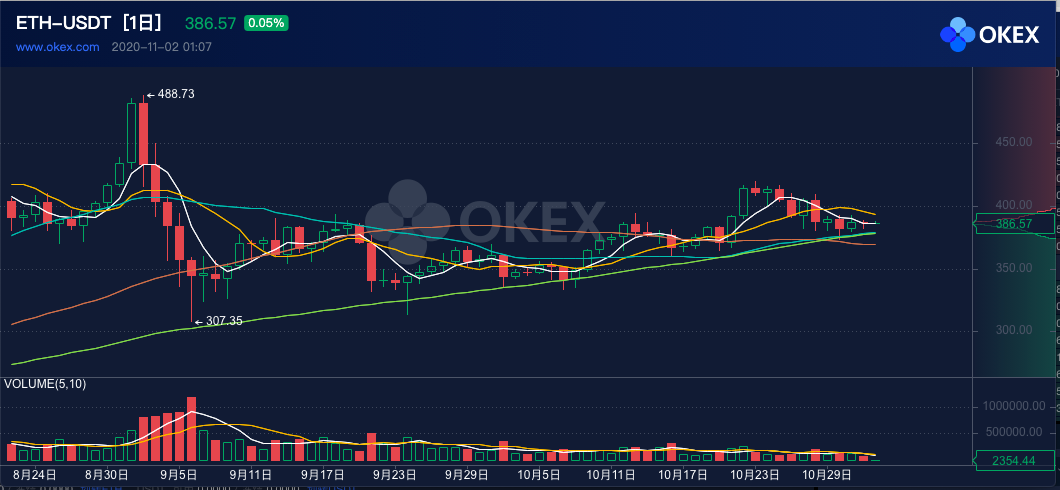
(ETH daily chart, picture from OKEx)
image description
2. Fund flow
(data from BiNuNiu)
(data from BiNuNiu)
(data from Tokenview)
3. Large transaction
(data from Tokenview)
Tokenview dataIt shows that the number of transfers on the chain rose slightly last week, and the number of large-value transfers of "above 5,000 ETH" and "above 10,000 ETH" increased by 11.19% and 14.07% month-on-month, but the number of large-amount transfers of "above 50,000 ETH" decreased by 6.25% month-on-month %, the frequency of giant whale account transactions has decreased; combined with the price trend, the short-term rise is weak.
OKlink data3. Ecology and technology
3. Ecology and technology
1. Technological progress
(1) Quantstamp completed the audit of the Teku client and said that Ethereum 2.0 is ready for release
(2) Ethereum 2.0 client Prysm released the first beta version
According to a core developer conference call held last Friday, the Ethereum "Berlin" (Berlin) hard fork upgrade will take at most a few months, and a soft goal has been set for January next year, following the planned launch in December After the Ethereum 2.0 beacon chain. The system-wide upgrade was originally scheduled to take place in July, but was delayed this summer due to limited client staff energy and higher demand for client diversity. (CoinDesk)
2. Voice of the Community
2. Voice of the Community
(1) V God: Ethereum has gradually become a real ecosystem, and solutions can be proposed to solve problems that arise
On October 27, the 6th Blockchain Global Summit opened in Shanghai. At the summit, Vitalik Buterin, the founder of Ethereum, said in a speech that Ethereum has gradually become a real ecosystem and a self-sustaining ecosystem. Every time a problem arises a solution can be proposed to solve it.
If you want payment scalability, there are now Loopring, ZKsync, OMG website; if you want stable value, there are DAI, USDC, etc. If you want to have an extended smart contract, there are Optimism and Arbitrum; if you want a user name that someone can read, such as sending Ethereum to others, but you don’t want to use the addressing method, you can use ENS (Ethereum domain name) system); if you want privacy, there are Tornado.cash, AZTEC, zkopru; if you want to exchange and exchange assets, there are Uniswap and other decentralized exchanges, etc.
On October 28, Balancer co-founder and CTO Mike McDonald tweeted his views on Balancer and expansion solutions. He stated that it is important to be clear that we are 100% focused on Ethereum. Although Balancer has provided small grants to some third parties to help them implement the Balancer protocol on other L1 networks, this is for research purposes only and all internal efforts remain on Ethereum. At the same time, he also said that Zk Rollups is the most promising expansion solution, and it is also the only expansion path that Balancer is currently exploring internally. Having said that, moving from an L2 demo application to a co-existing L2 with a meaningful locked state of funds will still require significant time and ongoing development.
3. Project trends
(1) Dharma launched the Uniswap governance proposal community vote again
Due to the use of other tools to interact with the Uniswap contract, 12,619 Ethereum addresses did not receive the 400 UNI airdrop. On October 26, the Uniswap community launched a second community vote to decide whether to give these addresses a total of 5,047,600 UNI token airdrops (total value of about 14 million US dollars).
As the initiator of this and the first community vote, Dharma stated that it will no longer initiate airdrop-related proposals. If the proposal is passed, Dharma will promise to allow Dharma users to entrust the platform or directly use their UNI to vote. Collaborate with other community members to participate in improving the Uniswap Improvement Proposal (UIP).
On October 31, the Uniswap Community Governance Proposal No. 2 initiated by Dharma was not passed. The final vote was 37,555,068 in favor and 1,280,632 against.
(2) Harvest Finance suffered a flash loan attack and lost more than 30 million US dollars
On October 26, a Twitter user broke the news that the attacker relied on the cost (handling fee) of 20 ETH to arbitrage in the Curve protocol y pool to obtain impermanent losses through flash loans, and the Curve.fi Y pool is the DeFi aggregation protocol Harvest treasury investment The place. The attacker then converted the funds into renBTC and cashed out, and Harvest lost millions of dollars as a result. Many participants claimed to have lost more than 15% to 20% of their funds.
Affected by this, the price of FARM, the governance token of Harvest Finance, plummeted from $237 to $78 at one point, with a maximum drop of nearly 70%; the lock-up volume of the Harvest protocol also plummeted from $1.11 billion to $450 million, with a maximum drop of 60% .
On the morning of the 27th, Harvest Finance issued a statement in response to yesterday's flash loan attack.
(3) The Ethereum mutual insurance project Nexus Mutual has newly added support for the new AMM protocol CoFiX
(4) Nansen completes USD 1.2 million in seed round financing
Launched in April this year, Nansen is a subscription-based product currently focused on ethereum data. Svanevik said the company hopes to add support for the bitcoin blockchain and other ethereum Layer-2 networks within the next year. (The Block)
4. Borrowing
Defipulseimage description
(Lock value on the DeFi chain)
(Lock value on the DeFi chain)
image description
5. Mining
(data from etherchain.org)
etherchain.orgThe data shows that the average computing power decreased by 0.26% month-on-month, temporarily reporting 268.9 TH/s; the average mining difficulty decreased by 0.28%, temporarily reporting 3388 T; among them, on October 30, the mining difficulty once reached 3536.5 T, breaking the record of October 2019. The record of 3523.5T was created on the 6th, creating a new high in two years; Gas fees continued to decline, and the total mining revenue decreased by 1.17% month-on-month; new addresses decreased by 3.74% month-on-month, and the activity on the chain decreased.
4. News
(1) NFT report: Ethereum and WAX account for almost 100% of daily active wallets and transaction volume
(2) Report: DeFi's high yield may threaten ETH 2.0 participation
(3) The number of Ethereum addresses holding more than 10 ETH hit a record high
(4) Data: Nearly 24% of Ethereum is held by exchanges, three times that of Bitcoin





