


Messari Report: 2020 Q3 public chain war heats up, Ethereum dominates


Editor's Note: This article comes fromBabbitt Information (ID: bitcoin8btc)Babbitt Information (ID: bitcoin8btc)
Note: The original text comes fromMessari。
Babbitt Information (ID: bitcoin8btc)
Note: The original text comes from
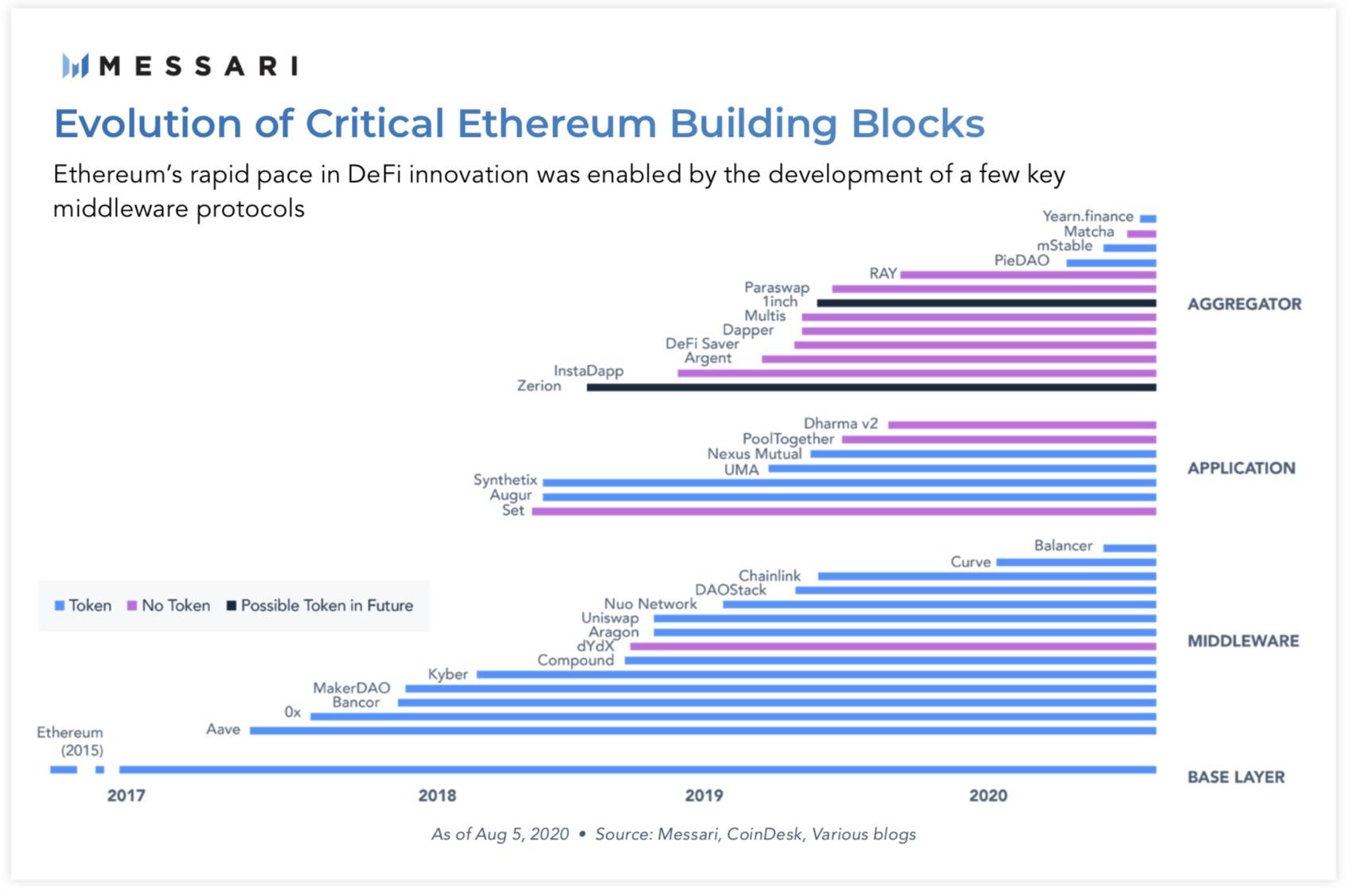
In the third quarter of this year, Decentralized Finance (DeFi) has undoubtedly become the focus, and it has further consolidated the status of Ethereum as an encrypted financial center, and this largest smart contract platform will continue to absorb the ever-growing industry. The thinking of most users, liquidity and developers.
why not? Almost all relevant DeFi tokens run on the Ethereum platform, which fulfills the most popular use case in the cryptocurrency market (speculation). It also has a multi-year head start in developing tools and money middleware, which spurs innovation and puts Ethereum ahead of other technologically superior competitors.
image description
Source: Messari, CoinDesk and various blogs
However, the "but" cannot be forgotten, because the growth of Ethereum's activity in the third quarter has a price, and this price is the cost of gas. The boom in DeFi, and later NFTs, has driven Ethereum network fees to an all-time high, making them too expensive for retail investors and wreaking havoc on non-financial applications. This “gas crisis” has created a perfect storm for so-called Ethereum killers, who can flex their low-fee environment and better scaling technology to attract those looking for an alternative.
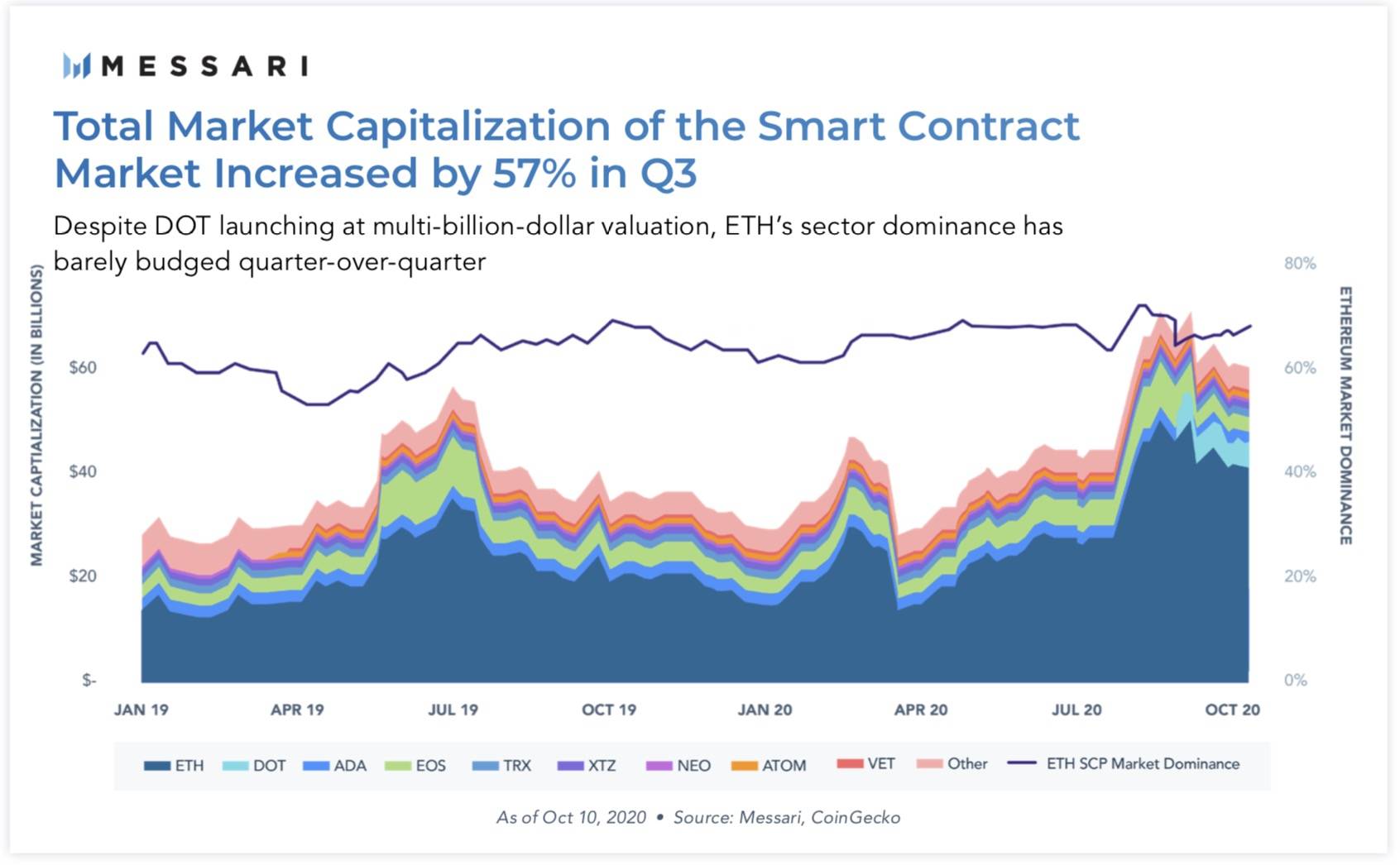
The third quarter set the stage for the smart contract platform race, with almost all high-profile Ethereum competitors launching or about to launch by the end of the year. How these projects position themselves in the community in a crowded market, and whether fees are always disruptive, will determine whether new talent and liquidity will move away from Ethereum. So far, no public chain has proven irreplaceable, and even Ethereum is not immune to competition.
image description
Source: Messari, CoinGecko
Public sale is the core of the fair ecosystem
Q3 is like turning back the clock and breathing new life into public token sales. After the token boom of 2017, new sales on Layer-1 platforms have all but stalled, with only six projects opening crowdfunding campaigns to non-accredited investors outside the US between early 2019 and July 2020.
image description
Source: Messari, CoinList and various blogs
It has to be said that the timing is very good, and several smart contract platforms that were once dormant have profited by raising funds and launching them at the peak of market optimism. These projects are able to maximize their fundraising goals while achieving favorable valuations once the tokens start trading.
image description
Source: Messari, CoinList and various blogs
Whether the timing is right or not, these crowdfunding deals benefit projects beyond just funding. A public sale is essential to distribute network ownership to insiders and VC backers. They also ask participants to make a pre-purchase decision, which often creates a stronger psychological connection between the investor and the stock he or she holds. A fair token distribution, coupled with a strong belief in financial upside, is an ideal way to optimize long-term community engagement. Ethereum was able to succeed because it made early investors rich. And it thrives because of the sizeable number of early contributors.
And projects that distribute tokens to insiders (teams, founders, and VC firms) at the expense of the community put themselves at a disadvantage. Rebalancing the ratio of insider versus community network ownership post-launch is a daunting task, and it can be even more difficult for proof-of-stake (PoS) networks. This last point is important because, outside of the Kadena and Nervos networks, every competing Ethereum network launched in the last two years uses proof-of-stake (PoS), and not every chain takes this consequence into account.
Investors should pay attention to how projects distribute tokens between insiders and the public. For example, Placeholder prefers agreements that only give 20%-30% of the token supply to founders, investors, team members or advisors. According to Chris Burniske, any project that goes above 30% is going to lose some opportunity because we're trying to allocate capital and power better than the existing shareholder-driven system.
image description
However, not all VCs are inherently bad, and project backers often not only bring in revenue, they also help design key network components and fund supplementary services that provide solutions to protocol-specific problems. For example, Paradigm has funded some projects that are only marginally related to Ethereum (Optimism and Gauntlet), but they provide potentially key solutions to the bottlenecks of the Ethereum network (scalability and network security).
Source: Messari
While any project would benefit from an influential backer like Paradigm, Layer-1 would greatly benefit from these types of VCs due to the difficulty required to migrate a new network from zero to DeFi.
Source: Messari
The road to success in the smart contract market is far more complicated than raising and hoarding large amounts of funds. Projects may be "successful" in the short term as they ride the latest market craze. But without a huge user base, they would never have thrived like Ethereum.
Ironically, older projects such as Polkadot, Cosmos, and Tezos gained an edge thanks to massive ICO fundraisings, with some big investors turning devout supporters, while more recent smart contract platforms must This level of support is only possible by bootstrapping actual utilities such as FTX-backed Serum.
secondary title
The Rise of Parallel DeFi Ecosystems
Ethereum is the main base of DeFi, and this is unlikely to change in the short term. However, it is inevitable that the popularity of DeFi will eventually inevitably spread to other platforms. Over the past few quarters, a number of networks have capitalized on the DeFi boom, supporting a small but growing number of financial applications that could form the cornerstone of the first DeFi ecosystem outside of Ethereum .
As we observed this summer, Cosmos appeared to be the first competing network to gain significant traction, and soon, Cosmos amassed applications such as Band Protocol, Kava, Terra, and THORChain, which represent the core of building a decentralized financial ecosystem. Critical infrastructure required by the system.
Cosmos’ DeFi plans don’t stop there, its community has taken initial steps to add an AMM module to the Cosmos Hub, which will enable the Hub to act as a cross-chain DEX. This upgrade has a great opportunity to improve the DeFi capabilities of the Cosmos ecosystem while also improving the utility of the Cosmos Hub (ATOM by default). It is reported that this first iteration of the Cosmos Hub could launch as soon as the first quarter of 2021, depending on a successful and timely Stargate upgrade.
At the same time, the DeFi ecosystem of Polkadot, another well-known public chain project, has also begun to show some vitality.
In the past two months, 5 different Polkadot DeFi projects have completed financing, and they have raised a total of more than US$18.5 million in funds. Although the funds obtained by the top Ethereum DeFi protocol cannot be compared, this also shows that the wave Cards (Polkadot) has an emerging DeFi community worth watching.
image description
Source: Messari and various blogs
Cosmos and Polkadot are not alone, with FTX-backed decentralized exchange Serum launching on Solana and Uniswap clone Dexter finally launching on Tezos in the past quarter. If a smart contract platform does not yet have a DEX or stablecoin solution, it is 100% under development.
For example, cross-chain exchanges like THORChain require the flexibility of the Cosmos SDK to launch an independent, application-specific network. Once launched, it will unlock an otherwise untapped market, allowing holders of idle cryptocurrencies such as Bitcoin to earn yield without tokenizing on Ethereum or turning to centralized custodians.
Another example is Serum, as of now, CLOBs on Ethereum have been clumsy and struggled to gain significant traction, eventually ceding control of the DEX market to AMMs. In contrast, Solana’s design prioritizes scalability over low verification costs, which allows Serum to have a user experience more similar to a centralized exchange.
If DeFi on Ethereum has just learned how to run, DeFi on other platforms has not yet begun to crawl. As the hype surrounding DeFi emerges, Ethereum's competitors will also begin to empty their token pools to establish a parallel DeFi ecosystem. These new networks are still miles behind Ethereum in terms of developer firepower, but they can take advantage of the technical characteristics of the underlying chain by supporting entirely different solutions.
secondary title
Are high fees disruptive?
This tweet from Arjun Balaji shows that there is a duality to transaction fees:
As users push ethereum to its limits and set records for gas costs, it's leading some to question whether the network's fee-based design is a strength or a fatal flaw.
From a security point of view, Ethereum is booming: In the third quarter, the activity on the Ethereum chain and the demand for block space were very strong, and the gas fee accounted for more than 50% of the mining revenue. highest percentage in history.
Although the income of miners did not exceed the historical high in 2018, due to the increase in gas prices, the block rewards suddenly soared, causing a large amount of computing power to flow into the Ethereum network. In the third quarter, the hashrate of the Ethereum network grew by 35%, the highest in two years.
Due to Ethereum’s ability to facilitate and encourage on-chain activity, transaction fees are likely to continue to be an important source of income for miners. If this fee environment persists, one might argue that Ethereum has achieved a more sustainable proof-of-work (PoW) system than BTC.
However, not all news is good news.
Rising transaction costs are not only a by-product of network congestion, but also a result of arbitrage bots jacking up transaction fees to increase the chances of their transactions being included in a block. Fees paid to miners are one potential source of miner-extractable value (MEV), which represents the profit that miners can extract from transactions during the ordering process. As demonstrated in the Flash Boys 2.0 paper, MEV can expose the network to consensus attacks and pose a greater threat as the percentage of block rewards attributed to MEV increases. While higher fees do not guarantee sufficient MEV, it can be assumed that growing DEX volumes (as seen in Q3) will lead to increased activity such as front-running.
Another obvious concern is that rising transaction costs could deter non-financial applications and retail users, as well as those on the sidelines. High fees can turn DeFi into a rich man's game, as illustrated in a recent article by Nic Carter: "As fees rise, users become reluctant to make smaller transactions" unless absolutely necessary On-chain activity and DEX liquidity adversely affected. Only speculators with deep pockets and knowledge will reduce trading profits to an uneconomical level. In short, "Without retail investors, there is no party."
Many new Layer-1 and Layer-2 platforms are built on the premise that users and non-financial applications will tire of Ethereum's fee market. There is nothing wrong with their strategy, and those affected by continued high costs will inevitably explore alternative platforms. Nobody wants to stay in one place out of some irrational sense of loyalty foolishly. But in fact, the conclusion that all on-chain activity will jump to the low-fee network is wrong for two reasons:
Fees are just another variable that users need to consider when engaging in transactions or other on-chain activities such as yield farming. As long as the transaction is properly sized, rational users should not be put off by losing a relatively insignificant percentage point in transaction costs. The diversified development of the Ethereum DeFi ecosystem provides a sufficient environment for profit opportunities, which can offset excessive fees;
Ethereum appears to follow Nic Carter’s fee space oscillation model, which suggests a semi-predictable relationship between on-chain activity and transaction fees. The point is that high fees are usually temporary and tend to decrease when the number of transactions decreases. Ethereum users don’t have to jump to other networks when gas prices spike, they just have to be patient.
In this case, the winners are users and developers who can temporarily move to another network in the event of a gas crisis. Ethereum will also benefit from every blockchain linked to it. While some liquidity will leave, more will come in, and Ethereum ends up looking more like a cross-chain hub than a universe.
And Layer-1 hopes to expand Ethereum into a side chain, which will start a head-to-head confrontation with Ethereum's Layer-2 expansion plan. They will all be fighting to win the love of the same set of apps, developers and users. The recent proliferation of collaborations between Layer-2 networks and well-known DeFi applications (such as Optimism and Synthetix, or zkSync and Curve) suggests that the market share up for grabs may shrink rapidly, as once one domino falls, the rest are likely to fall. Will follow soon.
Of course, the ultimate goal is not to tout Ethereum's current market share, but rather the growth of the overall market. While ethereum is unlikely to lose much of its existing economy to another "fee crisis," in its current state it may not be able to support a large influx of new users. For new layer-1 networks, the real opportunity is to take a different approach and break into new markets. And trying to copy Ethereum and its applications will inevitably become a side chain of Ethereum.
secondary title
fasten your seatbelt
The next twelve months are likely to define the smart contract platform wars, with almost every high-profile Ethereum competitor going live by the end of the year, and Ethereum’s leading figures have been vehemently advocating for the Ethereum network to rollup-centric s future. The timing is impeccable, at least until Ethereum 2.0 is fully implemented (at least 1-2 years), both solutions are now at a critical juncture to determine who may become the future infrastructure of the crypto-financial economy.





