






Binance IEO Subscription is Coming Soon, Quick Analysis of INJ Valuation in Five Minutes


On October 12, 2020, Binance Launchpad officially announced the launch of Injective Protocol.
secondary title
DeFi and Injectives
Since the beginning of this year, the popularity of DeFi has continued to heat up, and the decentralized exchange DEX, which is an important part of DeFi, has also continued to receive attention. As a typical DEX, the AMM automatic market maker has created a precedent for financial asset transactions that do not rely on order books. When Uniswap released the V2 version in May this year, it may not have imagined that in just four months, AMM DEX would set off such a big wave in the encryption industry. On September 2, Uniswap's liquidity pool locked up as much as $1.95 billion in funds, and its trading volume reached $953 million. This data is enough to shake any centralized exchange. Take Coinbase, a compliant exchange, as an example. When all the data is completely true, within a one-year time period, it is rare to reach a transaction volume of nearly 1 billion US dollars.
With the popularity of DeFi, the performance problems of the Ethereum public chain also followed. Gas fees soared all the way to 500 Gwei, the number of unconfirmed transactions reached more than 140,000, and the block confirmation time was as long as about 15 seconds. The confirmation time of online transactions is often several minutes. Someone ridiculed that the performance of Ethereum is not enough to provide a normal use of a DeFi project. Therefore, the issue of on-chain expansion has become a hot topic again. So either introduce the Ethereum sidechain, or deploy it on a faster chain. If it is deployed on other chains, it will encounter ecological problems. After all, most tokens are currently built on the Ethereum network. To sum up, the layer-2 project based on Ethereum may be more suitable for the current derivative DEX. Injective Protocol is a layer-2 project based on Ethereum. The side chain is based on COSMOS, and the block generation time is as fast as 1 second, which can greatly improve the order matching efficiency and support Ethereum cross-chain. In order to solve the problem of front-running transactions, a time stamp is added to the order by integrating a verifiable delay function (VDF), so as to prevent transaction cheating and prevent miners from "preempting" users.
secondary title
Comparative Valuation Against the Binance LaunchPad Project
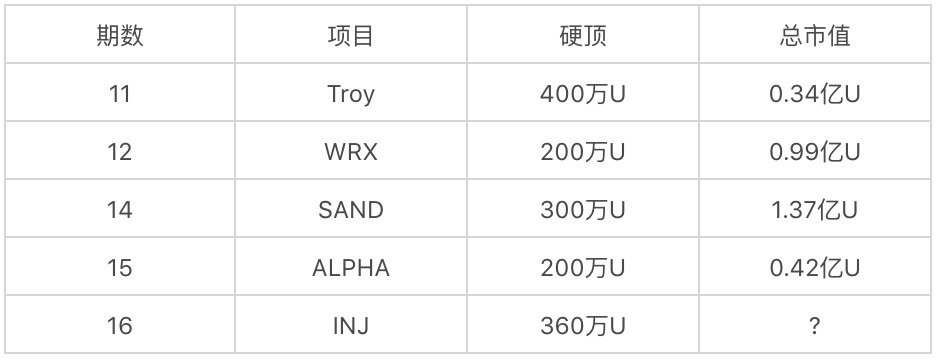
Calculated at the price of 0.4U, the overall market value is 40 million US dollars, and considering the popularity of the subdivided fields, such as DEX, derivatives, Layer2, etc., the total market value must be higher than that of SAND, then 2-5 One hundred million dollars is a more reasonable valuation.
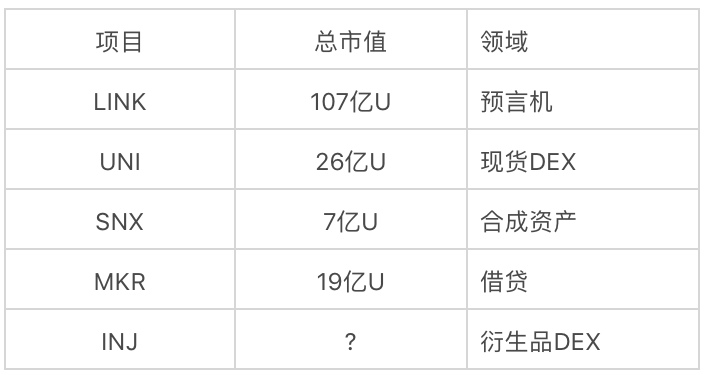
Comparable valuation with DeFi projects
secondary title
INJ's Value Capture
In the DeFi field, people racked their brains to find a valuation model. Even so, there is no universally recognized valuation standard, and there is no truly effective general method, and everything is constantly being explored. The two calculations given above are relatively common comparative valuations, but they do not really reflect the value of INJ itself. From a value perspective, whether INJ tokens are overvalued or undervalued depends on their ability to capture value. So, where does the value of INJ come from?
First, let's review what Injective does? Injective's goal is to help traders build and trade financial derivatives in a decentralized way. It rewards people for making transactions easier with INJ tokens. for example:
1. Market maker incentives;
2. Incentives for relayers;
3. Value accumulation and return of transaction costs;
4. Side chain governance;
5. POS security;
6. Mortgage assets of derivative contracts;
7. Injective ecosystem and platform participation incentives.
INJ has both financial value and governance value, and transaction fee income will be repurchased and destroyed on the chain to increase the value of INJ, which means that INJ will enter a deflationary mode in the future. Then as long as the transaction volume and number of users of the platform increase, the fees for repurchase and destruction will naturally increase, and the corresponding governance functions will also be cherished by currency holders, and the market value of INJ will naturally be reflected as it should be. So what about the future development space? Let’s first look at the current trading situation in the DEX field.
If we don’t consider the derivatives market, let’s compare it to the DEX spot trading market. The cryptocurrency data website CoinGecko recently released a report on the DeFi market, which mentioned that affected by the DeFi protocol, the inflow of funds into the encryption market in Q3 increased by US$9.15 billion. In the third quarter, while trading volume on decentralized exchanges such as Uniswap was only 6% of the volume on centralized exchanges such as Binance, the volume of the former increased by 700% during this period. This is no accident, DEX user experience has improved significantly in the past few years, and the recent liquidity mining has influenced more people to try these DEX.
In any significant financial system, the typical market size ratio between currency/debt/derivatives is 1/10/100. If there is already a relatively mature derivatives DEX, then based on the 9.15 billion USD transaction volume of DeFi in the third quarter, the derivatives market should be about 910 billion USD, which is a huge market.
image description
The left picture shows the trading volume of derivatives on major trading platforms in April, May, and June 2020; the right picture shows the total amount of monthly derivatives and spot transactions.
secondary title
Value capture in traditional financial markets
Centralized derivatives exchanges are very inefficient in the design and establishment of derivatives markets. I once designed a USDT-USD perpetual contract product. At present, the daily transaction volume of USDT has surpassed that of BTC, becoming the number one digital asset in the field of cryptocurrency. Whether it is an on-site transaction or an off-site transaction, the value of USDT has a decisive impact on the currency circle. Because USDT lacks official legal currency acceptance and real asset endorsement, the exchange rate that should have been exchanged at 1:1 always fluctuates around 1 in real scenarios, such as 0.996-1.004. But even such a derivative product that can be used to hedge USDT risks was only launched on the Huobi perpetual contract two weeks ago.
But it is very convenient on Injective, I can build such a financial derivative in just a few minutes (of course, it still takes some time to think about the design and parameter setting in advance). If we expand further, we have more products to choose from, such as gold and silver. Have you ever thought about establishing a XAU-USDC CFD trading pair on Injective (XAU is the abbreviation code for London spot gold)? So what about Nasdaq trading pairs? What about oil? The latter can be slowly realized by yourself, there are too many things that can be played in the decentralized market. I once wrote a comparative analysis of traditional financial derivatives and digital asset derivatives in August, and now some excerpts are as follows:
image description
summary
summary
Derivatives are vital to any financial system. This is because the financial system is made up of financial markets, and financial markets are all about risk—every transaction carries some risk. Professional market participants such as traders, banks and investment firms will want to offset or hedge these risks to prevent financial disaster in the event of unexpected events such as large price swings. This is what derivatives like options and futures are for. Derivatives allow market participants to manage their risk by limiting potential returns and losses. Simply put, derivatives smooth out gains and losses, thereby preventing financial crises.
At present, the truly influential "decentralized BitMEX" has not yet appeared, but it is conceivable that once it appears, it will bring great changes to the current blockchain world. Derivatives-based decentralized exchanges are becoming an important part of the DeFi Lego as well as the underlying infrastructure. Can Injective, which is fully decentralized based on Layer 2, seize this huge opportunity and become a bridge linking digital assets and traditional assets? We still have to watch, but if successful, INJ's value is immeasurable.





