


ETH Weekly | V God updates the Ethereum roadmap; Grayscale regards the transition of Ethereum to 2.0 as a price risk factor (10.5-10.11)


Author | Qin Xiaofeng
Author | Qin Xiaofeng
Produced | Odaily
1. Overall overview
1. Overall overview
Second, the secondary market
Second, the secondary market
1. Spot market
image description
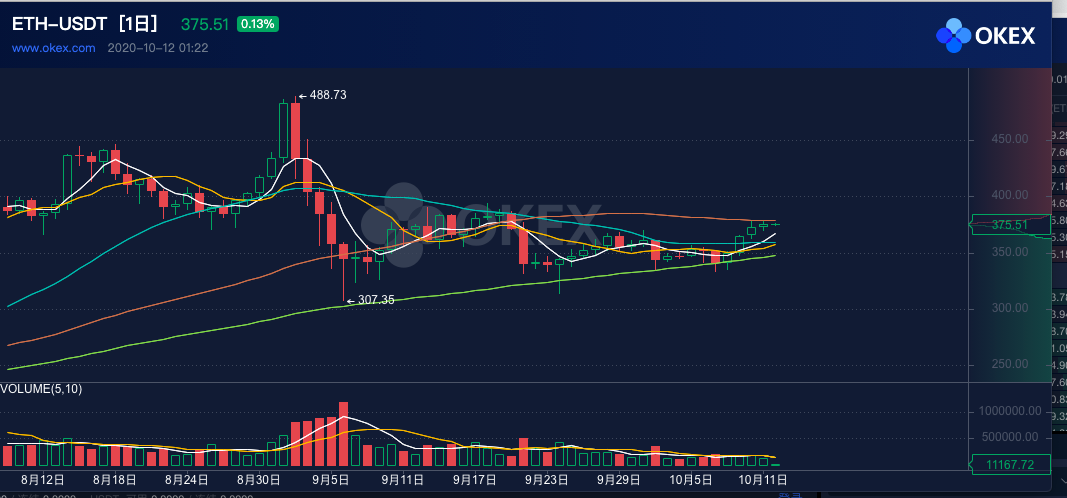
(ETH daily chart, picture from OKEx)
(ETH daily chart, picture from OKEx)
image description
(data from BiNuNiu)
(data from BiNuNiu)
(data from Tokenview)
3. Large transaction
(data from Tokenview)
Tokenview dataIt shows that the number of transfers on the chain dropped sharply last week. The number of large-value transfers of "above 5,000 ETH" and "above 10,000 ETH" decreased by 11.64% and 14.47% month-on-month, but the number of large-amount transfers of "above 50,000 ETH" increased by 16.67% month-on-month %, the frequency of giant whale account transactions has increased; combined with the price trend, the upward support is effective, and there is still a demand for rebound in the short term.
OKlink data3. Ecology and technology
3. Ecology and technology
1. Development and technology
(1) Release of Ethereum 2.0 Specification v1.0.0 Candidate 0
On October 9, Danny Ryan, the head of the Ethereum 2.0 project, said that he had released version 0 of the Ethereum 2.0 specification v1.0.0. He stated, "v1.0.0-rc.0 is a release candidate based on the release candidate 1.0 branch/PR in preparation for the v1.0.0 release. Although it is intended to be compatible with the final v1.0.0, it will not work in the final configuration Small incompatibilities may arise during selection or any unexpected issues."
The release of v1 has given the green light to the release of the Genesis block for Ethereum 2.0, which is expected to be released this November. Prior to this, there is also a testnet called Zinken, which will be launched at 20:00 Beijing time on October 12.Danny RyanIn addition, the leader of the Ethereum 2.0 project
Announced that a bug bounty program dedicated to the launch of Ethereum 2.0 phase 0 has been launched. The plan details the Phase 0 specification as well as specific software clients such as Prysm, Lighthouse, and Teku. "We call on the community and all bug bounty hunters to help identify bugs in the protocol and client," the official website states.
(2) The Prysm client on the Ethereum 2.0 Medalla testnet has the highest usage rate
(3) Vitalik updated the roadmap of Ethereum, focusing on rollup construction
On October 2, Vitalik released the "Ethereum Roadmap Centered on Rollup" document on Twitter. Content display:
In the short term, the Eth1 Rollups program will be mainly promoted. This move is due to the fact that the expansion of the Ethereum base layer will mainly focus on the expansion of how many data blocks can be expanded, rather than the efficiency of on-chain calculations or IO operations. At this stage, EIP 2929 and EIP 1559, etc. will continue to play a role. EIP 2929 will ensure that the chain can safely resist DoS attacks at the current gas level; EIP 1559 is mainly for ETH destruction and block transaction confirmation. At the same time, Eth1 clients can be reused as Optimistic Rollup clients.
Centering on rollup will reimagine the long-term future of eth2 as a single high-security execution shard that everyone can handle, and a scalable data availability layer.
According to official news, the monthly active users of the Ethereum light wallet MetaMask have exceeded 1 million, an increase of more than 400% compared with December 2019. Among them, the top four countries in the number of mobile terminal users are the United States, India, Nigeria and the Philippines. According to MetaMask, the recently launched MetaMask mobile app played an important role in the introduction of new users. In addition, user growth has been further accelerated by the significant growth in adoption of DAOs, Web3 games, and rapid consumer adoption of DeFi products and services over the past twelve months. (Medium)
2. Voice of the Community
(1) Survey: Most Ethereum mining projects do not approve of the EIP 1559 proposal
Eight out of nine mining projects that participated in a community survey of ethereum’s EIP 1559 proposal had a negative view of the proposal, according to a new survey. Seven of them said they would refuse to implement the EIP if included in a future hard fork. The survey included 25 ethereum projects, most of which chose to remain anonymous. According to ConsenSys product manager and survey implementer Tim Beiko, the survey lacked participation from exchanges or wallets.
Ethereum co-founder V God said that due to scalability issues and skyrocketing gas prices, the current Ethereum network cannot support many types of applications. The scalability problem cannot be solved in the short to medium term without using a Layer 2 solution. Therefore, upgrading Ethereum 2.0 is a necessary step to fundamentally solve this problem, but it will take a lot of time to fully realize Ethereum 2.0.
3. Borrowing
Defipulseimage description
(Lock value on the DeFi chain)
(Lock value on the DeFi chain)
Specifically, last week, ETH mortgages fell from 8.473 million to 8.339 million, a drop of 1.5%; BTC mortgages increased from 140,376 to 142,643, an increase of 1.6%.
image description
(data from etherchain.org)
etherchain.org(data from etherchain.org)
According to data from Glassnode, the transaction fees earned by Ethereum miners have dropped by more than 85% in the past three weeks.
4. News
4. News
(1) Data: In the third quarter, the total transaction fee of the Ethereum network was as high as 318 million US dollars, 3.5 times that of Bitcoin
(2) After BitMEX was accused by the CFTC, the open interest of its Ethereum futures contract was nearly halved
(3) Tether blacklists 100 Ethereum addresses
(4) Foreign media: Venezuela will create a decentralized stock exchange on Ethereum
(5) Singaporean payment company Xfers officially issued a stablecoin XSGD anchored to the Singapore dollar
(6) Grayscale regards the transition of Ethereum to 2.0 as a potential risk factor
Grayscale stated in the Ethereum Trust-related documents submitted to the US Securities and Exchange Commission (SEC) that the potential risks of the transition from ETH 1.0 to ETH 2.0 may have a significant adverse impact on the price of Ethereum and Grayscale stock. Failure to properly implement transitional changes in Ethereum could lead to temporary or permanent forks, which could have negative consequences, the document states.





