


ETH Weekly Report | ETH balance on the trading platform drops to a 9-month low; Prysmatic Labs will complete the development of all functions of ETH 2.0 next month (9.21-9.27)


Author | Qin Xiaofeng
Author | Qin Xiaofeng
Produced | Odaily
1. Overall overview
1. Overall overview
On September 21, Glassnode data showed that the number of Ethereum held by users on the cryptocurrency trading platform dropped significantly, hitting the lowest level in nine months, and the current balance exceeded 16.58 million ETH. At the same time, the number of Ethereum wallets holding 1,000 or more has also dropped significantly. However, the number of wallets holding Ethereum is increasing and hitting new highs, with about 47.18 million wallets currently holding Ethereum.
Second, the secondary market
Second, the secondary market
1. Spot market
According to OKEx market data, the price of ETH once fell to around $310 last week, and then rebounded, closing at $355.46 during the week, a week down 4.1%.
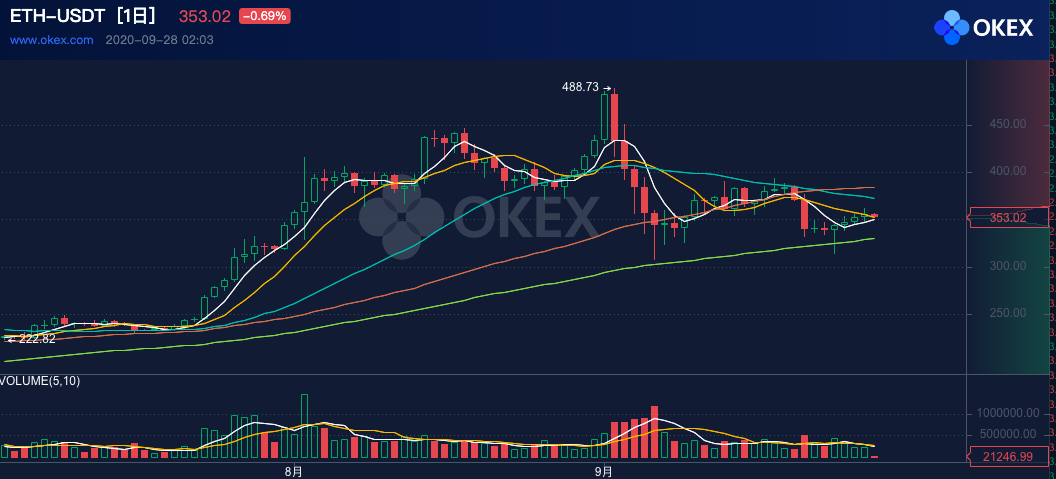
image description
(ETH daily chart, picture from OKEx)
image description
(data from BiNuNiu)
(data from BiNuNiu)
In terms of funds, the first four days of last week showed a continuous net outflow of funds, but on Friday and Saturday, funds began to flow back, showing signs of stopping the decline; the largest net outflow was 130 million US dollars, and the largest net inflow was 30 million US dollars.
(data from Tokenview)
(data from Tokenview)
Tokenview dataIt shows that the number of transfers on the chain dropped sharply last week, and the number of large-value transfers of "above 5,000 ETH" and "above 10,000 ETH" decreased by 44.8% and 36% month-on-month; The frequency of account transactions has dropped slightly; combined with the price trend, there is still demand for a rebound in the short term.
OKlink data3. Ecology and technology
3. Ecology and technology
1. Development and technology
1. Development and technology
(1) EIP-1057 Proposal Progress: Implement ProgPow as an alternative on client and testnetSeptember 21
, the Ethereum development community has updated the next steps of EIP-1057, that is, to reach a consensus on whether to adopt the ProgPow compromise plan, which is to "implement ProgPow on the client and testnet (not the mainnet block), so that As a backup plan."
, Ethereum developer Tim Beiko tweeted to update the development process of the EIP-1057 proposal. The specific content includes:
Both Besu and Geth clients have implementations for EIP-1559. Multiple implementations help find bugs, and more client implementations will be added as more complex scenarios are progressively tested.
The Ethereum Foundation Robustness Incentives group has been working on agent-based simulations. The simulation was done primarily to analyze how EIP 1559 would respond under a range of different usage patterns.
Mechanism design researcher Tim Roughgarden has been contracted to conduct an evaluation of the fee market mechanism proposed in EIP 1559 and will compare it to other options, such as escalator fee schemes.
Ethereum Cat community members have begun reaching out to various projects to seek input on the EIP 1559 proposal from outside the community.
(2) Spadina, the new Ethereum 2.0 testnet, will be launched on September 29Evan Van NessOn September 21, Ethereum developers
Said that Spadina, the new Ethereum 2.0 test network, will be launched on September 29.
Previously, Danny Ryan, the coordinator of Ethereum 2.0, stated that there will be another public test before the launch of the Ethereum 2.0 mainnet, that is, the launch of the new test network Spadina. Spadina has a lifespan of 3 days and will run in parallel with Medalla later this month. .BitflySeptember 23,
(3) The latest progress of Ethereum 2.0
On September 23, Danny Ryan, the head of the Ethereum 2.0 project, wrote an article announcing the progress of Ethereum 2.0:
The new testnet Spadina Launchpad has been activated. Spadina will run in parallel with Medalla for three days starting September 26 for public testing;
Security research organization Trail of Bits has completed an audit of the deposit CLI (eth2.0-deposit-cli) tool. In addition, there are many ongoing eth2 client software that are also under review;
Submitted phase 0 upgrade proposal EIP 2982 with Vitalik Buterin last week. The release of EIP 2982, the final v1.0 mainnet parameters, and the release of the deposit contract (to be discussed) are all milestone events before the mainnet launch.
On September 25th, Synthetix was running on the Optimistic testnet, the second-tier scaling solution of Ethereum. The first stage of the transition from Synthetix to Optimistic Ethereum is an incentive testnet, which means that users can conduct fast transactions on the second-tier network. The test function will be open to stakers with 1 to 2500 SNX. According to Synthetix, this is only Phase A of the Optimistic Ethereum testnet trial.
2. Voice of the Community
(1) The core developers of Ethereum believe that there is a chance to expand the capacity by more than 10 times before network sharding
(2) V God: The risk of clock bugs in the previous Medalla testnet was exaggerated
On September 24, Vitalik said in an interaction with the founder of ETH Gas Station that the risk of the Medalla clock bug on the Ethereum 2.0 testnet is exaggerated.
The founder of ETH Gas Station said that he ran the nodes of the Medalla test network and also experienced the clock bug of the test network. In the weeks before and after the clock bug, its Medalla validators have been running without any interruptions or issues. At the same time, he also said that the Medalla test network responded very quickly to the vulnerability, and except for the fact that it occurred on the test network, it would actually cause only a small amount of revenue loss. And since there is no real value, validators have little incentive to update and restart.
In response, V God responded that if Medalla used the updated penalty parameters designed for early stage 0, then his Medalla node has now returned to normal. So do think those risks are overstated.
Raul Jordan, chief developer of Prysmatic Labs, said that he has been working on Ethereum 2.0 software development for more than two years, and the team will complete the development of all functions by October 15. Final features currently being developed by Prysmatic Labs and other software development teams include ensuring that Ethereum 2.0 clients are interoperable and that users can freely use them interchangeably without risking losing validator tokens. (CoinDesk)
3. Borrowing
Defipulseimage description
(Lock value on the DeFi chain)
(Lock value on the DeFi chain)
Specifically, ETH mortgages rose from 7.93 million to 8.171 million last week, an increase of 3%; BTC mortgages increased from 116,017 to 129,588, an increase of 11.7%.
image description
(data from etherchain.org)
etherchain.org(data from etherchain.org)
The data shows that the average computing power has increased by about 0.56% month-on-month, temporarily reporting 250.4 TH/s; the average mining difficulty has increased by 4.12% month-on-month, temporarily reporting 3266 T; new addresses have increased by 34% month-on-month, and the activity of miners has increased; network congestion has eased , the Gas fee has dropped, Ethereum currently recommends that the Gas fee is around 100 Gwei, and the total mining revenue has decreased by 28% month-on-month.UniLoginRecently, it was announced that because of the high cost of subsidizing users due to the continuous high gas fees of Ethereum, the entire project will be closed, the remaining funds will be returned to investors, and new directions will be found. UniLogin said that the new direction they are considering is to implement a Layer 2-focused DeFi wallet or login solution in the Ethereum sidechain xDAI.
4. News
(1) The balance of Ethereum on the trading platform fell to a 9-month low
(2) Data: The number one non-exchange holds 7.27 million ETH in Ethereum addresses, a record high in 50 months
(2) The ETH-BTC three-month implied volatility difference peaked in mid-August and then began to decline





