


Notes to ETH2 Verifiers: How to Determine the Validity of "Proof"


source|Attestant
source|
first level title
prove
Proofs refer to votes initiated by validators on the current state of the Eth2.0 blockchain. Each active validator initiates a proof every epoch (about 6.5 minutes), which consists of the following elements:
image description
One of the interesting processes is chain head voting, which refers to validators voting to prove the latest valid block, which is the chain head. The composition of chain head voting is shown in the figure below:
image description
Figure 2: Composition of Chain Head Voting
Here, the slot refers to the position where the validator voted to prove the current chain head, and the hash value identifies the position of the validator. The combination of these two uniquely identifies a certain point on the blockchain, and after obtaining enough votes, the network reaches a consensus on the state of the chain.
An aggregate is composed of multiple proofs, and all proofs are voted by the same committee, including chainhead voting and finality voting, which are then combined into one aggregate proof:
image description
Figure 3: Composition of aggregated proofs
Aggregate proofs differ from simple proofs in two ways. First, there are multiple validators in an aggregated proof. Second, his signature is an aggregate signature, composed of signatures of matching simple proofs. Aggregation proofs are very good for storage, but come with an additional communication and computational burden (more on this below).
Validators who perform this aggregation process are called aggregators.
first level title
Increase Proof Rewards
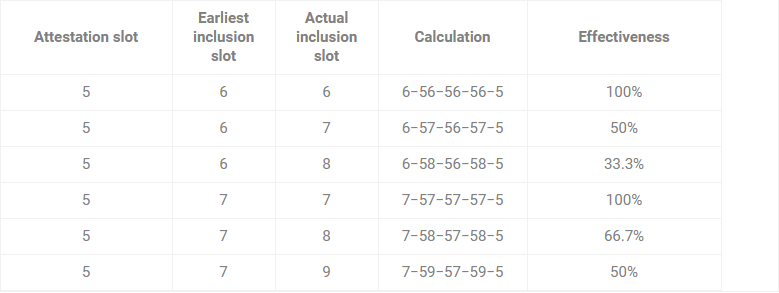
Eth2.0 uses the metric inclusion distance to calculate the rewards for validators to prove. The packaging distance of a slot refers to the difference between the slot where the proof is made and the slot that first packs the proof into the block. For example, if the proof is made in slot ss, and it is packed into the block in slot s+1s+1, then the packing distance is 11. If it is packed into the block at s + 5s + 5, the packing distance is 55.
In order to reflect the relative value of the proof, different rewards are given to the verifier responsible for the proof according to the size of the packing distance. Specifically, the reward is multiplied by 1/d, where d is the packing distance.
image description
If the network works well, all proofs will have packing distances of 1. This means proving that achieves maximum effectiveness, and correspondingly maximum rewards. If the proof is delayed, the validator's reward will be reduced accordingly.
first level title
Packaging Proof Process
So how is the proof packaged into the Eth2.0 blockchain? The process is as follows:
1. Each proof verifier will generate a proof based on the data related to the chain state;
2. The proof is broadcast to the corresponding aggregator in the Eth2.0 network;
3. The aggregator who receives the proof merges it with other proofs voted by the same committee;
5. If the aggregated proof has not been added to the chain, any validator who proposes a block can include it in the block. When the proven packing distance exceeds 1, it is necessary for us to figure out the reason. There are several influencing factors:
secondary title
Verifiers may have a "proof generation delay" problem. For example, information about the state of the chain may be out of date, or the verifiers may not be capable enough to spend a lot of time generating and signing proofs. Whatever the reason, the delayed proof has an indirect effect on the remaining steps in the process.
secondary title
Once a verifier generates a proof, it needs to be broadcast to the aggregators of the network. This process is designed to allow aggregators to receive the earliest proofs in time to aggregate proofs before they are broadcast to the entire network. Validators should attempt to connect with as many other validators as possible to ensure fast broadcast proofs to aggregators.
secondary title
Demonstrate that the aggregation process may be delayed. The most common reason for this is that the generated proofs overload the nodes. However, the speed of the aggregation algorithm can also cause significant delays in aggregation when there are a large number of validators requiring aggregated proofs.
secondary title
Similar to proof broadcast delays, aggregate proofs also need to be broadcast to the network and may suffer from the same delay.
secondary title
Block Production Failure
It proves that in order to become part of the data on the chain, it must be packaged into a block. However, block generation may fail. When the verifier is offline, or fails to successfully synchronize the data of the rest of the verifiers in the network, the generated invalid data will be rejected by the chain.
Since block generation will be affected by the status of the verifier, we define the earliest packaging slot, which is the first slot after the slot where valid blocks are generated and certified. Such bounds take into account that proofs cannot be packed into non-existent blocks, and avoid being affected by validator validity.
secondary title
Still, it is possible for a malicious validator to refuse to aggregate any given proof, or refuse to include a proof in its block. The solution to the former is to assign multiple aggregators to each proof group, while the solution to the latter is to penalize the behavior of refusing to pack aggregated proofs into a block. However, if the penalty for refusing to include a block is financially compensated, or if the act is more valuable politically, then the validator responsible for the proof cannot take any measures to force the validator responsible for producing the block to include the proof in the block.
first level title
Computational Proof of Validity
Proof validity refers to how useful a proof is to the network, taking into account block production and block distances. It is calculated as:
If a proof fails to pack because its packing distance is a maximum of 32, then the proof's validity is 0.
first level title
For a single proof, calculating the validity of the proof may be interesting, but the value itself is not very meaningful. The effectiveness of aggregated proofs (including longer time and more validators) can give us a better understanding of the overall effectiveness of a group of validators. The validity of an aggregate proof is the average of the validity of the individual proofs. For example, take a 7-day log of the validity of all validators in a given group and take the average.
Summarize
Disclaimer: ECN's translation work aims to deliver high-quality information and learning resources for the Chinese Ethereum community. The copyright of the article belongs to the original author. Reprints must indicate the source of the original text and ethereum.cn. For long-term reprints, please contact
For more Ethereum information, please pay attention to:
Public account: ETH Chinese website
Website: ethereum.cn
Disclaimer: ECN's translation work aims to deliver high-quality information and learning resources for the Chinese Ethereum community. The copyright of the article belongs to the original author. Reprints must indicate the source of the original text and ethereum.cn. For long-term reprints, please contactethereumcn@gmail.comAuthorize.





