


Soaring 7 times, how to avoid being PUA at the sky-high gas price of Ethereum?


Recently, as the price of ETH broke through the new high of the year and even exceeded 400 US dollars (the price before the deadline), the ETH2. , The more "gratifying" gas fee also caused many DeFi users to complain.
A senior user "tucao" said, "In order to mortgage my $15 into Curve, I have already spent $14 in gas fees!" Then he teased and said helplessly: "I can earn 0.079 $SNX every week. With so many dollars, it only takes me a 'short' 177 weeks to break even (of course this does not include the gas fee required to close the position)!"
secondary title
Gas fees soared 7 times, and the utilization rate of the Ethereum network was as high as 95%
Before exploring the "secret" of the skyrocketing gas fee, let's first understand what the gas fee is (those who know more about the gas fee can skip this part directly).
Gas, as the name suggests, is similar to the fuel of a car. Cars rely on fuel to drive and drive, and the Ethereum ecosystem needs gas to operate and process transactions. The unit of gas fee is usually expressed in gwei (1ETH = 1,000,000,000 Gwei).
As we all know, Ethereum is essentially a virtual machine. This virtual machine is decentralized, and people all over the world can operate on it and unite to form a "world-class computing network." When you send tokens, execute smart contracts, transfer ETH or other ERC-20 tokens, the Ethereum "computer" is processing the transaction and needs to perform calculations, which consume network resources. In this way, you have to pay the "gas fee" (that is, gas) to let the computer work for you and let the miners package transactions for you.
according to
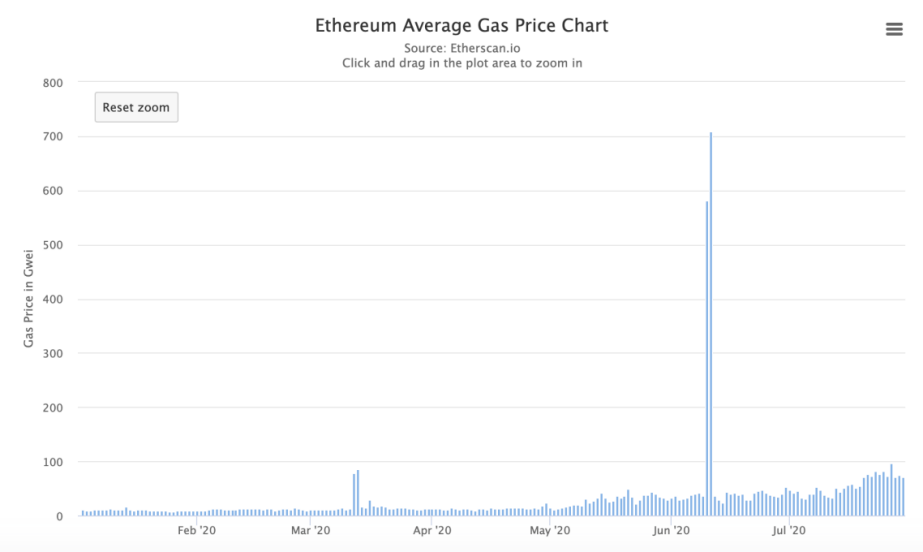
according toetherscanThe data shows that since the first ten days of May this year, the gas fee of Ethereum has shown an exponential growth trend, and the average gas fee has remained between 50-100 gwei, and throughout 2019, the gas fee of Ethereum has basically remained at 10-20 gwei. On June 11, the gas fee hit a new high in nearly three years, reaching 709 gwei. Since late July, the gas fee has basically remained between 70-100 gwei.
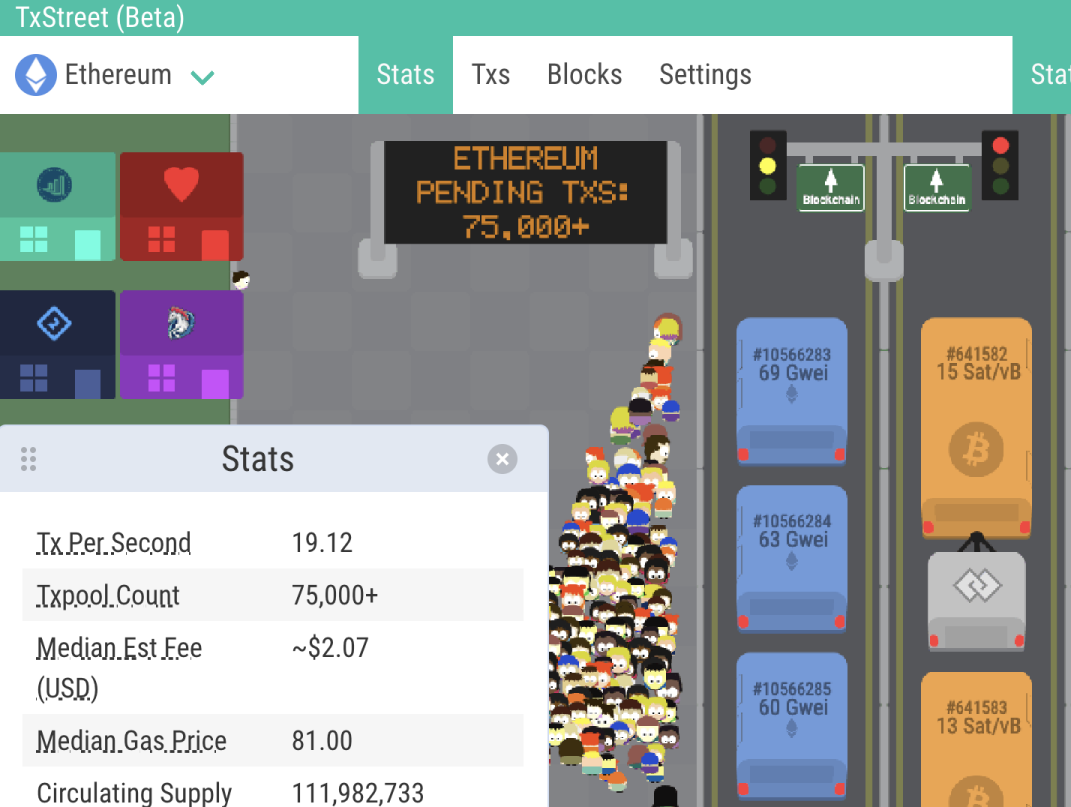
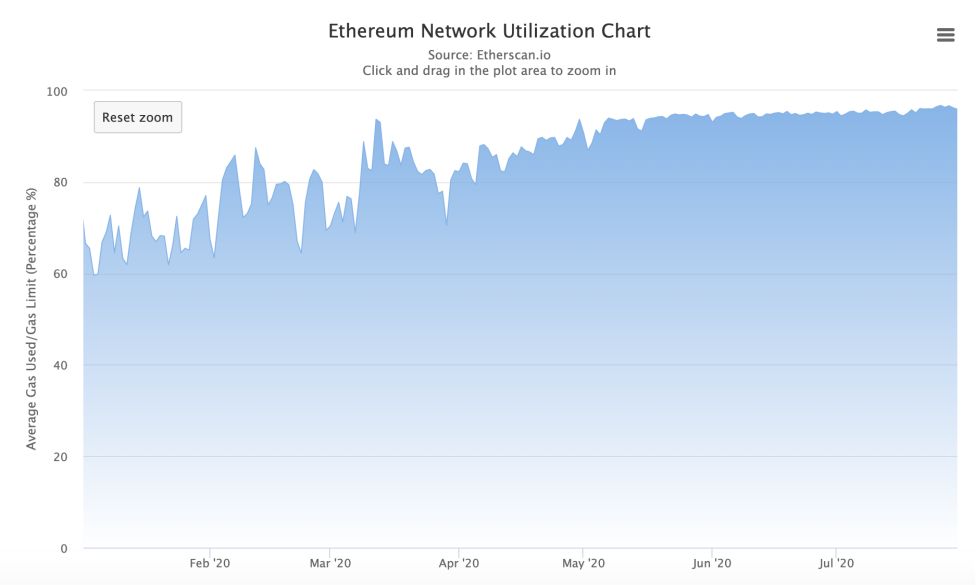
The fundamental reason for the increase in Gas fees is that the utilization rate of the Ethereum network is constantly increasing and it is in a state of serious congestion. Also based onetherscanIt shows that the utilization rate of the Ethereum network has risen from less than 60% at the beginning of the year to more than 90%; especially in the past two months, this figure has been hovering around 95%. According to the txstreet website, before the deadline (around 9:00 on August 1st), the Ethereum network was in a state of extreme congestion, with as many as 75,000 unprocessed transactions.
secondary title
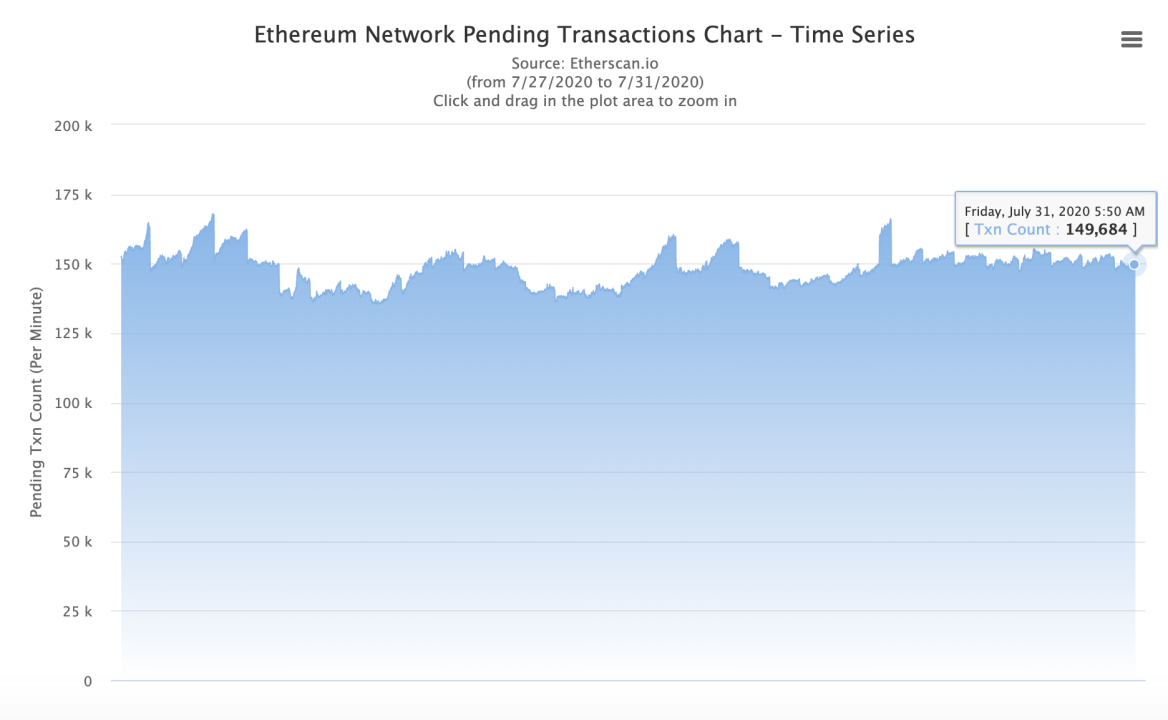
Transaction volume keeps rising, resulting in high gas fees
In the previous article, we also mentioned that the root cause of the rising gas fee is that the utilization rate of the Ethereum network is constantly increasing, and it is in a state of serious congestion. So the question is, why is the Ethereum network so congested? The fundamental reason is that the transaction volume of Ethereum is constantly rising, which I believe everyone should feel deeply.
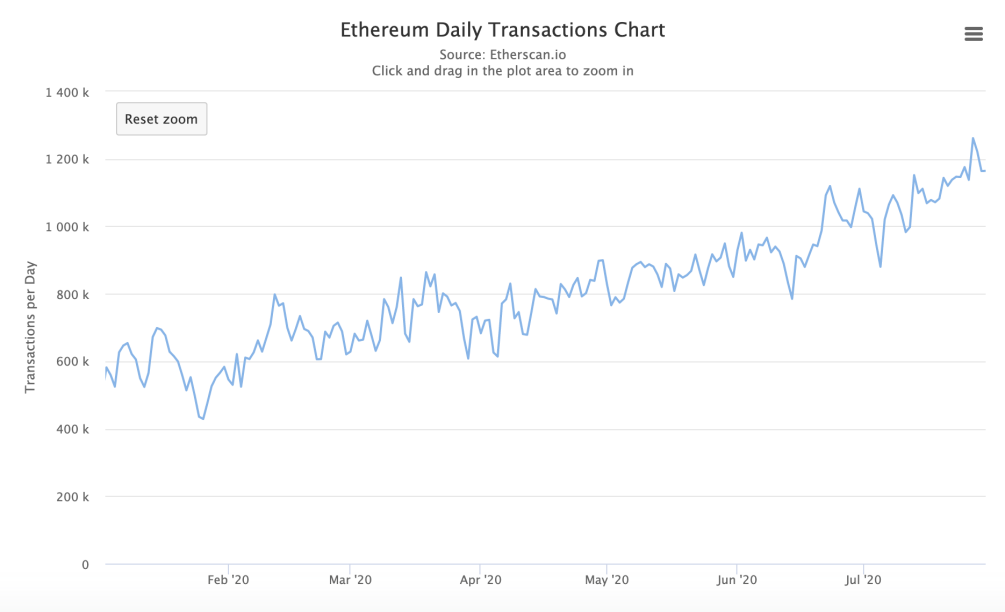
The author believes that the driving force behind the rising transaction volume of Ethereum comes from three aspects:
1. With the rise of Yield Farming, the total value of DeFi locked-up assets hit a record high
On June 16th, Compound launched lending mining for the first time, and various mortgage agreements competed to imitate it, setting off a wave of "Yield Farming" coin issuance. Last weekend, the governance token YFI issued by the DeFi aggregation income agreement yearn.finance exploded by more than 100%. It is to max out the major WeChat communities and Moments, and once again push DeFi tokens to the cusp of public opinion.
ETH is the entry ticket for users to enter DeFi, and the further upsurge of Yield Farming has stimulated a surge in market demand for ETH.Defipulse Data shows that the number of ETH locked on the entire DeFi chain has surged in the past month, from 2.618 million to 4.2 million, an increase of 60%, a record high.
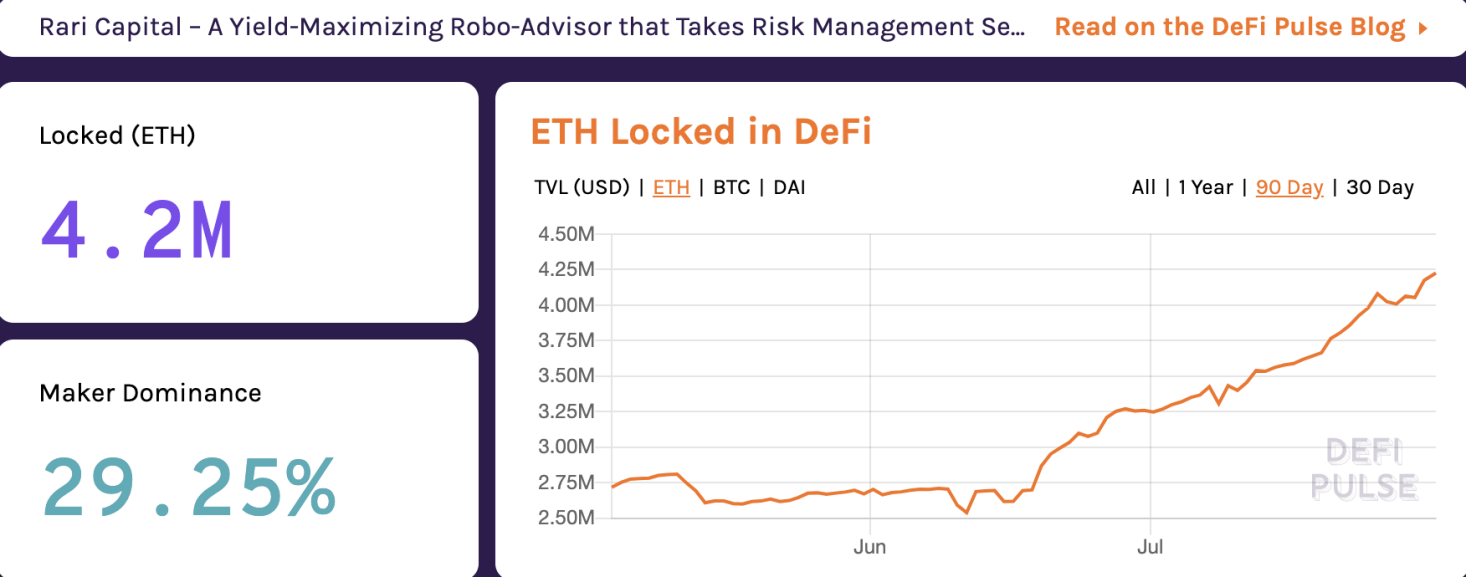
Of course, the high gas fee also brought some negative effects to the DeFi market.
First, it severely hinders the innovation and use of complex smart contracts in the DeFi field. For example, Uniswap has the least gas fee among products of the same level, so Daily Huo has been occupying the top of the DEX list. The decentralized trading platform Balancer, which competed with it some time ago, is more flexible and versatile in the design and use of mathematical models, but because of Its gas fee is too high to highlight its innovative advantages.
What's even more ironic is that, as Uniswap's number one competitor, Balancer's platform currency, BAL, has even more liquidity on Uniswap than Balancer.
Secondly, the high gas fee also made it difficult for some early DeFi projects to complete the cold start. Although Yield Farming can help some small and medium-sized DeFi projects complete the cold start, there are also some inevitable problems in the process, such as the FOMO sentiment of retail investors. Too heavy, platform users are not sticky, user transaction volume is too small to cover gas fees and other issues. So for some early DeFi projects, even with the buff blessing of Yield Farming, they may not be able to successfully complete the cold start, and eventually the liquidity will still gather to the top DeFi projects. There is no doubt that this situation is very detrimental to the overall DeFi. ecological development.
2. ETH2.0 is coming soon
Undoubtedly, friends who pay attention to the blockchain/currency circle will find that the sentiment of being bullish on ETH this year is largely due to a major benefit that we have been looking forward to for a long time: the zero-beacon chain in the ETH2.0 phase ( Beacon Chain) will be officially launched soon. The goal of Ethereum 2.0 is to improve the scalability, security and programmability of Ethereum. Unlike Ethereum 1.0, which can only achieve a throughput of 15 TPS, Ethereum 2.0 can process thousands to tens of thousands of transactions per second (or even more), without reducing its degree of decentralization.
The beacon chain is the main chain of ETH2.0. The importance of the beacon chain to ETH2.0 is just like the importance of the human heart to people. It can make the Ethereum system orderly in harmony and consensus run. ETH2.0, which is far away but within reach, continues to stimulate our nerves.
However, on August 1, according to Ethereum official data, the Ethereum 2.0 multi-client test network Medalla has met the start-up requirements, and the start-up progress has been completed 100%. According to official data, 557,824 ETHs have been sent to Ethereum 2.0 Testnet for staking.
3. Additional issuance of stable coins
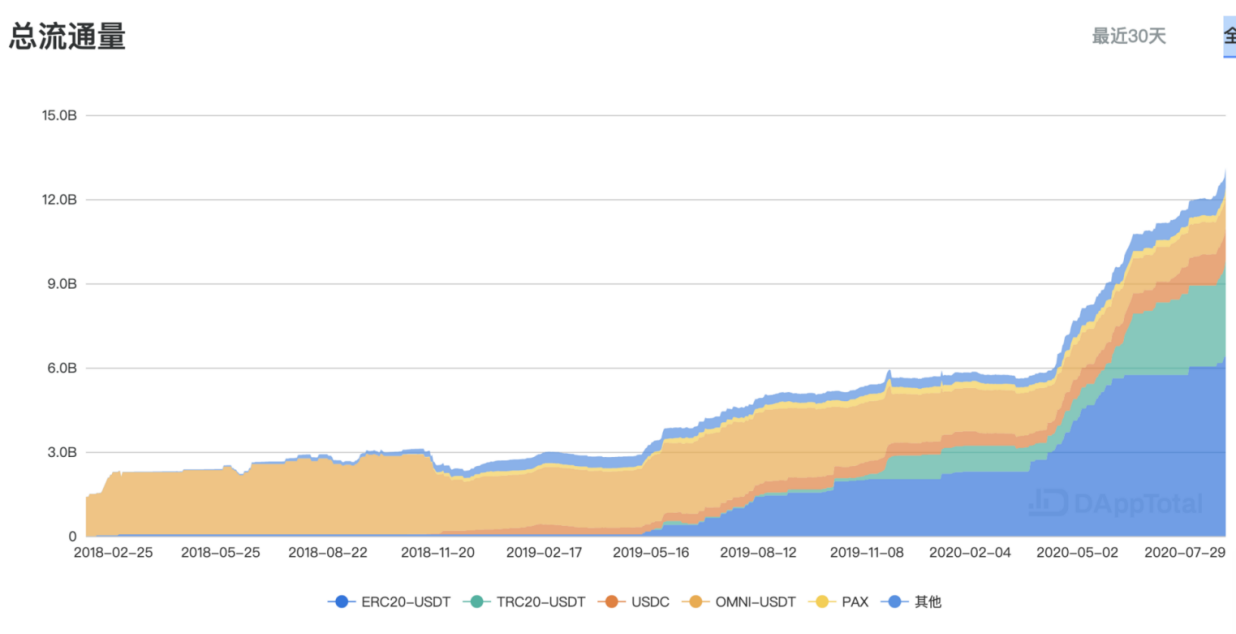
Once upon a time, everyone liked to ridicule that the biggest usage scenario of Ethereum was "issuing coins". After the collapse of the ICO craze, with the strong growth of the DeFi market, stable coins worth billions of dollars were issued on Ethereum. The network is naturally congested.
ethgasstationThe data shows that in the past 30 days, USDT has been the largest contributor to gas fees on the Ethereum network, spending more than 7,000 ETH in total, far exceeding other applications.
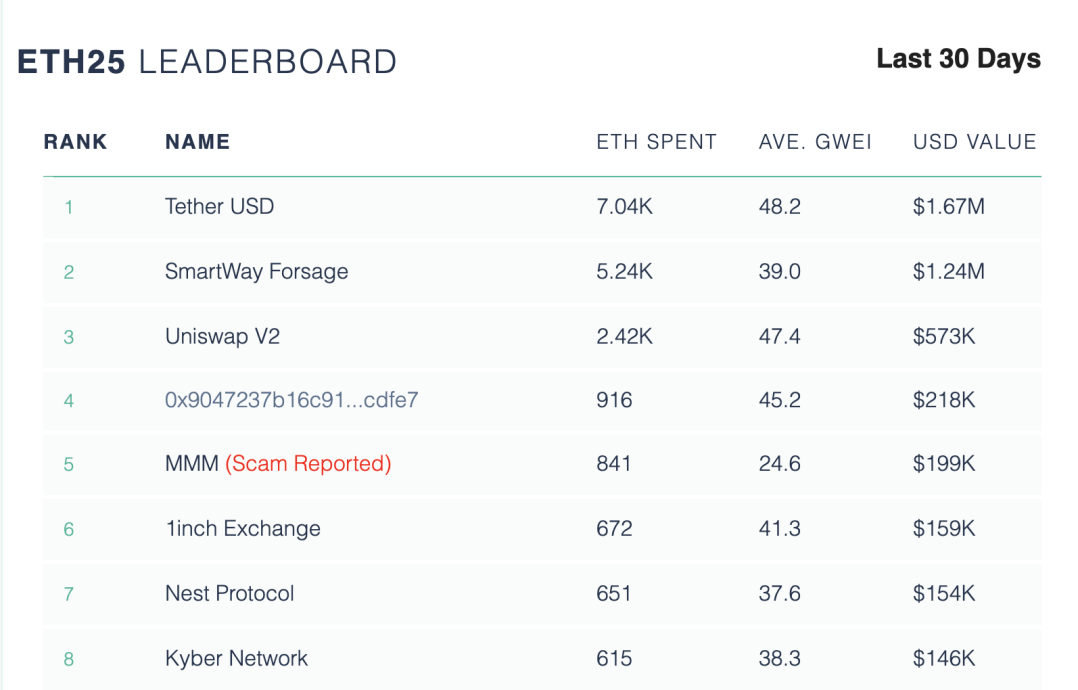
According to incomplete statistics, in the past April and May, USDT issued a total of 3.3 billion U.S. dollars, and the largest additional issuance in April was 1.8 billion U.S. dollars, setting a new historical record. Among them, 1.5 billion USDT was issued on Ethereum. according toDAppTotalsecondary title
Is there any help for the prohibitive gas fee?
On June 19th, Ethereum miners voted to increase the gas limit per block from 10,000,000 to 12,500,000, but unfortunately the gas fee is still high.
Later, V God and other developers in the industry proposed the Ethereum Improvement Protocol 1559 (EIP-1559). The protocol proposes a system that would eliminate the "inefficient" and unstable auction model currently used to determine transaction fees. EIP-1559 will also abolish the right of miners to modify the upper limit of gas; accordingly, the adjustment of upper limit of gas fee will be realized through hard fork.
Some people have also proposed expansion solutions to solve the problem of excessive gas. There are two different research directions for expansion developers:
One is Layer 1, which emphasizes that a single node does not have to process each operation in parallel. This is also the idea behind sharding, which was proposed by Ethereum Vitalik and other researchers. The so-called sharding means that a blockchain is divided into many different "slices", and each "slice" can process transactions independently. Fragmentation generally refers to the expansion scheme of layer1, because it is implemented on the underlying protocol of Ethereum. Ethereum 2.0 will introduce the concept of sharding in Phase 1.
The other is Layer 2, which reduces on-chain mainnet transactions and extends some other operations outside the chain, making it possible to interact outside the chain, and these interactions can still return to the main chain when needed. Related designs include state channels, Plasma, and Truebit.
Although the directions are different, they ultimately lead to the same goal. Recently, V God also publicly stated that the initial deployment of Layer 2 expansion was "basically" successful, and the rest is refinement and deployment.
secondary title
text
In contrast, Conflux hopes to solve the problem with the "subscription payment mechanism", so that new users can experience the blockchain in the simplest and most convenient way. To put it simply, Conflux has designed a sponsor (Sponsor) mechanism that pays transaction fees for transactions that invoke smart contracts from the protocol level, allowing accounts with a balance of 0 to directly invoke smart contracts.
For ordinary accounts with non-zero account balances, Conflux has designed a "smart contract transaction fee sponsorship mechanism" to pay transaction fees for users. This mechanism includes the following four roles:
Sponsor: Records the provider who provided the current sponsorship
Sponsor balance: records the balance of the current sponsorship;
Sponsor limit per transaction: This is the upper limit of sponsorship that the sponsor is willing to provide for each transaction;
User Whitelist: This list records the list of accounts that the contract is willing to fund, and can also be set to fund all accounts.
If user A initiates a transaction that calls contract C, A is in C’s beneficiary whitelist, and the transaction fee does not exceed contract C’s sponsorship balance and the upper limit of a single transaction funding amount, the source of the transaction fee will be Contract C's sponsorship, not A's account balance (whatever A's balance is). So when encountering such a transaction, miners only need to check whether the called contract C is willing and able to pay for the transaction to decide whether to pack it or not. (For the Conflux generation payment mechanism, please refer to:https://mp.weixin.qq.com/s/dm318fvjTXj6_xJ1uFdk-w)
The advantage of this is that users can completely ignore the existence of digital currency when using blockchain services and applications. Even if users do not hold any digital currency, they can still experience the open source and privacy-protected blockchain in the Conflux network Application, truly realize the goal of establishing a "usable and easy-to-use" blockchain ecology, and using technology to benefit all beings.





