


ETH Weekly Report | In the second quarter, the income of DeFi projects fell from the previous quarter but the currency prices soared; the cumulative transaction volume of Ethereum was close to 6.5 trillion US dollars (7.13-7.19)


Author | Qin Xiaofeng
Author | Qin Xiaofeng
secondary title
1. Overall overview
1. Overall overview
Second, the secondary market
Second, the secondary market
1. Spot market
image description
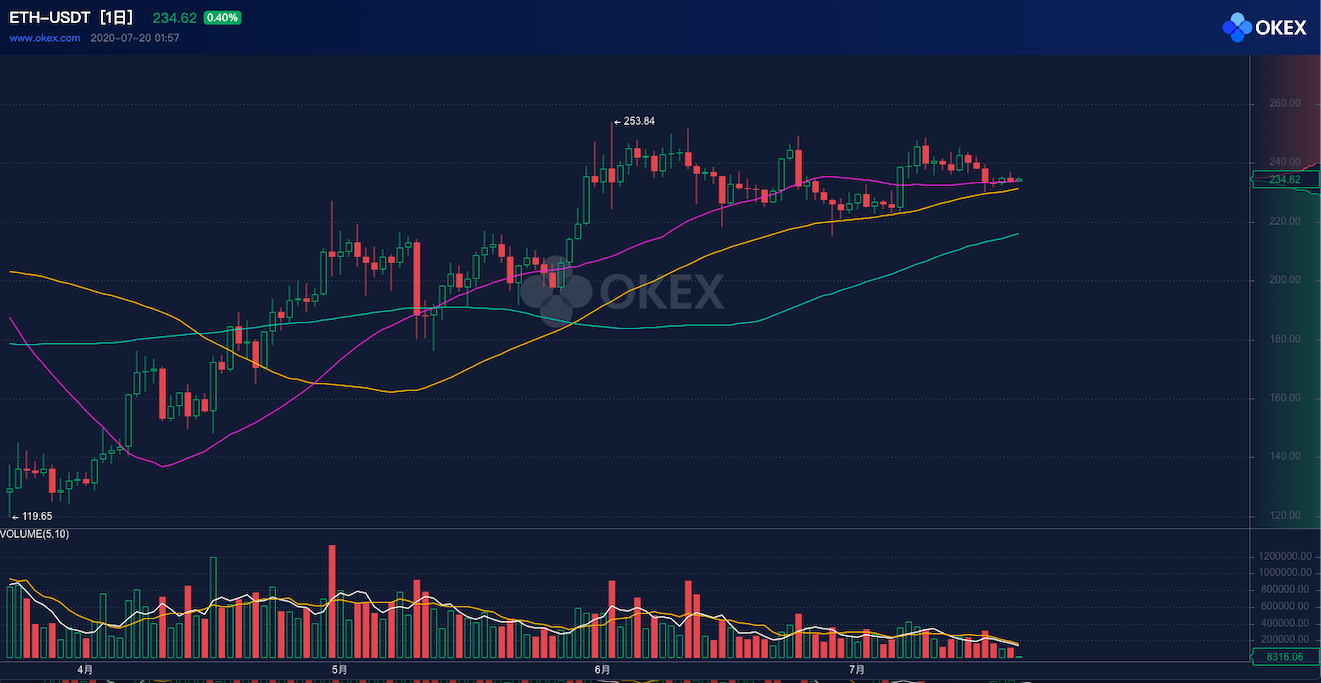
(ETH daily chart, picture from OKEx)
(ETH daily chart, picture from OKEx)
image description
(data from BiNuNiu)
(data from BiNuNiu)
(data from Tokenview)
3. Large transaction
(data from Tokenview)
Tokenview dataTokenview data
It shows that the number of transfers on the chain dropped sharply last week, and the number of large-value transfers of "above 5,000 ETH", "above 10,000 ETH" and "above 50,000 ETH" decreased by 18.75%, 12.75% and 89% month-on-month respectively; giant whale accounts The frequency of transactions has decreased, and the willingness to trade in the short term is not strong; combined with the price trend, it is in a shrinking decline, and the support is still valid, and it is bullish in the long term.Last week, there was a total of 1 transfer of "more than 50,000 ETH", and the maximum transfer amount was 207,800 ETH.unknown new addresstransfer in, and then transferred out again in small amounts, and the split has been completed.
OKlink data3. Ecology and technology
3. Ecology and technology
1. Development and technology
1. Development and technology
(1) ETH 2.0 beacon chain client progressQuantstampOn July 15, Smart Contract Audit Firm
CEO Richard Ma revealed that the ethereum 2.0 client Prysm is "basically ready." Richard Ma said that although many Ethereum 2.0 clients have joined various testnets throughout the spring of 2020 to test and verify Phase 0, the migration of Ethereum and the DeFi ecosystem to Ethereum 2.0 is still an extremely arduous process.StatusJuly 17,
Announced on its official blog that the Nimbus ETH 2.0 Beacon Chain client security assessment has been officially launched. Status’ Nimbus is one of the seven clients of Ethereum 2.0, and is in charge of three independent providers, Consensus, NCCsecurityUS and Trail of Bits The audit evaluation is planned to be completed within 4 months. The evaluation will be conducted in 3 stages: network core, ETH2.0 specification core, validator core, and user experience.
(2) Economic analysis of Ethereum 2.0 PoS: three variables including ETH pledge amount determine the security of the network
On July 17, Tanner Hoban and Tom Borgers from ConsenSys released an independent research report on Ethereum 2.0 network economics. According to the research, the security of the Ethereum 2.0 network depends on three key variables: ETH pledge amount, ETH price and volatility, and when the ETH pledge rate reaches 13.8%, the Ethereum 2.0 network can provide similar security to Ethereum 1.0 Finally, the report also recommends increasing the base reward factor of Ethereum 2.0 from the current 64 to at least 128 to ensure the security of the network.
Ethereum 2.0 will spend less on network security than Ethereum 1.0, the report said. The report predicts that the ETH2.0 network inflation will be close to 0.55% per year, which is much lower than the current 4-4.5% of the Ethereum proof-of-work network.
On July 19, the DeFi-based on-chain liquidity underwriter KeeperDAO v1 was officially launched on the mainnet. KeeperDAO is an on-chain liquidity underwriter jointly launched by the distributed system development company Talo and the digital asset management platform Amber Group. It encourages token holders to participate in the liquidity pool through economic incentive strategies to coordinate margin transactions, loans and exchanges liquidation and rebalancing in applications such as KeeperDAO allows users to pool funds into Ethereum smart contracts and gain mutual benefits through on-chain arbitrage and liquidation opportunities, which not only allows all participants to obtain passive income through gaming, but also ensures the liquidity of decentralized financial applications and orderliness. In order to maximize the utilization of idle funds, all assets in the fund pool will continue to provide loans to Compound, dYdX, etc. (KeeperDAO)
2. Voice of the Community
(1) ETH 2.0 project leader: ETH 2.0 full testnet launch date this week
Ethereum developers said on July 18 that there was little left to do before launching the full Ethereum 2.0 testnet. This is a milestone and the final stage before the genesis block is mined. Danny Ryan, the head of the ETH 2.0 project, said that after communicating with the client team, they have confirmed that there is still some stability work to be done. In addition, there are some functions that affect the user experience (trying to make the key management As close as possible to the mainnet), the launch date of the testnet is expected to be announced on Monday (July 20) or Tuesday (July 21).
The work on the Ethereum 2.0 PoS phase has been going on for more than two years, and since last year, the single-client testnet has been running. The upcoming testnet will be a real environment, but with fake ETH instead of valuable tokens. This is what everyone has been waiting for, and its release will be a clear signal that Ethereum 2.0 will not be launched until 2030, but this November.
(2) Data: The cumulative transaction volume of Ethereum is close to 6.5 trillion US dollars
On July 17, Joseph Lubin, co-founder of Ethereum and founder of ConsenSys, tweeted that the security of the beacon chain is crucial to the success of ETH 2.0 and the smooth launch of the first phase of ETH 2.0. Joseph Lubin also said that ConsenSys is trying to make efforts and contributions to the beacon chain ecosystem, and is working with teams such as ethstatus to evaluate the security of the beacon chain.
3.DEX
according toDAppTotal.com DEXaccording to
The data on the special page shows: 17 DEX projects based on the Ethereum network have been counted. The transaction volume on the chain in the past week totaled 164,050 ETH (approximately 38.38 million U.S. dollars), a decrease of 20.5% from the previous week; up 1%. As follows:
It can also be seen from the above figure that the transaction volume and user volume of DEX on the chain have shown a downward trend in the past seven weeks. A very important reason is that the assets on the chain have basically turned to DeFi pledges, and the transaction demand has dropped sharply.
According to the number of transactions, Uniswap, IDEX and Tokenlon ranked the top three, accounting for 43.33 39.71% (up 3.6%), 38.55% (up 15.3%) and 15.26% (down 15.3%), Kyber continued to fall out of the top five list .
4. Borrowing
Defipulseimage description
(Lock value on the DeFi chain)
(Lock value on the DeFi chain)
according to
5.Dapp
according toDappreview data, Dapps on the ETH chain added 16 Dapps last week, and the total number of developments reached 4,450; the newly added Dapp "Draken" with the largest seven-day transaction volume exceeded 14,700 ETH (about 3.4 million U.S. dollars). Draken, a cross-chain decentralized exchange, currently only has seven trading pairs for its own platform currency DRK.
image description
image description
(data from etherchain.org)
etherchain.orgThe data shows that the average computing power increased by 0.31% month-on-month, and was temporarily reported as 193.7TH/s; the average mining difficulty increased by 0.29% month-on-month, and was temporarily reported as 2427 T; It was flat, down 0.26%.
4. News
1. Data: Ethereum transaction fees are up 500% since April
Glassnode data shows that the average daily gas price for Ethereum transactions exceeds 50 Gwei. That transaction cost was five times higher than in April and the highest in nearly two years. Some analysts and supporters of the network believe high transaction fees may be responsible for ethereum's decline in the long run.Matt GarnettConsenSys researcher
2. Report: In the second quarter, the income of DeFi projects decreased by 30% from the previous quarter
On July 16, Bankless released the DeFi report for the second quarter. The main points of the report are as follows:
The income of DeFi projects dropped from about US$5.58 million in the first quarter to US$3.92 million in the second quarter, a quarter-on-quarter decrease of about 30%. A big factor was that MakerDAO’s reduction of the base fee rate to 0% saw Maker’s earnings drop from $1.2 million in Q1 to $152,000 in Q2. Synthetix was another reason for the earnings decline, as it beat its first-quarter profit;
The DeFi project with the highest income in the second quarter was Kyber, which reached US$634,000, followed by Compound (US$625,000) and dYdX (US$624,000);
Although the revenue of DeFi projects has declined to a certain extent, the average price of DeFi tokens increased by 199% in the second quarter, far better than Ethereum (70%) and Bitcoin (43%). Among them, Bancor (BNT) and Aave (LEND) saw the most prominent gains, up 546.9% and 514.5% respectively, followed by REN, SNX, and COMP;





