






Economic Analysis of Ethereum 2.0 PoS: Three Variables Determine the Security of the Network


Editor's Note: This article comes fromBabbitt Information (ID: bitcoin8btc)Editor's Note: This article comes from
Babbitt Information (ID: bitcoin8btc)
, by Tanner Hoban and Tom Borgers, translated by: Free and Easy, published with permission.
Here is the translation:
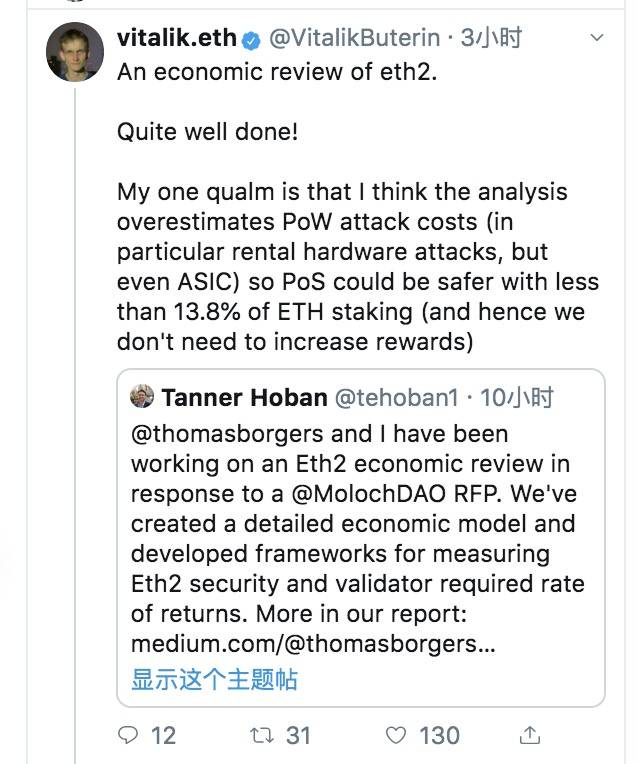
Tanner Hoban and Tom Borgers from ConsenSys conducted independent research on the economic issues of the Ethereum 2.0 network. They believed that the security of the Ethereum 2.0 network depends on the three key variables of ETH pledge, ETH price and volatility. When the ETH pledge rate reaches 13.8%, the Ethereum 2.0 network can provide similar security to Ethereum 1.0 to resist potential attacks. Finally, they also propose to increase the basic reward coefficient of Ethereum 2.0 from the current 64 to at least 128. To ensure the security of the network.
For this research report, Vitalik Buterin, the co-founder of Ethereum, spoke highly of it, but he also worried that the researchers' analysis overestimated the attack cost of PoW, so he believed that even if the ETH pledge rate of Ethereum 2.0 is lower than 13.8%, The network is also more secure than expected, so he doesn't see an increase in rewards as necessary.
Here is the translation:
We would like to thank Molchdao, the stakeholders who spoke with us, and the Ethereum Foundation for their support throughout the project. Special thanks to Danny Ryan, Barnabe Monnot, Trent Van Epps, and Vitalik Buterin for their comments and suggestions on the draft report.
While we strongly recommend that you read the entire report, in order to save your valuable time, here is a summary of the important content of the report:
The Ethereum 2.0 network upgrade is an ambitious, gradual shift to a proof-of-stake (PoS) consensus algorithm and incentive system, which has profound implications for the economic properties of the network. The design of the system is complex, with an incentive mechanism that rewards honest network participants for validating transactions and determining the historical state of the network, while penalizing offline and malicious validators. This paper defines, measures, and analyzes the cryptoeconomic security of Ethereum 2.0 using a detailed network economic model and new economic assessment tools.
In other words, the security of Ethereum 2.0 is highly dependent on the pledged ETH. We build a model to understand the motivations of capital efficient investors, which we call the Demand Serenity Active Validator Yield (RSAVY) model, to account for the risk and cost of collateral and the corresponding required rate of return (RRR). Based on our findings, we expect validators to consider participating at an annualized rate of return of 3.3% (which we use as a proxy for minimum rate of return). In the more pessimistic but stable scenario, the annualized return increases to 11.6%.
in conclusion:
The RSAVY model can be used not only to calculate the required rate of return, but also to form a network map under selected scenarios. We apply different parameters in these scenarios to support our conclusions and recommendations, summarized below:
secondary title
in conclusion:
Proof of Stake (PoS) in Ethereum 2.0 is more complex than Proof of Work (PoW). Ethereum 2.0 is a highly complex and well-designed system. Its structure is elegant and thoughtful, but it may be difficult to grasp from the perspective of verifiers, which leads to uncertainty and unpredictability, which is a potential source of uncertainty. Capital efficiency verifiers, presenting practical and narrative hurdles.
The security of the Ethereum 2.0 network depends on three key variables: ETH pledged, ETH price, and volatility. Each of these variables has a direct or indirect effect on the cost of attacking a network. Relatively speaking, the total pledged amount of ETH is the most controllable variable, while the price of ETH has a direct and potentially huge impact on network security, but it is not within the control of the system. Volatility can come from different sources and indirectly affect ETH pledged volume and price.
Attacks on Ethereum 2.0 are easier to scale than attacks on Ethereum 1.0. In Ethereum 2.0, the hardware and power consumption burden of participating in the network is basically reduced to a minimum. Furthermore, the boom in DeFi and its eventual connection to Ethereum 2.0 can greatly accelerate and amplify this trend.
Capital efficiency verifiers are more predictable. While the participation of Ethereum enthusiasts was important for a successful beacon chain launch, it was ultimately not enough to achieve an adequate level of security. Attracting capital-efficient validators will lead to accuracy against sufficient levels of ETH staked.
With a target of 13.8% of ETH pledged, based on historical prices, the Ethereum 2.0 network will reach the security level of Ethereum 1.0. We calculate that the target pledge rate for ETH is 13.8% given the volatility of historical prices.
Economies of scale for validation exist but decrease when ETH price increases. Unlike the PoW environment, which can only achieve profitability through continuously expanding scale operations, as the price of ETH rises, the cost of Ethereum 2.0 verification will gradually decrease. We generally find that network economics are very conducive to more decentralized network participation, which meets the design goals of Ethereum 2.0.
Currently 77.7% of the ETH supply is held in validator “eligible” wallets (meaning addresses with more than 32 ETH). There are about 86.6 million ETH in non-exchange wallets (77.7% of the total supply), and another 18.7 million ETH is held by exchanges, which may provide staking services. This is a compelling, serviceable addressable market, and a key goal of the incentive program is to maximize network participation, converting these wallets into active validators.
Lack of liquidity in Phase 0 and Phase 1 can lead to unpredictability and centralization. Given the lack of a two-way bridge between Ethereum 1.0 and Ethereum 2.0, and the lack of transaction capabilities in Phase 0 and Phase 1, we expect the emergence of derivatives and centralized secondary trading markets. The use of these platforms by highly centralized validators creates centralization risk and unpredictability.
suggestion:
Beware of derivative attacks. The Ethereum ecosystem is growing rapidly, so is ETH as an asset class, the number of options is increasing, and unique financial instruments such as "flash loans" are being exploited maliciously. With this momentum, derivatives could become the most favored avenue of attack for counterparties.
secondary title





