


Omen: A Next Generation Prediction Market


Editor's Note: This article comes fromEthereum enthusiasts (ID: ethfans)Editor's Note: This article comes from
Ethereum enthusiasts (ID: ethfans)
, Author: Gnosis, translation & proofreading: Min Min & A Jian, reprinted by Odaily with authorization.
The Omen prediction market went live on July 2nd and can be accessed via Omen.eth or an IPFS link.
The Competitive Environment of the Prediction Market
-Omen.eth-
Building a fully decentralized prediction market raises a new set of design problems, while also opening up new opportunities for concrete implementation. Among the many applications on Ethereum, Gnosis and Augur are often put together. In this article, we will analyze the main differences between the two protocols in detail. First, we'll describe how Gnosis has developed a set of infrastructure and tools to address the unique challenges of decentralized prediction markets.
image description
secondary title
Introduction
Omen is the ultimate decentralized prediction market platform launched, maintained and managed by DXdao. DXdao builds Omen on top of Gnosis' open framework specially developed for prediction markets.
On Omen, anyone can create a predictive project based on any question. When creating a forecast project, you can customize the following properties:
outcomes and initial probabilities;
Tokens as collateral: projects can be denominated in a range of assets and stablecoins, including Gnosis’ OWL token designed for this use case;
Type: Projects can be of various types, including but not limited to technical, cryptocurrency, and political;
Arbitrator: Projects can have a custom oracle (information entry mechanism).
Oracles are predefined data sources used to add real-world information onto the blockchain to validate prediction market outcomes. While most prediction markets have an oracle system determined by the platform, Omen is not locked into oracles, so technically you can specify any custom data source as an oracle. Omen version 1.0 uses the decentralized tool Realit.io as the oracle, and the dispute mediation platform Kleros as the final arbiter. In the future, Omen may also introduce Chainlink, Aragon Court and traditional news organizations as oracles. Rather than being overly prescriptive, Omen is designed as a modular, open platform so that different norms and best practices related to prediction markets can grow organically throughout the ecosystem.
secondary title
Omen is designed to address the liquidity shortcomings of earlier prediction market proposals. Many on-chain prediction markets use traditional order books, but because of the lack of liquidity, the spreads are large. However, the Omen prediction market uses automatic market makers to match transactions, allowing users to easily provide liquidity, similar to Uniswap's liquidity pool. Increased liquidity means that pricing in prediction markets always reflects the latest professional opinion on the topic.
Omen is one of many platforms built on a conditional token framework. Essentially, with this framework, we can create a new asset class — yes, conditional tokens — that can improve the clarity of information discovery in prediction markets. Since conditional tokens are based on the ERC-1155 standard and can be wrapped as Ethereum's ERC-20 tokens, tokens created on Omen will soon be available on external decentralized exchanges like Gnosis Protocol Trading. This move will not only give prediction market assets better access to global liquidity pools, but also enable cross-platform interoperability between different prediction market providers such as Omen or Polymarket. Both platforms are built on the conditional token framework developed by Gnosis.
In addition to enhanced liquidity and interoperable tokens, another important innovation of Omen is governance. As DXdao's flagship product, Omen aims to be an autonomous collective with open membership, allowing its members to develop, govern and grow decentralized financial protocols and products on the platform. DXdao is formed by a group of decentralization supremacists who want the organization's applications to have full-stack decentralization on the serverless hosting layer, application layer, and governance layer. Under the DAO-based governance model, Omen adheres to the principle of decentralization, solving the "trust problem" of the centralized prediction market, while maintaining the flexibility of platform improvement and upgrading.
secondary title
How are prediction markets on Omen different from Augur?
Central to Augur's design is having a decentralized oracle. Holders of Augur’s REP tokens are called “Reporters” and they are able to influence the outcome of prediction market decisions. When the resolution date for a forecasted project passes, the Initial Reporter—the REP token holder, who is usually also the market creator—sets the market’s “Tentative Winning Outcome” and other REP token holders can challenge that outcome and stake REP tokens on another outcome. By combining economic incentives and dispute window mechanisms, Augur's oracle system has successfully created a decentralized reporting pool to record real-world events on the Ethereum blockchain. This is a very useful aspect of Augur's design. In effect, Augur's oracle system can act as the arbiter of Omen's prediction market resolution outcomes.
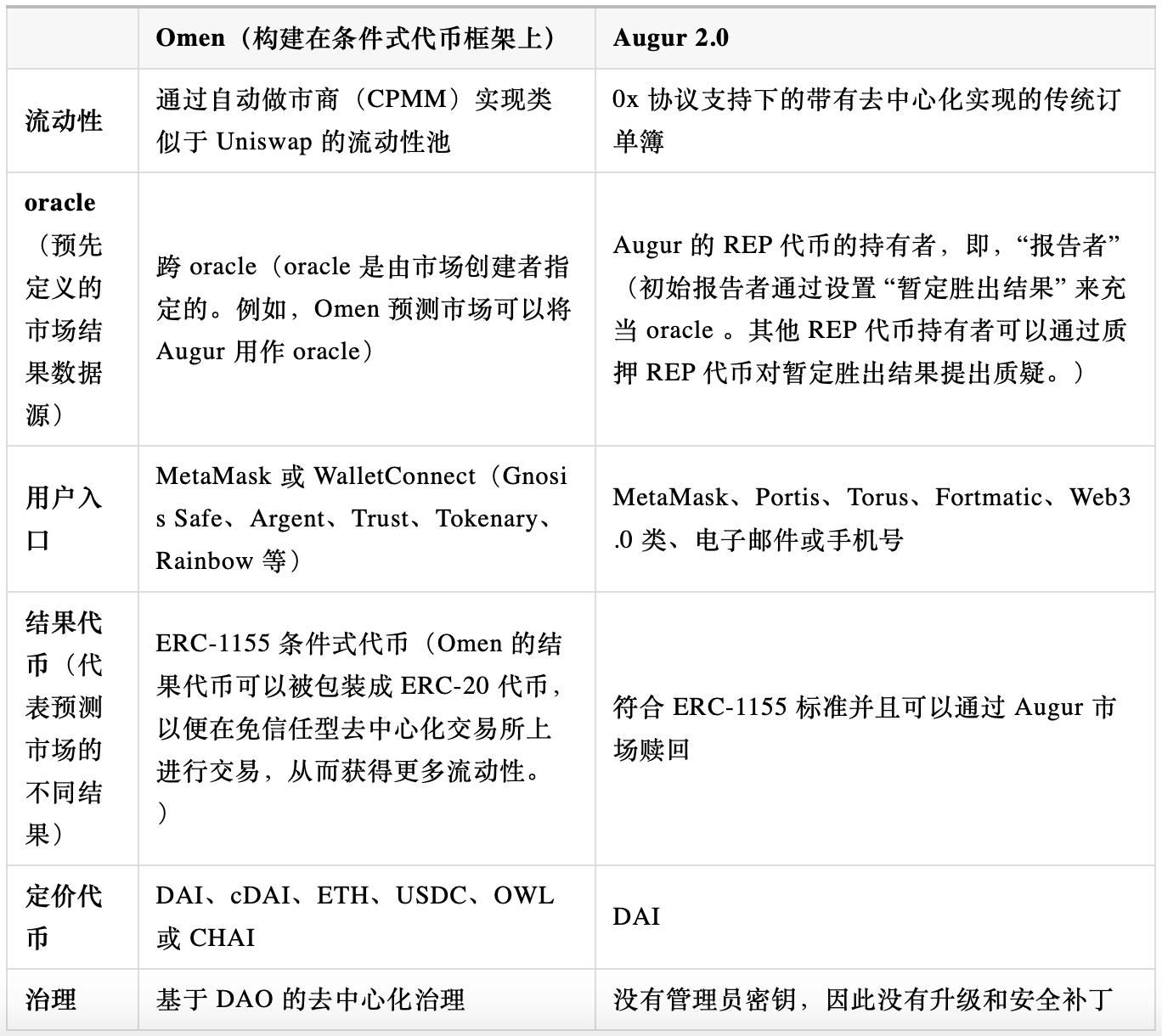
Considering liquidity, the prediction market of Augur version 2.0 adopts an off-chain order book supported by the 0x protocol. The order book enables orders to be collected off-chain and then settled on-chain. While orders are shared on a peer-to-peer network through an efficient discovery mechanism supported by version 3.0 of the 0x protocol, the system still relies on synchronized token-pair orders. In contrast, automated market makers like Omen create large Uniswap-like liquidity pools for token pairs.
The following table compares Omen and Augur 2.0 more fully:
image description
-List of Omen and Augur-





