


A thorough reading of the Ethereum 2.0 economic model: supply, demand and ecological participants


Editor's Note: This article comes fromCrypto Valley Live (ID: cryptovalley)Editor's Note: This article comes from
Crypto Valley Live (ID: cryptovalley)
, Author: Hao Kai, reproduced by Odaily with authorization.
This article mainly studies the economic model of Ethereum 2.0, focusing on the analysis of changes in supply and demand, and discusses the impact of Ethereum 2.0 on all participants in the ecosystem after changing the consensus mechanism. When the amount of ETH mortgaged in the Ethereum 2.0 system is small, the annual rate of return of the verifier will be high; when the participants of Staking and the rate of return reach a certain balance, only investors who have a stronger sense of identity with Ethereum will choose to be a validator.
There are many improvements in Ethereum 2.0, and the change of the consensus mechanism from PoW to PoS is one of the important changes. The change of the consensus mechanism will have a great impact on the economic model of Ethereum 2.0.
secondary title
supply
The supply of ETH can be divided into two parts: initial tokens and additional tokens.
an initial token
In 2014, Ethereum conducted a 42-day pre-sale. The number of ETH sold was 60,102,216, and a total of 31,531 bitcoins were raised. According to the bitcoin price at that time, it was about 18.43 million US dollars. Meanwhile, early contributors to the Ethereum community and the Ethereum Foundation received 5,950,119 ETH each. The total initial token supply of Ethereum is approximately 72 million.
The issuance of additional tokens can be divided into common block fixed rewards and uncle block rewards.
Due to the relatively short block time of Ethereum, temporary forks are a very common phenomenon. Therefore, Ethereum has set up uncle block rewards, the main purpose of which is to improve the fairness of mining and the enthusiasm of miners, and protect the integrity of the Ethereum network. System security, more reasonable use of computing power.
image description
image description
The composition of ETH (data source: Etherscan)
image description
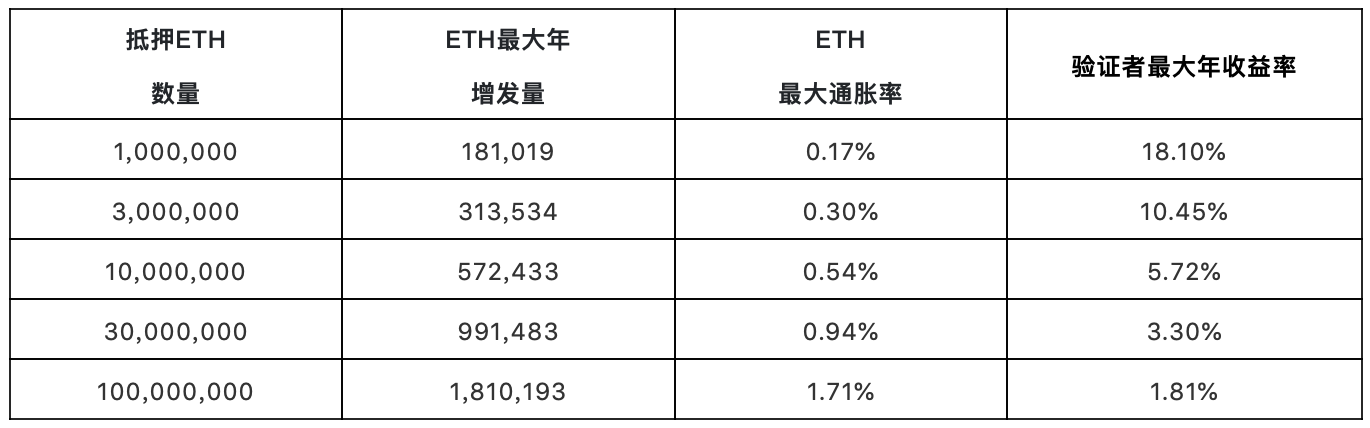
Table 1: ETH issuance volume upgraded to Ethereum 2.0 (data source: EthHub)
image description
Table 2: ETH historical additional issuance (data source: Etherscan)
secondary title
Demand
Currently, the rights and interests of ETH are mainly usage rights. In the Ethereum ecosystem, transfer transactions and execution of smart contracts require the use of ETH to pay Gas fees, and miners can get Gas fees. However, there is a view that the gas fee model is "whoever uses pays", which does not capture value well. The execution of smart contracts in the Ethereum ecosystem will be limited by the performance of Ethereum. The number of transactions per unit time is not high, and the consumption of Gas fees is very limited. Moreover, many projects based on Ethereum will expand performance through Layer 2. The Gas fee model cannot capture this part of the value, and ETH cannot achieve simultaneous growth with the development of these projects.
image description
Gas fee consumed per day (Image source: Etherscan)
The performance of Ethereum 2.0 will be significantly improved, and more blockchain projects will be developed and operated based on Ethereum. This means that the consumption of Gas fees will increase, and the actual demand for ETH in the entire ecology will increase significantly, which will drive the value growth of ETH. Of course, the gas fee model has not changed, and the problem of value capture has not been fundamentally solved.
The income right mainly refers to the user's staking income obtained by mortgaging ETH, which is the user's new demand for ETH. Users who participate in Staking need to hold 32 ETH first, and then mortgage 32 ETH through the smart contract to become a validator. When the amount of ETH mortgaged in the Ethereum 2.0 system is small, the annual rate of return of the verifier will be high, which will attract users to participate in Staking in the early stage to obtain benefits. The ETH participating in Staking withdraws from the market, which will support the price of ETH.
Upgrading to Ethereum 2.0 will not have much impact on Ethereum’s governance mechanisms. The governance mechanism of Ethereum 2.0 has not yet been finalized, but it is very likely to maintain the current structure of separation of powers among foundations, node operators, and developers, and continue to implement off-chain governance. Although the mainstream governance mechanism of the proof-of-stake public chain is on-chain governance, in the short term, ETH will not be given governance rights.
secondary title
Impact on participants in the ecosystem
Participants in the Ethereum ecosystem mainly include miners, verifiers, node service providers and exchanges. Ethereum has a great influence in the blockchain field, and changes in the consensus mechanism will affect all participants in the ecosystem.
a miner
There are three paths that miners may choose next: one is to give up mining completely and follow Ethereum 2.0 to find a position in the new gameplay, and miners will suffer great losses. The second is to use current mining machines and equipment to mine tokens like ETC (Ethereum Classic) and leave the Ethereum community. The third is that miners unite to hard fork Ethereum, and continue to use the PoW consensus mechanism for mining on the forked chain.
At present, miners in the Ethereum ecosystem need to be equipped with hardware facilities and consume electricity, and do not need to hold ETH. Instead, miners are constantly selling ETH to pay for electricity, labor, maintenance, etc. A miner's risk exposure is mainly due to the impact of a drop in the price of ETH on the value of their mining machines, mine farms and other equipment they own.
The miners of Ethereum are in a competitive relationship, and there is no interactive communication and collaboration. Whoever finds the random number Nonce first will get the bookkeeping right and block reward. In order to smooth the uncertainty in the mining process and share risks and benefits, multiple miners can form a special cooperative relationship such as a mining pool. However, there is still a strict competitive relationship between mining pools. The centralization of Ethereum computing power is very high. The figure below shows the distribution of the computing power of Ethereum. It can be seen that the sum of the computing power of the top ten mining pools in Ethereum accounts for about 83% of the computing power of the entire network.
image description
Ethereum computing power distribution map (Source: Etherscan)
Two verifiers
After upgrading to Ethereum 2.0, validators are a new category of groups. In order to avoid centralization problems, Ethereum 2.0 lowers the threshold for ordinary users to participate in Staking. Ethereum users only need to mortgage 32 ETH through smart contracts to become validators.
Compared with miners, verifiers face much lower hardware requirements, but participating in Staking requires holding ETH. The risk exposure of verifiers mainly comes from the liquidity risk and term risk of locking ETH.
Ethereum 2.0 is a big project. Phase 0 will be launched soon, which does not support transfer transactions. It is expected that transfer transactions and smart contracts will be implemented in Phase 2. Therefore, the staking lock-up period for participating in Ethereum 2.0 is very long, about two years. A long and uncertain lock-up period will hinder users from participating in Staking.
Three-node service provider
Ethereum 2.0 is an opportunity not to be missed for all PoS node service providers, and it is also a very big challenge.
As can be seen from the table below, compared to the popular projects of PoS node service providers such as EOS, TRON, Tezos and Cosmos, the market value of Ethereum is larger than the sum of the market value of these projects, and Ethereum 2.0 will directly become the one with the highest market value. PoS project, and there will be a lot of users participating in Ethereum Staking in the future. Therefore, Ethereum 2.0 is an unmissable opportunity for all PoS node service providers.
image description
Table 3: Market capitalization of popular PoS projects (data source: CoinMarketCap)
At the same time, node service providers also need to provide different services to different customers. For large customers holding a large amount of ETH, service providers need to help large customers allocate ETH to multiple different accounts; for small customers holding less than 32 ETH, service providers need to help small customers merge. For node service providers with large scale and good reputation, these tasks can be realized in a centralized way; for small service providers, smart contracts need to be used to attract users. Moreover, there is fierce competition among node service providers. Therefore, Ethereum 2.0 is a big challenge for all PoS node service providers.
Four exchanges
At present, many exchanges have established their own PoS mining pools, using the digital currency managed by users for Staking to obtain profits. After the consensus mechanism of Ethereum 2.0 is changed, these exchange mining pools will definitely participate in Staking. At the same time, exchanges have unique advantages in solving the liquidity problem of staking tokens. Exchanges can provide liquidity solutions in a centralized manner. For example, when a new option-type currency anchored to Staking tokens is launched, the exchange can provide on-site transactions, but withdrawals and transfers are not allowed.
secondary title





