


Chris Burniske: DeFi has more impact on Ethereum than ICO


Editor's Note: This article comes fromBabbitt Information (ID: bitcoin8btc), Author: Overnight Porridge, published with authorization.
Editor's Note: This article comes from
Babbitt Information (ID: bitcoin8btc)
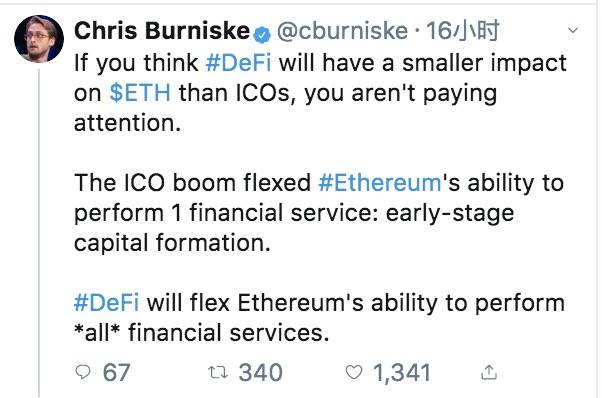
Babbitt Information (ID: bitcoin8btc), Author: Overnight Porridge, published with authorization.Chris Burniske, a partner of the well-known investment institution Placeholder, commented on the recent rising DeFi.

A Superior Financial System
Here is the translation:
"Blog post, which respectively analyzed the functions that Bitcoin and Ethereum will undertake.
image description
(Picture: Chris Burniske, partner at Placeholder)
Here is the translation:
Speculation fuels the growth of capital, and with capital, a group of people has resources that can then be deployed at scale to a shared vision. We see this with railroads, electricity, cars, computers and the web, and cryptocurrencies are no exception. Over the past decade or so, cryptocurrency networks have been capitalized into corresponding products, and the industry was close to a trillion-dollar size in late 2017.
In capitalizing itself into corresponding products, this crypto-capital boom builds a native financial system that responds to its own bootstrapping. While other revolutionary technologies have undoubtedly led to the evolution of the existing financial system, none of them have built an entirely new financial system from scratch. Instead, they remain dependent on the existing financial system, handing power to predictable people. The blockchain, on the other hand, can be regarded as a 21st century accounting and production system owned by "the people". Therefore, this field has created a new financial system that replaces the old financial system.
The system targets a global audience with macro- and micro-resilience, cost advantages, and services designed for the 21st century and beyond. While this will eventually achieve functional parity with existing financial infrastructure, it won't stop there. The foundation of the blockchain is superior, and so is the end product.
secondary title
global audience
Unlike companies that go country-by-country to find users, cryptocurrency networks search for users globally from the start. Unlike companies that own or rent servers to provide services, in a cryptocurrency network, a group of sovereign servers around the world perform work for the network based on economic value. While the supply side of cryptocurrency networks is currently largely machine-based, it is expected that there will be an explosion of human-based jobs in the future, leading to widespread wage earning in the cypher space.
Also, don't be surprised when the number of units of ever-changing crypto services becomes faster than ever. This has happened, for example, when the infrastructure behind Bitcoin was built at an exponential rate, or it took Bitcoin 10 years to become a strong competitor to gold assets 1000 years ago. Or consider that MakerDAO borrowed almost as much in its first year ($200 million) as LendingClub did in its first five years ($250 million). The global and accessible nature of cryptocurrencies has made this egregious virality inevitable.Gitcoinsecondary title
Macro and Micro Resilience
Resilience or resilience is important from a macro and micro perspective as tensions between cryptocurrency networks and current meatspace+digital financial networks continue to exist. Resilience comes from sovereignty, and once these fields realize that the crypto industry is a threat to their existence, meatspace+digital cannot kill the movement.
From software security to hardware security, cryptography has been working to ensure that the security budget of the underlying hardware is large enough to be reliably maintained and attached to the ledger at scale. In principle, we must prevent "double spending" that could damage the trust in the accounting system. I remember doing calculations for ARK Invest that even if Google put all of their computing power into Bitcoin, Google would account for less than 0.25% of the Bitcoin Ledger's security computing power, and this calculation was done in 2015.
Cost advantage
On a micro level, the ability to defend against attacks is critical to all those involved in any property. In the world in which authors live, protecting property is essential to creativity. Only when people feel confident that their creations will be protected (or shared, if they choose) will they feel the highest motivation. Here, public key cryptography plays a huge role in protecting property and digital creations at low cost. Remote confiscation is nearly impossible, and encryption is building protection techniques and micro-resilience into the fabric of online culture.
Together, these macro- and micro-resiliences ensure that no army is required to defend a cryptocurrency network. Instead, the economics and nature of the network make it resistant to all attacks by design. From a standpoint of individual sovereignty, the absence of the military force required to keep encrypted networks resilient and operational is key to allowing these economies to operate at lower cost in the long run. They require less extraction to maintain since they are less expensive to run and maintain. As meatspace + digital try to kill all bridges to the cypher economy (taxing bitcoin transactions, a small form of it) may be the final test of resilience, at which point the cypher world may shrug and move on grow endogenously.
secondary title
Cost advantage
As an example of the superiority of cryptocurrencies, one can now run an organization on Ethereum that is functionally equivalent to an investment firm, business, or sovereign democracy, and burn about $16 a month. Ethereum itself doesn't provide this functionality, it's a software service built by Aragon that sits dormant and waiting to be invoked after the software logic has been sent to Ethereum's ledger via a transaction. While the software does require occasional maintenance and does have associated costs, "dormant-but-running software" on Ethereum results in zero operational costs until invoked. When invoked, it is the user who pays for operations whose costs are set according to the transaction complexity of the Ethereum Virtual Machine (EVM). In other words, the fee charged to the consumer is the cost of the goods, with hardly any margin added to the service.
Similar to Ethereum, Bitcoin users are spending money to enter the commodity block space of a 21st century accounting system. This is a fee market where there is competitive pressure from a global add-on ledger that keeps their margins and fees low. I expect these miners will have similar profit margins to power companies once Bitcoin has a fixed supply, social risk is reduced, and the transaction network is heavily used. Custody fees and other “carrying costs” are virtually zero for BTC users, as are all other public cryptocurrency networks.
functional equivalence
Time and time again, low-cost services make up a huge chunk of our economy.
If you believe in the gospel of low cost, you better believe in the promise of the cypher industry in the long run.
secondary title
Using services built on Ethereum, you can now access interest-bearing deposit accounts (USD 8% per annum), borrow and lend various assets, create cypher-native credit, deposit into indexed asset managers, get paid by asset managers, Exchange all your crypto assets, buy insurance, and do it all through a simple interface. This is but a small subset of the services of Ethereum, a cousin of Bitcoin.
The speed at which these permissionless financial services have emerged and iterated on Ethereum is mind-boggling. Judging by the breadth and depth of talent I've seen pouring into the space from Wall Street, Silicon Valley, and around the globe over the past six years, there's no doubt that the DeFi community will continue to grow.
As we all know, Bitcoin allows for the storage and transfer of value on a massive scale, and you can access it anytime, anywhere. Billions of dollars in transactions can be processed via Bitcoin for less than $1. Based on the backbone of Bitcoin, many independent companies have built a wide range of services to integrate into the meatspace+digital economy. Due to its time and scale, Bitcoin has been more integrated into the existing world than any other cryptocurrency network, making it the main lineage of cryptocurrency liquidity and capital injection mechanisms. Ethereum, on the other hand, is not far behind.
The combination of capital pipelines and flawless accounting systems, coupled with a rapidly iterating and evolving suite of financial services, speaks to the fact that cryptocurrencies are moving towards functional parity in meatspace+digital. Some would say that because these systems are not yet functionally equivalent, they are toys that will never be realized and should therefore be ignored. This would be a serious mistake because it confuses one instance with the long-term trend. We already know that the next big thing really looks like a toy in the beginning.
secondary title
21st century service
At the same time, within the Ethereum platform, there are also many financial services that have no equivalent in the meatspace+digital world. First, all asset types on Ethereum (stocks, bonds, encrypted assets, real estate, virtual land, etc.) speak the same language, so there is a liquidity exchange between each asset type. ignore. This is in stark contrast to the meatspace+digital economy, where each asset class has its own exchange, custodian, and territory, all of which inject capital and time costs into transfers between territories. For retail users, in the meatspace+digital system, it takes at least multiple working days, or even weeks, to send stocks from one custodian to another, while in Ethereum, this transfer will Solved in less than 10 minutes.
in conclusion
A unified language for global assets is what has led some to refer to Ethereum as the global settlement layer of the future, enabling seamless settlement through a single blockchain.
One of the more obvious things about the Ethereum community is their ability to innovate, they invent new services every month. With compound innovation, this pace of innovation is accelerating. Like flash loans, constant function market makers, or asset managers who pay for your assets, these are all new services, and in the meatspace+digital world, these do not exist.
secondary title
in conclusion





