


The holy grail of Ethereum scaling: zkRollup vs Validium


Editor's Note: This article comes fromBabbitt Information (ID: bitcoin8btc)Editor's Note: This article comes from
Babbitt Information (ID: bitcoin8btc)
Here is the translation:
, Author: Alex Gluchowski, translator: free and easy Xi, published with permission.
Written in the front: With the booming trend of applications such as stable coins, the Ethereum Layer 2 expansion debate has recently been on the line, and the Validium solution recently adopted by DeversiFi, Alex Gluchowski, founder of Matter Labs, wrote an article mentioning the existence of this solution Two major problems: 1. User funds can be frozen, 2. User funds can be confiscated. Therefore, it believes that the Validium solution may be applicable to traditional high-frequency transactions or games with low trust assumptions. In contrast, no trust is required at all The zkRollup solution is very suitable for expanding decentralized encrypted payments.
DeversiFi recently launched a new version of the exchange powered by StarkEx. This is an incredible technological achievement that raises the level of security on crypto exchanges. It also marks a historic turning point: it is the first time in history that STARKs (succinct zero-knowledge proofs without a trusted setup) have been applied in a production system.
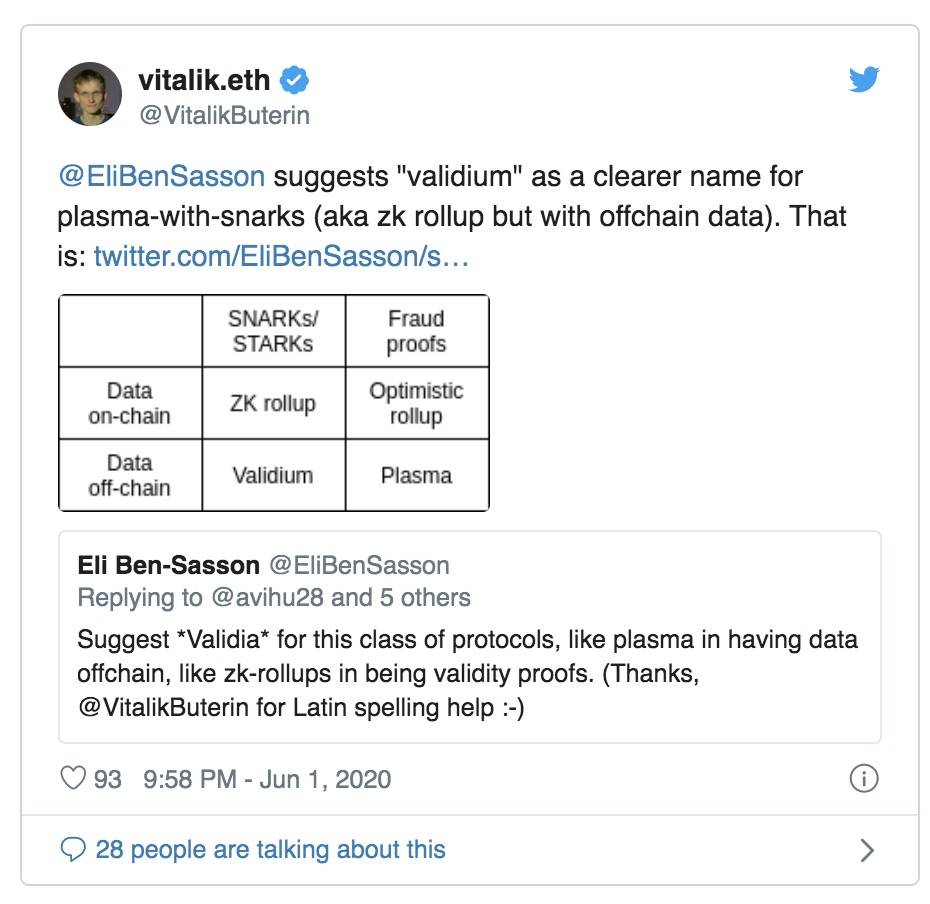
In the background, StarkEx is actually a Validium (a Layer-2 expansion solution), the validity of all its transactions is realized through zero-knowledge proof, and the availability of data remains outside the chain. This prevents theft of funds in Validium, as every transfer of value from a given user account must be authorized by that user.
“The people who can destroy a thing,Validium's mechanism is very similar to zkRollup, the only difference is that data availability in zkRollup is on-chain, while Validium keeps it off-chain. This allows Validium to achieve higher throughput, but it comes at a cost:
secondary title
Cost 1: Operators of StarkEx Validium can freeze users’ funds
—Frank Herbert, Dune
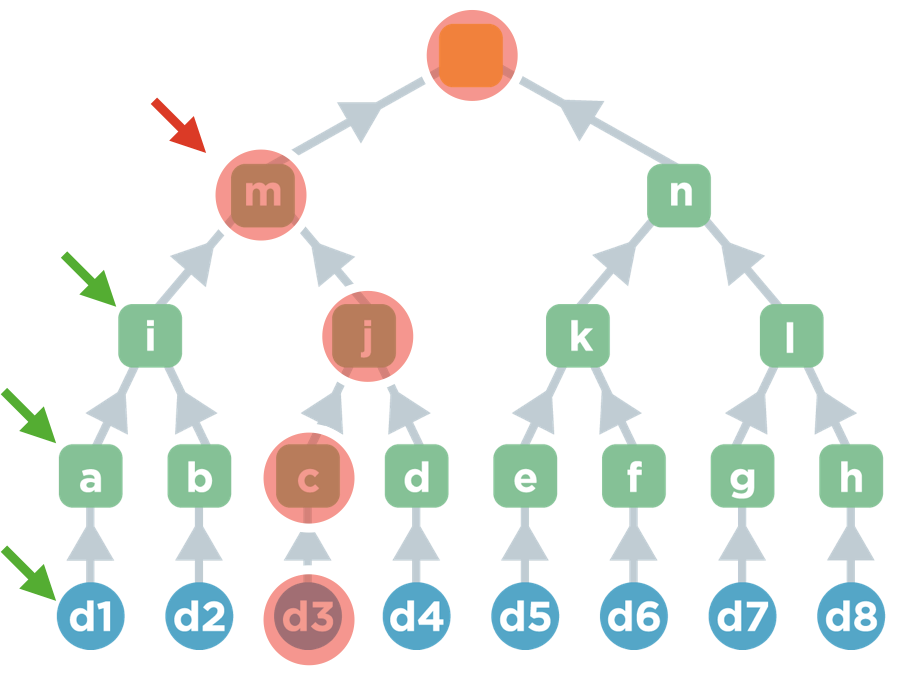
Without zkRollup's data availability guarantees, Validium's operator (or, more accurately, the data availability manager) is able to deny any user the right to transfer funds.
Here's how it works: Operators make small changes to the Merkleized state without disclosing the state change to the user. Lacking this information, users cannot create Merkle proofs of ownership for their accounts.image description。
Explanation: If the operator changes account d3, the owner of account d1 will lack the information needed for node m when proving ownership of his account.
Is there a way in Validium to prevent data withholding attacks? Since the concept of Plasma was proposed in 2016, this problem has been widely discussed, and zkRollup is the research result to solve this problem. In contrast, non-rollup attempts to ensure data availability in an unreliable manner, which will cause Validium
lose most of their competitive advantage
While this problem cannot be completely solved, StarkEx alleviates it by introducing a permissioned Data Availability Committee (DAC). A DAC must confirm that it has received data by signing every update to state by a quorum of its members. In StarkEx, the DAC is composed of 8 participants (adding too many members will jeopardize the liveness of the system), and these participants are also organizations with high reputations. They are less likely to abuse their power, but paradoxically, being well known, having a good reputation, and residing in a powerful jurisdiction is what makes them vulnerable. One possible scenario is that operators must enforce KYC/AML regulations and are obliged to freeze all funds in accounts with a transaction history of more than $10,000.
This is a nice security feature: if any missing constraints are found in StarkEx's STARK circuit logic, it can be quickly fixed without introducing any new vulnerabilities. However, this feature could theoretically also be used as a hidden censorship backdoor. In short, StarkEx operators can always deploy extensions to contract logic that introduce blacklists without prior warning to users. It's not entirely clear from their documentation, but it looks like the DAC's consent is not required to enforce the new rules.
This doesn’t make much sense if you think of StarkEx as a fully decentralized exchange protocol (for comparison, imagine Vitalik Buterin having a switch that instantly freezes any Ethereum account).
On the other hand, if you think of StarkEx as a security enhancement for a crypto exchange (which its creators certainly do), then it makes perfect sense.
secondary title
Cost 2: Operators of StarkEx Validium can confiscate users’ funds
Let's expand on the thought experiment. For whatever hypothetical reason (most likely due to circumstances beyond the operator's control), many users' assets have now been frozen. The next question is, can the user's funds on StarkEx be confiscated?
In fact, it can happen.
However, those whose funds have been frozen have no way to withdraw.
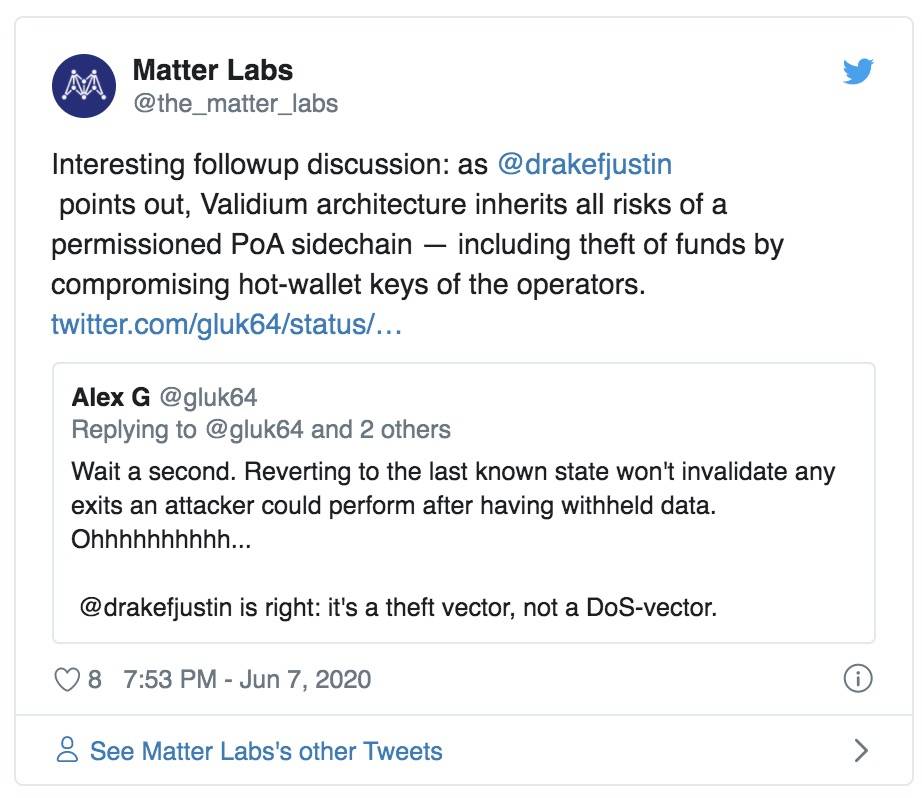
After the grace period is over, new contract logic can be deployed to transfer the frozen funds to the designated party's escrow wallet. Unfortunately, none of the affected users were able to take action against this.
There are also legitimate concerns that the upgrade notification period, by itself, may not be sufficient to allow every user who disagrees with the change to opt out (a so-called "mass opt-out" scenario). But this problem is a general contract upgradeability problem, not unique to Validium.
secondary title
zkRollup's data availability protects users' funds from seizure and censorship
With Merkle tree data, vetted users will always be able to claim funds directly from the zkRollup contract on mainnet. All they need to do is provide a Merkle proof of ownership of their account. Therefore, on-chain data availability guarantees that no one (including zkRollup operators) can freeze or obtain users' funds.
in conclusion
However, on-chain storage of data availability leads to throughput limitations - zkRollup has a strict practical cap of 2000 transactions per second (TPS) on the current Ethereum mainnet, while StarkEx Validium claims 9000+ TPS. This difference is likely to play an important role in determining the application domains and use cases of the two technologies. For example, zkRollup is very suitable for expanding decentralized encrypted payment (VISA's TPS is only about 2000), and suitable for immutable smart contracts with strict trust-free requirements. Validium, on the other hand, may be more suitable for traditional high-frequency trading or games with lower trust assumptions.
secondary title
in conclusion
We have shown that zkRollup and Validium (StarkEx) are somewhat similar in how they work, their main difference is whether the data is available on-chain or off-chain, which is crucial to understanding which applications they are suitable for. This difference means that zkRollup is a trustless decentralized scaling protocol, while Validium exhibits more properties of a managed PoA system (both in terms of throughput and risk characteristics), albeit with greatly improved security.





