Author | Qin Xiaofeng
Author | Qin Xiaofeng
Produced | Odaily

1. Overall overview
1. Overall overview
Second, the secondary market
Second, the secondary market
1. Spot market
image description
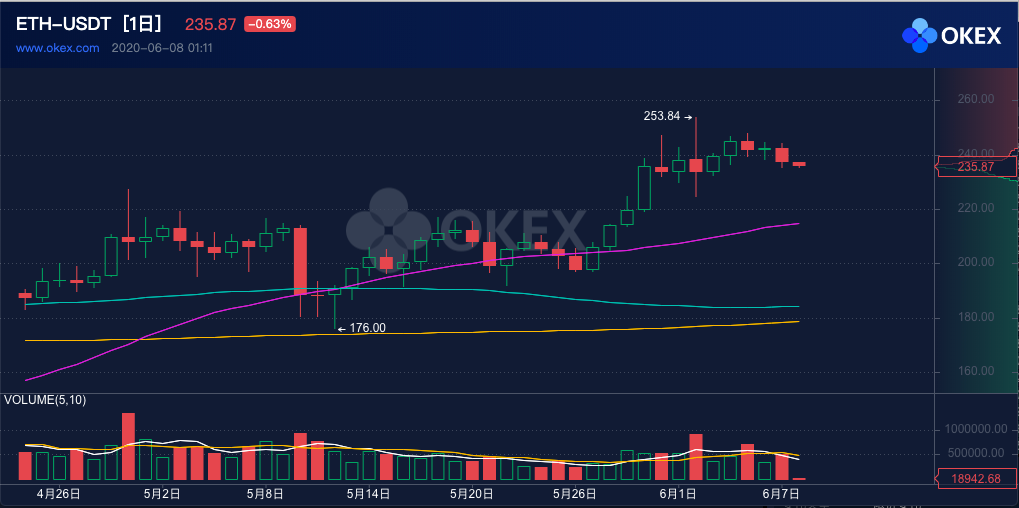
(ETH daily chart, picture from OKEx)
(ETH daily chart, picture from OKEx)
image description
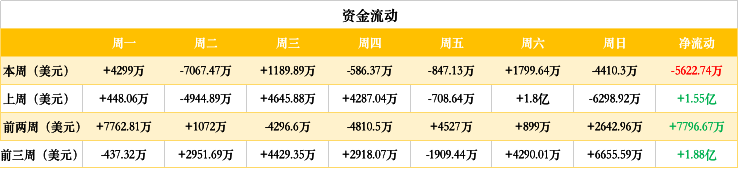
(data from BiNuNiu)
(data from BiNuNiu)
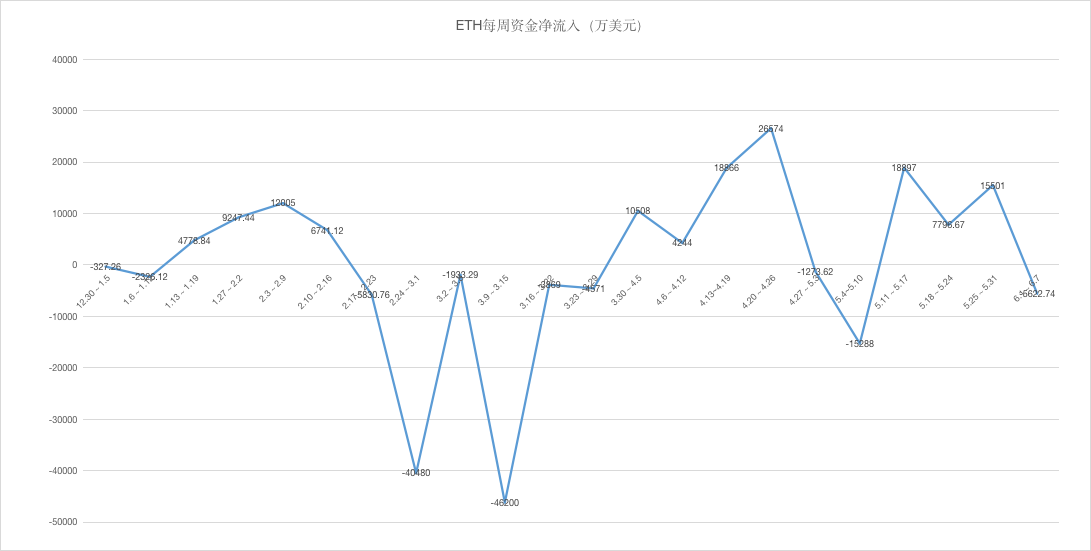
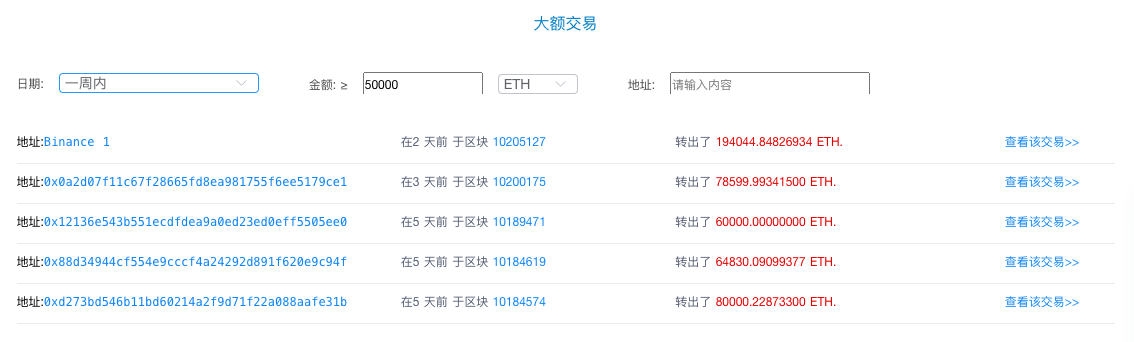
Last week, ETH’s net outflow of funds from the entire network exceeded 55 million U.S. dollars last week, a month-on-month decrease of 63%. In the short term, the phenomenon of capital flight is serious. In the coming week, the price may pull back slightly or remain volatile.
(data from Tokenview)
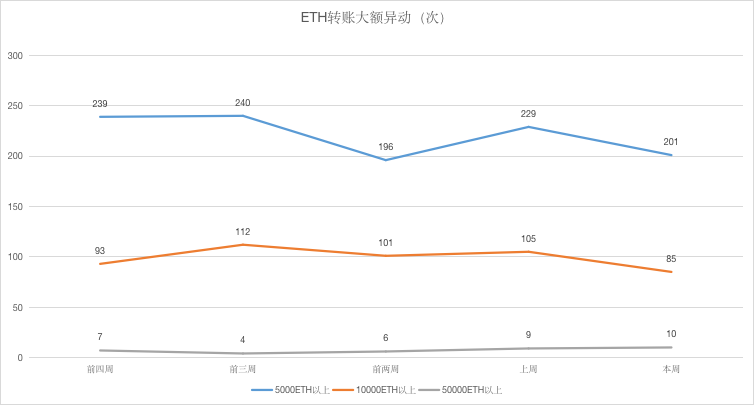
(data from Tokenview)
Tokenview dataTokenview data

3. Ecology and technology
3. Ecology and technology
1. Development and technology
1. Development and technology
(1) Phase 1 of ETH 2.0 is expected to start 64 shards
Danny Ryan, the head of the ETH 2.0 project, posted on the official Ethereum blog that Ethereum 2.0 phase 0 is to reach consensus, while phase 1 is to reach more consensus and appear in the form of many fragmented chains. Users can think of a shard chain as their own blockchain, roughly the same complexity as Ethereum today, but existing under the eth2 consensus (i.e. under, and built and controlled by, the Beacon Chain ). Beacon chain validators are given random short-term tasks to build and validate shard chains, make cryptoeconomic commitments to each chain's state, availability, and validity, and feed back to the core system. Today, developers expect 64 shards to start and total data available to the system to be in the range of 1-4 MB/s.
(2) Ethereum mixing platform Tornado.cash integrates Chainlink Ethereum Gas price oracle
The Ethereum mixing platform Tornado.cash has integrated the Ethereum Gas price oracle provided by Chainlink on the main network. If Tornado.cash cannot obtain off-chain Gas cost data, its front-end page will call Chainlink’s Gas price oracle to provide users with Gas fee predictions when submitting transactions provide data support. (medium)
(3) Ethereum application network project LUKSO redeploys "reversible ICO"
The Ethereum application network project LUKSO stated on its official blog that it will restart the "reversible ICO" with a lower starting price considering the price increase of Ethereum. LUKSO also stated that this "reversible ICO" also added new functions including changing whitelist addresses and changing frozen addresses. Users who have invested in Ethereum can return tokens to the ICO smart contract address. (medium)
MakerDAO is voting on whether to further diversify the loan collateral it accepts beyond cryptocurrencies and tokens to include real assets (RWA). Specifically, Maker will also allow supply chain invoices and future royalty streams from musicians to serve as collateral for loans in DAI, which will live on the Ethereum blockchain in the form of NFTs. Small businesses and artists can transfer borrowed DAI to crypto exchanges like Coinbase and convert it into cash. If approved, the move would pave the way for the first application of DeFi to solve real business problems outside of the crypto space. (CoinDesk)
2. Voice of the Community
2. Voice of the Community
(1) V God: It is unrealistic to increase the gas limit of Ethereum to 25 million
Ongoing congestion on the Ethereum network has led some developers and community members to call for gas limits to be raised. Some Ethereum builders (such as 1inch.exchange) are asking for at least a 2.5x increase in the gas limit from the current 10 million gas limit to the maximum.
In this regard, V God said: "I think 25 million gas is unrealistic. If you want to lobby for a higher gas limit, it is best to target 12-15 million gas. Although many client developers are even worried about risks at these levels."
(2) Vitalik: Ethereum’s Layer 2 expansion strategy has been basically successful
On June 1, Vitalik Buterin, the co-founder of Ethereum, tweeted that Ethereum's layer-2 expansion strategy has been "basically" successful, and the rest is perfection and deployment. The second-layer expansion strategy is not limited to the upgrade of Ethereum, but also includes the implementation of zero knowledge (ZK), state chain and Plasma expansion solution framework, etc. In terms of deployment, wallet providers and users will need to choose these two-layer solutions to execute their applications.
In addition, V God also added that the challenge is that users need to have a wallet so that they can use the Rollup or Plasma framework to store cryptocurrencies, which is an application challenge, not a technical one. Additionally, wallet providers and Rollup (or Plasma) frameworks must ensure L2 chain security in their initial design. Buterin believes that if the second layer chain is properly designed, it should be able to ensure a rapid rollback in the event of a problem. In addition to layer-2 solutions, Ethereum 2.0 will also add "sharding" functionality.
(3) StarkWare CEO: Ethereum’s second-layer scalability solution still needs some work
Uri Kolodny, co-founder and CEO of blockchain firm StarkWare, said that ethereum's second-layer scalability solution still needs some work.
When asked what held back ethereum’s second-layer scalability solutions, Kolodny said that “a lack of proper integration with wallets and other tools” was partly to blame. Additionally, developers lack confidence in second-layer solutions. Looking ahead, Kolodny said he believes “transactions will move to the second layer faster than we realize.” He explained that Ethereum’s current transaction fees are very high, which will force many companies to move to second-layer solutions, enabling them to perceive lower and more predictable transaction costs. (Cointelegraph)
On June 7, Jason Williams, the co-founder of Morgan Creek, an American investment management service provider, tweeted that he had recently bought a batch of Ethereum and was paying close attention to market trends for trading.
3.DEX
according toDAppTotal.com DEXaccording to
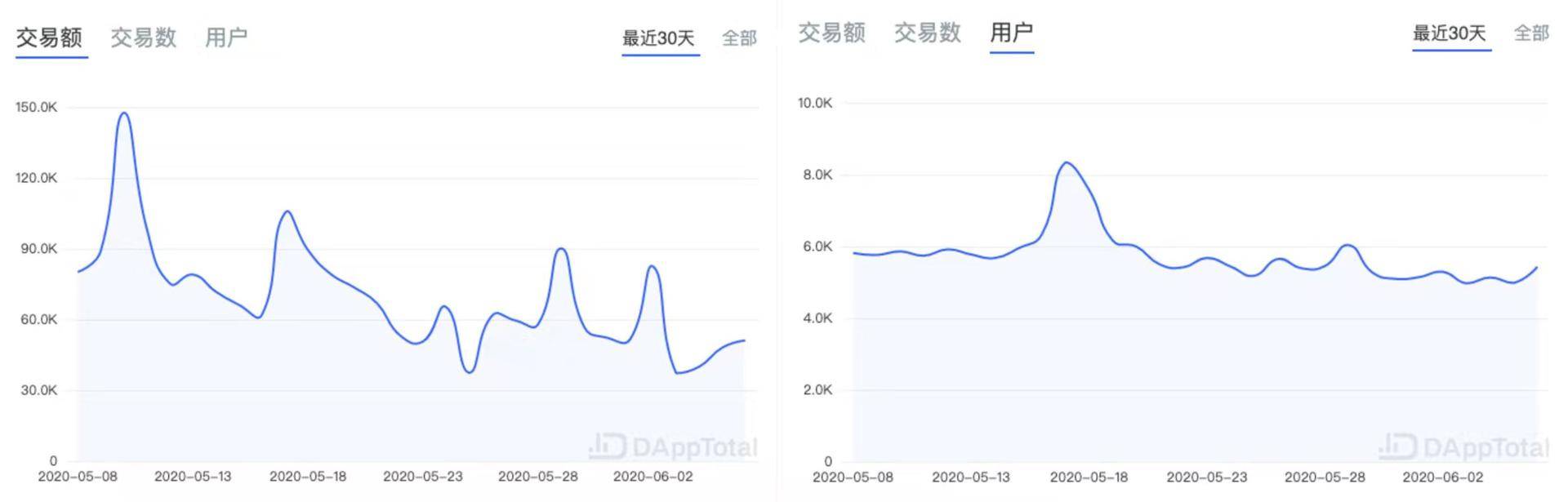
according to
4.Dapp
according toDappreview dataDappreview data
Collateral on Compound can be quickly traded through DeFlast, powered by Aave and Uniswap, and the Dapp is currently in the Beta (testing) stage.
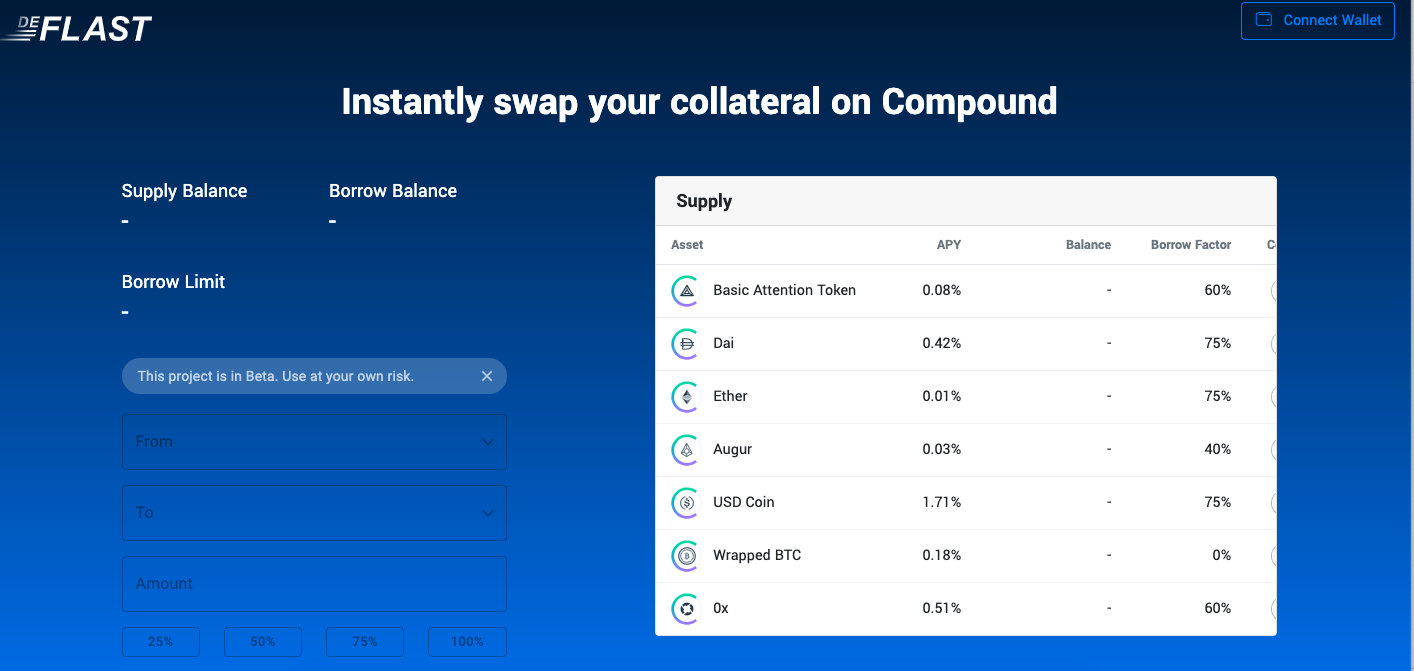
image description
image description
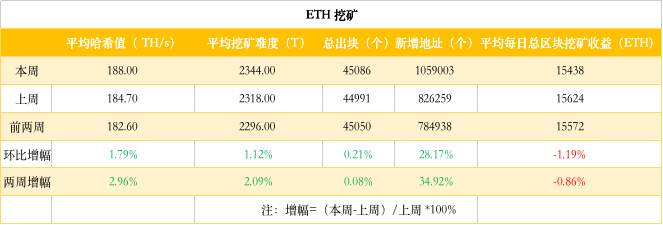
(data from etherchain.org)
etherchain.org(data from etherchain.org)
(Mining difficulty changes)
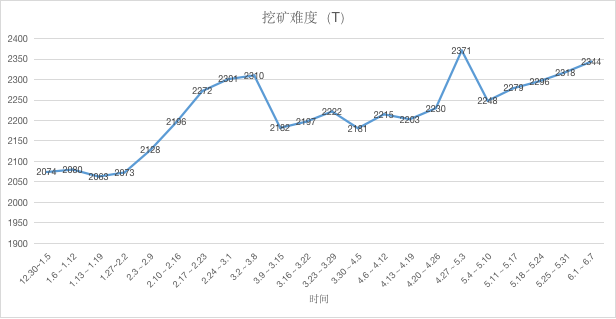
(Mining difficulty changes)
4. News
4. News
1. Grayscale has purchased $110 million worth of ETH this year
Ray Sharif-Askary, director of investor relations at Grayscale, revealed that the company has purchased $110 million worth of ETH so far in 2020. As a result, Grayscale’s purchases over the past five months have equaled 0.4% of Ethereum’s total market capitalization. Sharif-Askary noted that more than 38 percent of Grayscale’s current clients now hold more than one crypto asset, up from about 9 percent 12 months ago. During the same period, Grayscale purchased $390 million in Bitcoin, equivalent to 0.2% of Bitcoin’s total market capitalization. (cointelegraph)
2. Data: The number of Ethereum wallets with more than 32 ETHs has grown steadily this year
According to the latest data from Arcane Research, the number of Ethereum wallets holding more than 32 ETH has grown steadily in 2020, with nearly 120,000 addresses now eligible to become validators to take advantage of the staking feature. In fact, that number has soared 13% since the start of last year. However, the report highlights that there has been a lack of clarity regarding wallet owners. The report also added that there is not a 1:1 relationship between people and wallets, so it is difficult to determine how many people are really ready for staking. For greater transparency, we determined the current number of active validators on the testnet.
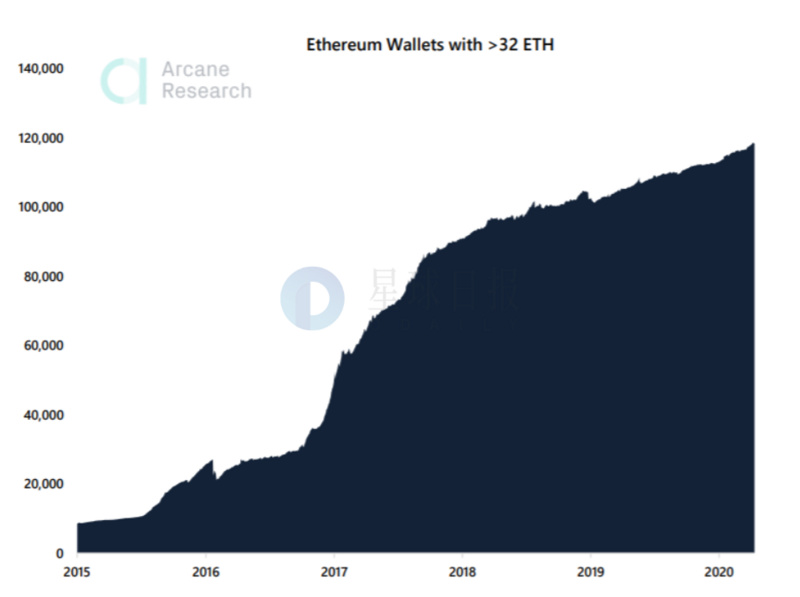
Data from etherscan.io shows that there are currently 39,653 active validators on the Beacon Chain, backed by a combined 1,267,947 eligible ETH. Earlier news, Glassnode data showed that since the beginning of the year, ETH computing power has increased by 26.8%, reaching the highest level in seven months. (AMBCrypto)
3. Data: Ethereum's implied volatility hits a 6-month low
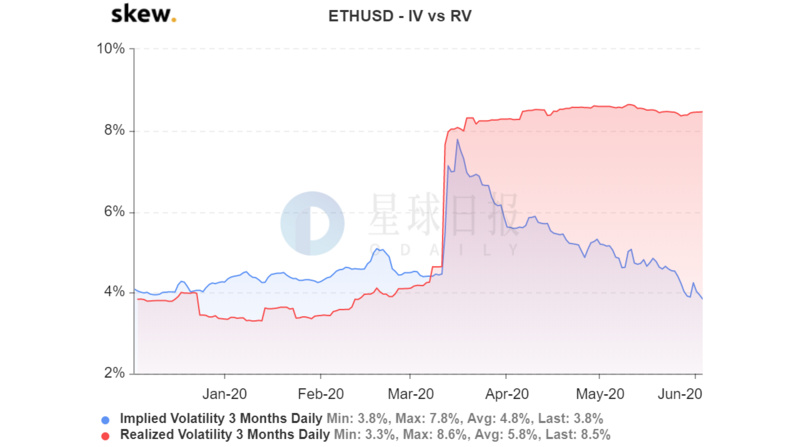
Skew data shows that the current implied volatility of Ethereum is displayed at 3.8%, a six-month low. The current Ethereum-Bitcoin 1-month implied volatility difference is on the rise, indicating that Bitcoin has not kept pace with the valuation of Ethereum in the market. Since the second week of May, Ethereum has seen significant improvements in on-chain fundamentals, aided by interest in ETH futures and options. Ethereum’s correlation with Bitcoin has also dropped to 0.8497 at press time, down from 0.89 in the previous month. (AMBCrypto)
4. Research: The total transaction volume of Ethereum DEX in the first six months of this year exceeded 300 million US dollars
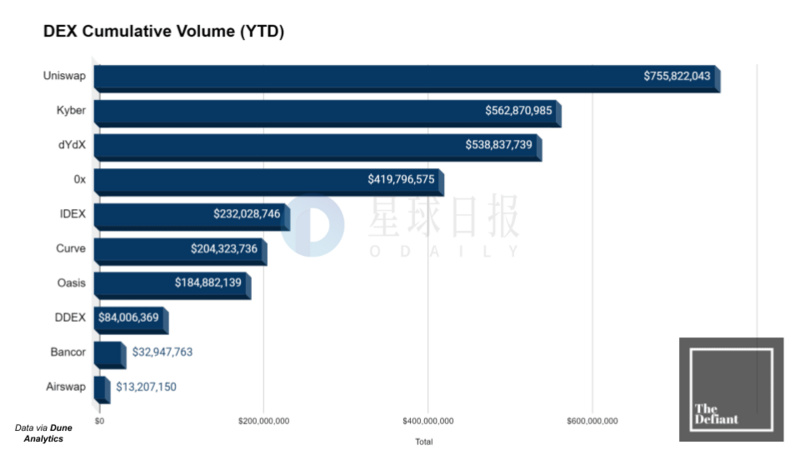
According to research by Lucas Campbell, founder of Mythos Capital, the Ethereum-based decentralized exchange DEX has a total transaction volume of more than 300 million US dollars in the first six months of 2020, compared with 2.4 million in the whole of 2019. One hundred million U.S. dollars. Since the beginning of this year, the trading volume of DEX has increased significantly. Uniswap is the dominant force in the DEX field. Since the beginning of this year, the trading volume of liquidity agreements has reached nearly 755 million US dollars, ranking first. Kyber and dYdX ranked second and third, with transaction volume of $562 million and $538 million, respectively. (The Defiant)
5. The open interest of Ethereum options on the Deribit platform reached 140 million US dollars
On June 4, the derivatives exchange Deribit tweeted that Skew data showed that the open interest (OI) of Ethereum options on its platform rose to 140 million US dollars, a new high. Additionally, the platform’s Bitcoin options open interest remains above $1 billion after the May expiration, with most of the OI being Q2 options. (U. Today)
6. Data: The number of bitcoins locked in DeFi exceeds 4,000, a record high





