


Popular Science: How to Safely Open the Era of Synthetic Assets


Editor's Note: This article comes fromEthereum enthusiasts (ID: ethfans)Editor's Note: This article comes from
Ethereum enthusiasts (ID: ethfans)
, Author: Allison Lu, Translator & Proofreader: Min Min & A Jian, reproduced by Odaily with authorization.
Although the term "synthetic assets" is so high-end, you may have used it long ago.
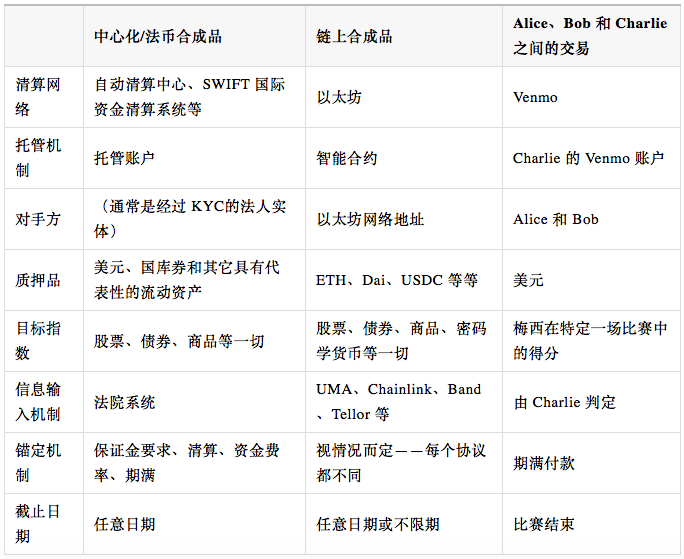
For example, you are Alice, and you and your good friend Bob made a bet on the result of a football game, which is actually a synthetic asset transaction. If your other best friend, Charlie, takes your bet and makes sure that the bet is paid out to the winner via Venmo after the game is out; then, Charlie acts as an escrow and settlement layer in the process. If you trust Charlie and give him the power to arbitrate disputes, Charlie acts as an information input mechanism.
Every synthetic product has the following core parts:
Synthetic products are popular precisely because of their flexibility. Synthetic products allow market participants to hedge risks that would otherwise be impossible to buy or sell, making them one of the most useful concepts in modern finance.
Before the emergence of derivatives, commodity producers could not hedge the risk of future price declines; commodity consumers could not hedge the risk of future price increases. At present, the fiat currency interest rate derivatives market, which allows borrowers and lenders to hedge interest rate risks, has exceeded $500 trillion. Products such as the 30-year fixed home mortgage rate in the United States are possible because of a liquid interest rate market—otherwise, what bank would be willing to offer a 30-year fixed loan rate when bank rates are dynamically changing ?
The importance of on-chain synthetic products
Open finance requires all participants to have fair access to the market. Tokenizing real-world assets through a centralized intermediary can centralize useful products on the same settlement layer. However, tokenization does not remove all barriers to entry, as users ultimately have to trust centralized intermediaries or custodians and abide by their rules. Synthetic products on the blockchain help to enhance the fairness and openness of the market, remove barriers to access to every financial market, and allow individuals, entities or DAOs (Decentralized Autonomous Organizations) to buy without going through a centralized intermediary Enter any type of financial product without encountering a single point of failure.
DeFi Synthetic Assets
Dai, managed by the MakerDAO system, is an example of a synthetic asset.
The synthetic nature of Dai is mainly reflected in two points:
The price of Dai is pegged to USD;
The price of Dai is backed by the collateral behind it, not inherent in the token itself.
Dai uses the USD/ETH price pair. However, you can also inject different target price pairs into Maker to create different synthetic assets.
Inject EUR/ETH - get synthetic EUR backed by ETH
Inject S&P Index/DAI - Get a synthetic S&P index backed by Dai
Through financial instruments, you can stake any token to generate synthetic tokens. You can even stake synthetic token A to generate synthetic token B. The creativity of financial engineers knows no bounds!
image description
-Synthetic assets can be designed into various applications that are useful to both holders and issuers. The above picture is just a rough outline of a frame-
However, not all synthetic assets are created equal. When building a synthetic product, you need to think carefully about its characteristics from the perspective of application scenarios. It's actually not that difficult. Just think about these two questions:
Which target price is this synthetic token to follow?
Under what circumstances does the peg mechanism for synthetic tokens work properly?
How to evaluate Dai and sUSD
For clarity, let's look at Dai and sUSD. Both have a target price of $1, but the mechanisms and liquidity guarantees they use to maintain the peg are very different.
sUSD is more suitable for short-term speculation. sUSD can be traded for the full dollar...but only on synthetix.exchange. As long as the price provided by the information input mechanism of synthetix.exchange is accurate, and the transaction pool has enough collateral endorsement, all synthetix.exchange transactions are completed at a fair price. Therefore, compared to other synthetic assets on Synthetix, sUSD is the most practical speculative tool, but there are few tools that can directly maintain stability outside the Synthetix platform.
Dai is more suitable for long-term holding. Dai is rarely traded at the full $1...but due to the volatility of Dai's price, the MakerDAO governance system can use some leverage to rebalance supply and demand. In the worst case scenario, the global liquidation mechanism redeems each Dai with a full $1 worth of collateral. As long as MKR holders are well governed, Dai will remain at the target price. Therefore, Dai is not suitable as a short-term transaction replacement for USD, but it has strong guarantees as a stable store of value (if you trust the work of MKR and the MakerDAO Foundation).
Different synthetic asset mechanisms all strive to maintain similar trade-offs.
Ask yourself from the user's point of view: What kind of protection do you need within a short period of time? You want to use this synthetic asset as short-term liquidity? Or a long-term store of value? This will help you decide which synthetic asset protocol is right for you.
Information input mechanism problem
No matter which asset protocol you use, you will need to use an information input mechanism at some point.
The information input mechanism is the biggest problem currently facing DeFi. The recent bZx flash loan attack, the SNX information input mechanism being blocked, and Maker’s Black Thursday all reflect the seriousness of this problem.
final thoughts





