


ETH Weekly Report | SlowMist discovered a new type of fake recharge attack on ETH; the Ponzi scheme is currently the largest consumer of Ethereum transaction fees (5.18-5.24)


Author | Qin Xiaofeng
Author | Qin Xiaofeng
Produced | Odaily
1. Overall overview
1. Overall overview
Second, the secondary market
Second, the secondary market
1. Spot market
image description
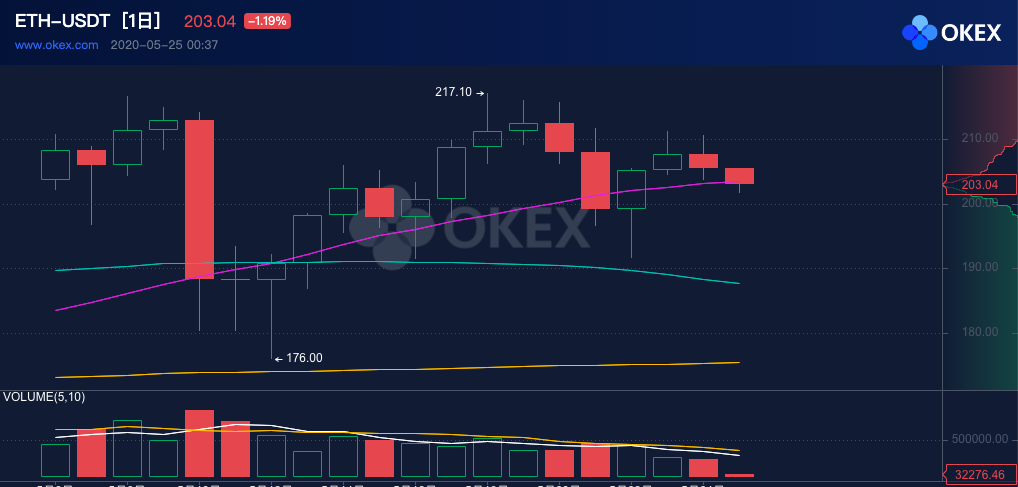
(ETH daily chart, picture from OKEx)
image description
2. Fund flow
(data from BiNuNiu)
(data from BiNuNiu)
In terms of capital, capital fluctuated greatly last week, with the largest net inflow on Monday, exceeding US$77 million; and the largest net outflow on Wednesday and Thursday, both exceeding US$40 million.
(data from Tokenview)
(data from Tokenview)
Tokenview dataTokenview data
3. Ecology and technology
3. Ecology and technology
1. Development and technology
(1) Ethereum 2.0 technical specification release version 0.12.0 important update
(2) Each validator in ETH2.0 consists of two sets of keys
(3) The Schlesi fork is caused by the mismatch of rewards/punishments between clients
On May 18, Afri Schoedon, a core developer of Ethereum, posted that the Schlesi testnet designed for the public beta of Ethereum 2.0 suddenly forked. This happened on May 17, 2020, slot 141184. This means that a testnet experienced an unexpected split and independently validated different slots. So far, it is the first public fork since the recent launch of the Ethereum 2.0 multi-client testnet.
(4) Topaz, the Ethereum 2.0 test network, has pledged more than 1 million ETH
Ethereum expansion program Matic Network has recently announced the launch of the mainnet. Matic marketing director Chandresh Aharwar revealed that the first round of verification nodes will support staking. Matic is a Plasma-based high-throughput scaling solution for Ethereum, using an improved version of Plasma, PoS-based sidechains. (BeInCrypto)
2. Voice of the Community
(1) V God: skeptical about the "trust model" of some ERC20 tokens anchored on the Ethereum chain
(2) Opinion: The delay of Ethereum 2.0 is caused by many factors, including technical and social scalability requirements
According to Ankitt Gaur, founder and CEO of trading platform Koinfox, who is deploying its proxy protocol on PoS blockchains, the network handling the PoS consensus algorithm is more complex than PoW blockchains in terms of management processes. “Ethereum’s latency is the result of many things. It starts with multiple clients, and those clients have to communicate with each other. The staking process gets more complicated when all validators need to communicate with each other,” he said. "
The Daily Hodl previously posted that the release of Ethereum 2.0 may be delayed again. The constant hunt for code bugs was the main reason for delaying the original January 2020 launch of Plan 0. The "multi-client model" caused delays because human resources were insufficient to ensure optimal development. (Cointelegraph)
3.DEX
according toDAppTotal.com DEXaccording to
according to
4.Dapp
according toDappreview dataDappreview data
, Dapps on the ETH chain added 11 Dapps last week, and the cumulative number of developments reached 4,289; "dForce—Trading", the new Dapp with the largest seven-day transaction volume, exceeded 4,500 ETH (about 900,000 US dollars) in seven days.
image description
(data from etherchain.org)
etherchain.org(Mining difficulty changes)
(Mining difficulty changes)
4. News
4. News
1. Slow Mist: Found a new attack method of ETH new fake recharge
On May 22, the SlowMist security team first launched the new ETH fake recharge attack revert method. The SlowMist security team continued to conduct in-depth research and discovered an attack method using Out of gas.
The SlowMist security team suggests: If you are not sure about the successful repair, you can temporarily suspend the recharge request from the contract address first, and then perform the following repair operations:
When using the contract to recharge ETH, it is necessary to determine whether there is a revert transaction in the inline transaction, and if there is a revert transaction, the account will be rejected;
When using the contract for ETH recharge, it is necessary to judge whether there is an Out of gas transaction in the inline transaction, and if there is an Out of gas transaction, the account will be rejected;
When using the contract to recharge ETH, it is necessary to determine whether there is a transaction in the Error field in the inline transaction. If there is a transaction in the Error field, the account will be rejected;
Manual entry is used to process contract entry, and manual entry is performed after confirming that the recharge address has arrived.
2. The total amount of encrypted assets managed by Grayscale reached a new high, reaching 3.8 billion US dollars
3. Analysis: Ponzi schemes and pyramid schemes are currently the largest consumers of Ethereum transaction fees
On May 23, The Block published an analysis article saying that Ponzi schemes and pyramid schemes are now one of the biggest consumers of Ethereum transaction fees. This is due to rising gas prices that have put pressure on legitimate projects, but have barely affected profitable platforms including fraud.
Vitalik Buterin said that while measures like EIP 1559 are aimed at easing the gas price problem in the short term, the real solution lies in improving the scalability of Ethereum.
4. Yiedl plans to launch an NFT-based non-custodial mortgage rental market
5. Arianee demonstrates the transfer of Tesla Model 3 ownership through NFT
6. Dapper Labs announced that CryptoKitties will be launched on the Flow blockchain





