


ETH Weekly | Ethereum 2.0 completes preliminary audit; V God takes stock of Ethereum's progress since 2017 (3.23-3.29)


Author | Qin Xiaofeng
Author | Qin Xiaofeng
Produced | Odaily
1. Overall overview
1. Overall overview
Second, the secondary market
Second, the secondary market
1. Spot market
image description
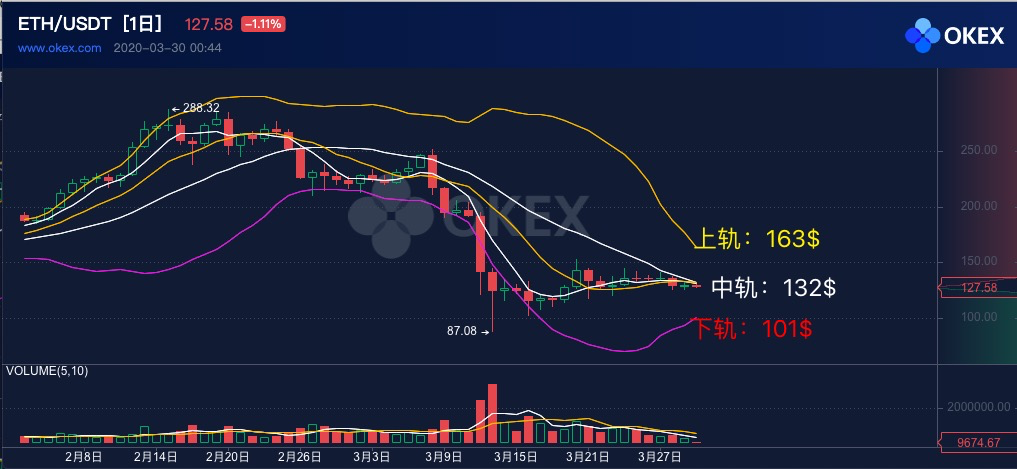
(ETH daily chart, picture from OKEx)
image description
2. Fund flow
(data from BiNuNiu)
(data from BiNuNiu)
In terms of capital, capital fluctuated greatly last week, with net outflows exceeding US$30 million on Friday and Saturday, and net inflows exceeding US$44 million on Tuesday.
(data from Tokenview)
(data from Tokenview)
Tokenview dataIt shows that the number of transfers on the chain dropped sharply last week. The number of transfers of "above 5,000 ETH" and "above 10,000 ETH" decreased by 44% and 38% month-on-month, respectively, but the number of "above 50,000 ETH" transfers increased by 15.38% month-on-month.
image description
3. Ecology and technology
3. Ecology and technology
1. Development and technology
(1)1. Development and technology
V God takes stock of the progress Ethereum has made since 2017http://Tornado.cash; Status; MakerDAO; ZK Rollup (such as Loopring), with a throughput of more than 2000 TPS; PoS test network; uncle block rate < 10%, block gas limit of 10 million; Gitcoin grants.(click to read)
(2) The preliminary audit of Ethereum 2.0 is completed: the protocol specification is generally good, and only fine-tuning is required
ETH 2.0 is scheduled to launch in July 2020. The original date was set for January 2020, but the developers pushed it back due to implementation delays. The testnet has been running since December 2019, and the node client has made progress since then. With the first audit complete, the Ethereum 2.0 team will be able to focus on improving the protocol and eliminating the flaws identified by Least Authority.
V GodV God
Fuel Labs announced the launch of Yul+, a new underlying language for Ethereum. As an experimental upgrade to Yul (a low-level intermediate language for the Ethereum Virtual Machine), various QoL functions will be added to Yul. Yul is a low-level intermediate language written by Solidity developers to further optimize the compilation target. It is simple and has a practical low-level syntax, allowing developers to be closer to the original EVM than Solidity, and has the potential to optimize gas fee usage efficiency.
2.DEX
according toDAppTotal.com DEXaccording to
according to
3.Dapp
according toDappreview dataDappreview data
image description
(data from etherchain.org)
etherchain.orgThe data shows that the average computing power rose slightly by 1.32% month-on-month, temporarily reporting 177.1 TH/s; mining difficulty rose slightly by 1.14% month-on-month, temporarily reporting 2222 T; the activity of miners decreased, and the number of new addresses decreased by 26% month-on-month.
(Mining difficulty changes)
4. News
1. Data: DeFi transactions continue to "cannibalize" the proportion of other types of transactions in the block capacity of Ethereum
Data released by Ganesh Swami, co-founder of ETH analysis company Covalent, shows that DeFi transactions account for an increasing proportion of Ethereum block capacity, while the share of ETH transfers is declining. Swami analyzed the gas costs incurred by Ethereum transactions over time to estimate the share of network activity represented by ETH transfers, simple ERC-20 transactions, and complex interactions with smart contracts typically associated with DeFi protocols. At the same time, the gas fee generated by each transaction category is constantly increasing.
Swami pointed out that “the total gas consumed by all types of transactions seems to be a natural upper limit”, which shows the “strong demand for ethereum’s block capacity” and its network’s “lack of scalability”, adding: “In In an ideal scalable blockchain network, all types of transactions have room to grow. But in Ethereum today, for one type of transaction to grow, it has to cannibalize the others.”
2. Analysis: The number of daily active addresses of Ethereum is close to 400,000, which is positive for the medium and long-term prospects
Crypto analytics firm Santiment tweeted: “Ethereum’s daily active addresses have been increasing steadily. This important metric reflects the level of daily user interaction (or speculation) with a particular token. As we see Yes, in the past week and a half, the transaction volume of the ETH network has increased greatly, and the same is true for the daily active addresses.”
On March 21, daily active addresses on the Ethereum network surged to 395,000. This hasn’t happened since June 2019, when ETH’s price hit a yearly high of around $336. In this regard, Santiment stated that approaching 400,000 is a promising development for Ethereum’s mid- to long-term prospects. (AMBCrypto)
3. EthFans Jian: Ethereum 2.0 is not prone to rampant whales and manipulation by big players
EthFans (Ethereum enthusiasts) chief creator A Jian responded to "PoS consensus makes more coins, more power, how to avoid similar problems in the process of Ethereum 2.0", said that Ethereum 2.0 has no on-chain governance solution, and ETH is decentralized , the PoS scheme does not support entrustment, and sets the concept of "effective balance", which makes it difficult for Ethereum 2.0 to have rampant whales and manipulation by large players. A Jian said that there are two main reasons why giant whales are rampant and big players manipulate PoS projects:
Token distribution is relatively concentrated;
The on-chain governance scheme is used, that is, tokens also have voting rights for decisions other than consensus (such as protocol upgrades). Ethereum 2.0 does not have an on-chain governance solution, and after several years of operation, the distribution of ETH is relatively scattered. So similar phenomena should not be so easy to happen.





