


Ethereum is the king of the public chain, no refutation is accepted


Text | Qin Xiaofeng Editor | Mandy Wang Mengdie
Produced | Odaily (ID: o-daily)
Joel Monegro, a partner at USV, once commented that the Ethereum community is chaotic but vibrant—chaotic and full of vitality, which is indeed the case.
The confusion lies in: on the one hand, after the demand for ICO fundraising plummeted, the price of ETH has been falling all the way, and the income is far lower than that of other mainstream currencies; on the other hand, the delay of ETH2. , It is unknown when it will land, and the future of miners is uncertain; in addition, frequent incidents such as community disputes and governance difficulties have also made the outside world question the stability of the Ethereum ecosystem.
The vitality lies in: In 2019, the story of decentralized finance (DeFi) brought new ecological prosperity to Ethereum, and the application of DeFi on the Ethereum blockchain continued to grow. On February 15, 2020, the DeFi market locked up The value reached a record high of 1.221 billion US dollars. More and more people believe that there is no DeFi outside of Ethereum.
At the same time, a group of outstanding developers are still active and only willing to be active in the Ethereum ecosystem. In the past few years, the Ethereum ecosystem has continued to expand and the development environment has continued to improve. According to Ethereum1MillionDeveloper data, there are currently 200,000 active developers on the Ethereum blockchain. Ethereum has been imitated and never surpassed.
At the same time, after in-depth research on Ethereum, Odaliy believes that Ethereum may usher in a new bright moment in the second half of 2020.
From the perspective of currency price, Ethereum has reversed its decline this year and has a strong trend. Although it has been pulled back recently, its cumulative income this year still exceeds most mainstream currencies. The CFTC (U.S. Commodity Futures Trading Commission) has also repeatedly called out to the media recently that Ethereum futures will be officially approved this year.
From an ecological perspective, the phase 0 Beacon chain (Beacon) of ETH2.0 in summer will be launched soon, marking the official entry of Ethereum into a new era of POS; and the DeFi ecology will further prosper under ETH2.0, which will promote the development of the Ethereum ecosystem. Active, and will lock more Ethereum on the chain, further reducing market circulation.
When all the public chains are still like headless chickens and can't find their way, the road to the return of the king of Ethereum is obviously clearer.
secondary title
ETH2.0 is no longer just talk on paper
As we all know, the most criticized ETH1.0 is the insufficient processing speed, that is, the TPS (Transaction Per Secound, transaction throughput) is not high, currently only 8.4, and has been around this value. In contrast, the TPS of the POS public chain is usually several times or even ten times this number.
The goal of ETH2.0 is to improve the scalability (improve TPS), security (POW to POS) and programmability of Ethereum. Ethereum founder Vitalik Buterin (V God) has repeatedly said: "The transaction volume that ETH2.0 can handle is 1,000 times higher than the existing version, which will make Ethereum a real world computer."
1. The long overdue phase 0
(ETH2.0 roadmap, no fixed timetable)
(ETH2.0 roadmap, no fixed timetable)
Phase 0 will introduce the Beacon Chain (Beacon Chain) as the "command and control" center of the entire Ethereum 2.0 network; Phase 1 will introduce shard chains, allowing data to be stored on these shard chains but not in the shard chain Transactions are processed on the shard chain; Phase 2 introduces the shard virtual machine, allowing transactions to be processed on the shard chain.
It is worth noting that although Phase 0 does not support accounts, asset transfers, and running smart contracts, it can still be regarded as a new journey for Ethereum to enter POS. Because the beacon chain will run the POS protocol Casper, and users can deposit 32 BETH (Beacon ETH) on the chain to become a validator, and they can also get BETH benefits after staking.
image description
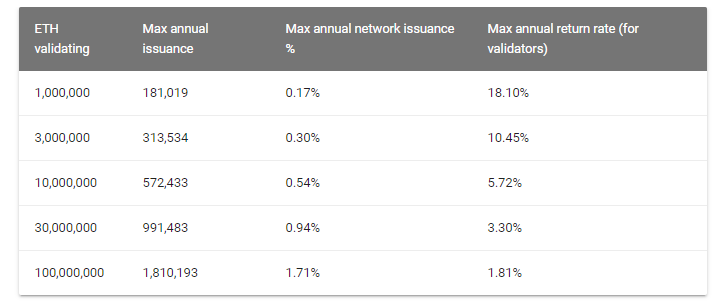
(The picture above is the Ethereum mortgage incentive policy disclosed by "V God")
According to the original plan of Ethereum developers, phase 0 will be launched on January 13, 2020. But in October 2019, the developers decided to reduce the number of shards (phase 1) from 1024 to 64, so the release plan was delayed.
On March 6 this year, V God said in an interview with the Block TV podcast that Phase 0 of ETH2.0 will start this summer, and POS (Proof of Stake) will finally become a reality. Preston, CEO of Prysmatic Lab, the ETH2.0 client implementation team, also said that the phase 0 mainnet will launch the mainnet at the end of the second quarter.
After two years of silence, ETH2.0 will finally come out this year. However, in view of the fact that the Ethereum community has skipped tickets many times before, some people also have doubts about this landing time.
"There is a high probability that there will be no (bounced tickets), but this kind of thing is also difficult to guarantee." A Jian, an Ethereum researcher and editor-in-chief of EthFans, is still full of confidence, "The technical specifications of phase 0 should be clear enough, and the next step is to It depends on the robustness of the client implementation, which requires patience.”
The successful launch of Phase 0 is inseparable from the efforts of many outstanding developers in the ecosystem.
"At present, there should be two main ETH2.0 research teams, one is the team under the foundation, which is directly under the researcher's team; the other is the quilt team, which was originally responsible for ewasm research, and is now also working on phase 2 research." A Jian told Odaily, "There are also 8 client implementation teams. The client implementation team is only responsible for implementing the client (software) and does not directly participate in research."
According to Ethereum researcher Grant Hummer, the above eight teams are all funded by the Ethereum Foundation, and each client has its own targeted use case. Some clients are optimized for smartphones, and some clients is purpose-built for the enterprise.
According to Ethereum researcher Grant Hummer, the above eight teams are all funded by the Ethereum Foundation, and each client has its own targeted use case. Some clients are optimized for smartphones, and some clients is purpose-built for the enterprise.
Client diversity is a core tenet of Ethereum - if one or two clients are compromised or have bugs, the entire network won't crash.
2. Coexistence of ETH1.0 and ETH2.0
What makes melon eaters unclear is that the launch of ETH2.0 phase 0 means that the current POW ETH1.0 will be directly replaced?
"The beacon chain cannot represent the entire ETH2.0. After that, POW's Ethereum will coexist with the beacon chain for a long time. After ETH 2.0 is fully launched, the state on the POW chain will also migrate to 2.0, which should change Become one of the fragments." A Jian explained.
"ETH2.0 and ETH1.0 will run side by side for a period of time, because the early ETH2.0 does not support transfers, how long it will take to completely switch is estimated to take two years." Yang Mindao, founder of dForce and Blockpower, told Odaily.
In fact, there is currently no specific plan on how to switch connections between ETH2.0 and ETH1.0. At present, only the specifications of phase 0 have been fixed, and phase 1, phase 2 and other subsequent phases have not yet been fully formed and fixed.
"The sharding system is extremely complex. Everyone has been studying this aspect for a long time, and it is constantly deepening. There have been a lot of research progress at the end of last year, but there has not been a particularly clear solution. Use sharding to To achieve scalability, the core challenge lies in the sharding of the state. After the global state is cut, many of the blockchain paradigms we are familiar with can no longer continue.” A Jian explained.
According to the developer's current plan, Phase 1 will be delivered in 2021, and Phase 2 will be delivered in late 2021 or early 2022.
However, V God said at the ETHLondonUK conference recently that the launch time of phase 1 is expected to be advanced, and sharding technology will be deployed as early as this year.
Based on the above actual situation, ETH2.0 phase 0 will be launched this year with a high probability, which is enough to answer the previous doubts.
secondary title
ETH's price counterattack in 2020
If I ask you: Since the beginning of 2020, which of the top ten mainstream currencies by market capitalization have the highest returns? Many people think of it as a halving currency without thinking.
image description
The figure above already shows that ETH’s earnings this year have outperformed most of the mainstream currencies.
In addition, observing the price curve of ETH/BTC, it can be found that ETH has been in a long-term downward trend in the past year, but since September 2019, the price of ETH/BTC has stabilized and rebounded recently.
Although the recent market is not good, and Ethereum has also experienced short-term compensation, but from a technical point of view, the price of Ethereum is likely to usher in a large-scale rise again this year.
1. Good supply and demand relationship: Miners are willing to participate in POS pledge, and the amount of DeFi lockup will increase
The two most critical factors affecting prices are always: buying and selling.
From the buyer's point of view, the demand for Ether purchases is increasing this year, especially large investors have begun to hoard coins. Crypto information website Santiment research shows that since the beginning of this year, the top 100 addresses on the Ethereum rich list have started hoarding coins again. “While it’s unclear how well these addresses correlate with future prices, the data is generally bullish for Ethereum.”
In addition to giant whales hoarding coins, some miners are also hoarding coins for the upcoming launch of ETH2.0. As mentioned above, stage 0 has entered the POS stage, and can make profits through staking.
"I asked some old miners who used graphics cards to mine ETH, and what was surprising was that they hoarded a lot of ETH and waited for POS to pledge for mining." Qiu Xiaodong, head of the Chinese market of Spark Mining Pool, told Odaily.
"It may be that ETH has been the king of the currency with the highest profit in graphics card mining for a long time, so many miners frequently use the Ethereum network to participate in in-depth experience, and at the same time they have feelings for it; maybe many old miners who invest in graphics card mining , Earn enough money on ETH mining. All in all, there will indeed be many miners who are willing to participate in POS pledge and continue to maintain the security of Ethereum’s value network.”
In fact, miners are natural "shorts". When they hoard coins, they also reduce the selling pressure in the market and reduce the upward pressure on the price of Ethereum.
With the further improvement of ETH2.0, the amount of ETH locked in the POS protocol will further increase. V God had optimistically estimated that the introduction of POS would lock more than 10 million ETH into the protocol.
In addition, the vigorous development of the DeFi market has also enabled more Ethereum to be locked, further reducing selling pressure.
In 2018, the DeFi market was still in the wild, with a limited number of products. At that time, there were only a few lending products such as MakerDAO, and the transaction volume was limited. After two years of development, dForce, dydx and other emerging lending products continue to emerge, and MakerDAO's market share has also dropped to about 55%.
The lock-up effect of the DeFi protocol on Ethereum is becoming more and more obvious, similar to staking at the application level, locking more Ethereum assets.
According to DefiPulse data, from October 2017 to the present, the number of locked ETH has shown an upward trend; especially from October 2018 to April 2019, the increase was the most obvious, exceeding 150%. On February 15, 2020, the locked value of the DeFi market reached a record high of US$1.221 billion.
Although the lock-up volume has declined due to currency price fluctuations recently, it is also showing a gradual recovery trend.
In addition, data from the centralized lending (CeFi) RenrenBit shows that since July last year, the number of locked ETH has also shown a continuous growth trend, with a maximum increase of more than 120%.
However, Ethereum fell to around $170 today, sparking concerns that a large-scale liquidation of MakerDAO may occur, further depressing the price of Ethereum.
In response, MakerDAO official Weibo responded that the current mortgage rate of the entire Maker system is around 300%, and it can theoretically withstand an 80% drop, so there is no need to worry too much.
The third factor of selling pressure is the old-fashioned giant whale, and the most unstable one is the selling pressure from ICO project parties.
According to The Block research, from July 2018 to June 2019, the amount of ETH held by project parties raising funds through ICO has been steadily declining. The data shows that among 57 token financing projects, each project liquidates or transfers an average of 2,500 ETH (approximately $530,000) per month. These projects raised a total of 8.2 million ETH, of which 5.9 million ETH (72%) have been transferred or liquidated since the token financing.
A large number of selling pressure not only made it difficult for the price of ETH to recover, but also suppressed the price to the bottom. But now, the project party is close to the end of the sell-off, and the upward resistance of Ethereum has been further reduced.
"The ICO of the project party's fundraising is basically the same as what should be issued or exchanged for legal currency. Most of the new projects use stable coins, so the new selling pressure from the project party will become smaller and smaller." Yang Mindao told Odaily.
In summary, the price increase factors of ETH are still very sufficient.
2. Recognition by the mainstream market: The chairman of CFTC has repeatedly stated that he is optimistic about Ethereum futures
In February of this year, Heath Tarbert, chairman of the US CFTC (Commodity Futures Trading Commission), said in an interview with Bloomberg that Ethereum (ETH) futures are brewing. “We’ve seen cash-settled and physically delivered bitcoin futures. My guess is we’ll see ethereum futures as well.”
In February of this year, Heath Tarbert, chairman of the US CFTC (Commodity Futures Trading Commission), said in an interview with Bloomberg that Ethereum (ETH) futures are brewing. “We’ve seen cash-settled and physically delivered bitcoin futures. My guess is we’ll see ethereum futures as well.”
Just a few days after Heath Tarbert's speech, Ethereum started to get stronger. In the next two weeks, the price of Ethereum once rose from $180 to $288, an increase of 60%.
In fact, this is not the first time Tarbert has been publicly bullish on Ethereum futures. As early as October last year, Tarbert said that Ethereum is a commodity, Ethereum futures may start trading in 2020, and the CFTC is willing to give the green light for new products. "I think you're likely to see an ethereum futures contract in the next six months to a year."
Even so, there are quite a few people who are skeptical about the arrival of Ethereum futures. According to a survey by The Block, 32% of respondents believe that the CTFC will not pass Ethereum futures.
Encryption analyst Noelle Acheson also expressed his doubts. She believes that there is a big difference between ETH and BTC: the total amount of BTC is fixed and has a certain degree of scarcity, which can more impress traditional investors. ETH is still issuing more and more, which does not have this feature; Fixed, less affected by the development team, and ETH has a development team and is about to switch to POS. These uncertainties also increase the investment risk of traditional investors.
Although there are voices of doubt, Odaily believes after research that it is very likely to pass this year.
First of all, the CFTC directly characterized Ethereum as a commodity, taking the jurisdiction and supervision of Ethereum from the US SEC (Securities and Exchange Commission). The latter characterizes all cryptocurrencies such as Bitcoin as securities, so it has not been traded through derivatives such as Bitcoin ETF.
Furthermore, CFTC has always held an inclusive and developmental attitude towards the encryption market. In June 2017, the CFTC approved LedgerX to obtain a digital currency trading license; on December 1, 2017, the CFTC was the first to officially approve the CME Group, CBOE and Cantor exchanges. Bitcoin futures listing request.
image description
(CME official website)
Another question is, what impact will the CFTC have on Ethereum and the entire encryption market through Ethereum futures?
For investors, Ethereum futures is undoubtedly a major benefit, but it also hides a crisis.
"If there are Ethereum futures, it will definitely increase the attractiveness of Ethereum to mainstream funds, and the price is difficult to judge." Yang Mindao said that he should not be blindly optimistic about the future price of Ethereum.
By comparing the trend of Bitcoin futures, we may get some inspiration. On November 1, 2017, CME announced the launch of Bitcoin options, when the price of Bitcoin was only $6,200; in the next two months, the price rose by leaps and bounds, and reached a historical high on December 17, the day before the launch of CME Bitcoin futures2 million US dollars, an increase of more than 200%, and then the price fluctuated and fell.
In other words, the price of Ethereum may usher in a 200% increase from the date of the announcement (hoping to reach $500), and may even break through the all-time high ($1400). However, after the futures launch, the price may experience a period of avalanche decline.
"Bitcoin futures gave traditional hot money the opportunity to short Bitcoin, especially when Bitcoin broke through a record high, and the willingness to short was stronger." Encryption analyst Li Ao told Odaily, "My suggestion is that before the official launch of Ethereum futures You can take profit appropriately.”
secondary title
Challenges that cannot be ignored despite optimism: the future of miners + community split + efficiency issues
Although there are many favorable factors in the ecology and currency price, there have been many problems in the Ethereum ecology that cannot be ignored for a long time.
In summary, there are mainly three challenges: the future of POW miners, the division and disputes in the community, and the low development efficiency that is often criticized.
1. Where does mining go from here?
Phase 0 of ETH2.0 is launched, and Ethereum turns to POS. POW mining will exist in parallel for a period of time, but eventually POW mining will die out.
"The miners' sentiment is definitely worried first, and they are particularly concerned about the specific time when Ethereum will turn to 2.0. However, since no one has a standard answer at present, the worry can only continue." Qiu Xiaodong told Odaily: "But it has not risen to panic, Because Ethereum has a roadmap for switching to POS at the beginning of its birth, but the launch of 2.0 has been delayed compared to the plan, which has caused miners to "dig for a long time." This day will come sooner or later, do the things right now, dig hard and earn money, this is the mood of many miners. "
Qiu Xiaodong added that, as a graphics card miner, he also hopes that Ethereum can slowly switch to POS, but technological innovation is ruthless.
Faced with this life-and-death situation, miners have only three options: one is to stop mining completely; the other is to switch to POS, and Staking mining continues to earn profits; the third is to find potential currencies for graphics card mining and switch GPU mining machines to other small Currency earns income.
"Mining is also a kind of belief. The computing power of mining for a long time is a little bit large. If there is no personal financial problem, it is basically unlikely to stop mining." Qiu Xiaodong explained, "GPU is the main force of Ethereum mining. Jun, the magic of GPU mining machines is that graphics cards are general-purpose computing hardware, not only one Ethereum can be mined, especially for N card miners, frequent switching of high-yield new currencies has become a daily routine, and the income will be higher than mining ETH all the time High. Graphics card mining machines are very able to withstand the bear market and have strong survivability. You can change places with one shot.”
For mining pools, they also have to make a choice: should they stay in the Ethereum ecosystem and become a POS mining pool, or should they find another way out?
"For the Spark Mining Pool, firstly, finding a more potential POW currency to undertake a large amount of ETH graphics card computing power is a top priority. Second, our team originated from ETHfans Ethereum enthusiasts, and we will also actively participate in the development of Ethereum 2.0 Ecology, continue to maintain the security of the value network, and hope that everyone looks forward to the launch of more new products in the future." Qiu Xiaodong introduced the future planning of Spark Mining Pool.
2. Governance Dilemma, Community Split
Lane Rettig, a core technical member of Ethereum, once wrote that the governance of Ethereum has failed.
"We are actually technocracy: a small group of technologists (core developers) have the final say on protocol updates." Lane Rettig explained that Ethereum is now facing more and more challenges in non-technical fields , but no one can stand up and make decisions on behalf of Ethereum.
"The core developers don't want to make these decisions because they think they are not capable enough, they are afraid of taking legal risks, or they are used to avoiding conflicts and only like to write code. The Ethereum Foundation will not make decisions because they are afraid. For the better It's a fear of taking sides, at worst it's a fear of taking sides," Lane Rettig said.
This is also the problem that Ethereum has been facing for many years: behind the seemingly decentralization, there is a lack of forming mechanism, which leads to low efficiency and is not conducive to project promotion.
The recent ProgPow incident reflects to a certain extent the split in the Ethereum community. The ProgPow update can make Ethereum mining more "ASIC-resistant". It has been widely mentioned since 2019 and has been tried many times to join the Ethereum update proposal, but has not been able to do so.
Recently, some Ethereum developers told the media that they had passed the ProgPoW proposal, but it was not passed, which caused a war of words on social media. As the backbone of the community, V God, although he has implicitly stated many times that he is not in favor of this proposal, he still expresses a neutral attitude towards it, which has also led to endless debate on the proposal.
"I think the transitional plan of ProgPoW is meaningless, and it is obviously not enough to promote the consensus of ProgPOW. There is no need to waste time to consider this plan. Now it seems that this plan cannot be implemented." Yang Mindao also expressed his position.
Qiu Xiaodong is also not optimistic about ProgPoW, and he also gave his own reasons: first of all, from the perspective of the foundation's current overall efforts, developers are working hard to develop POS, and more funds and personnel should be allocated to the main direction, not for anti-ASIC And anti-ASIC.
Secondly, the current algorithm of Ethereum is quite stable. At present, there are very few POW currencies that support the ProgPoW algorithm, and large-scale stress tests are not enough. Therefore, although the algorithm's ability to adapt to hardware is indeed attractive, uncertainty still exists. A public chain with such a large computing power and market value as Ethereum affects the whole body, and the impact of the uncertainty brought about by radical changes may be amplified like a butterfly effect.
Finally, the obvious change of the ProgPow algorithm for N card miners is that the advantage of mining ETH increases, but at the same time it will also increase power consumption. This economic account, miners still have to calculate clearly.
3. Efficiency issues: difficult communication, slow decision-making?
Ethereum has been criticized by the outside world for its low communication efficiency.
Grant Hummer explains why Ethereum seems inefficient: on the one hand because it takes a long time to develop, and on the other hand because taking a step-by-step approach reduces technical risk. For such a multi-billion dollar cryptocurrency network, the philosophy of "move fast and break things" doesn't apply.
“Unlike centralized tech companies that can quickly fix problems, a cryptocurrency network with a critical client-side vulnerability can cause long-lasting damage as participants in the network manually update to new client versions. In the worst case (e.g. an attacker successfully launching a double spend attack), multiple transactions would have to be rolled back in order for the network to remain secure. This would have a huge reputational impact, like the hack of The DAO in 2016 That's what happened," Grant Hummer said.
In Qiu Xiaodong's view, the efficiency of the Ethereum community is not low. From the perspective of global distributed collaboration, it is already efficient.
write at the end
write at the end
Recently, the global economy has plunged, and the digital currency market has not been spared. ETH, which was the most "resilient" before, has also shown a certain trend of compensating for the decline. But the strong will always be strong, and the Matthew effect will still apply to the blockchain industry. No matter what the short-term price trend is, Odaily is optimistic about Ethereum in the long run.
References:
References:
Big talk about Ethereum: Vitalik is the Washington of Ethereum





