


With the global economy under water, the digital currency bull market has died?


Author | Qin Xiaofeng
Author | Qin Xiaofeng
Produced | Odaily

image descriptionCoinTelegraph)
(picture from
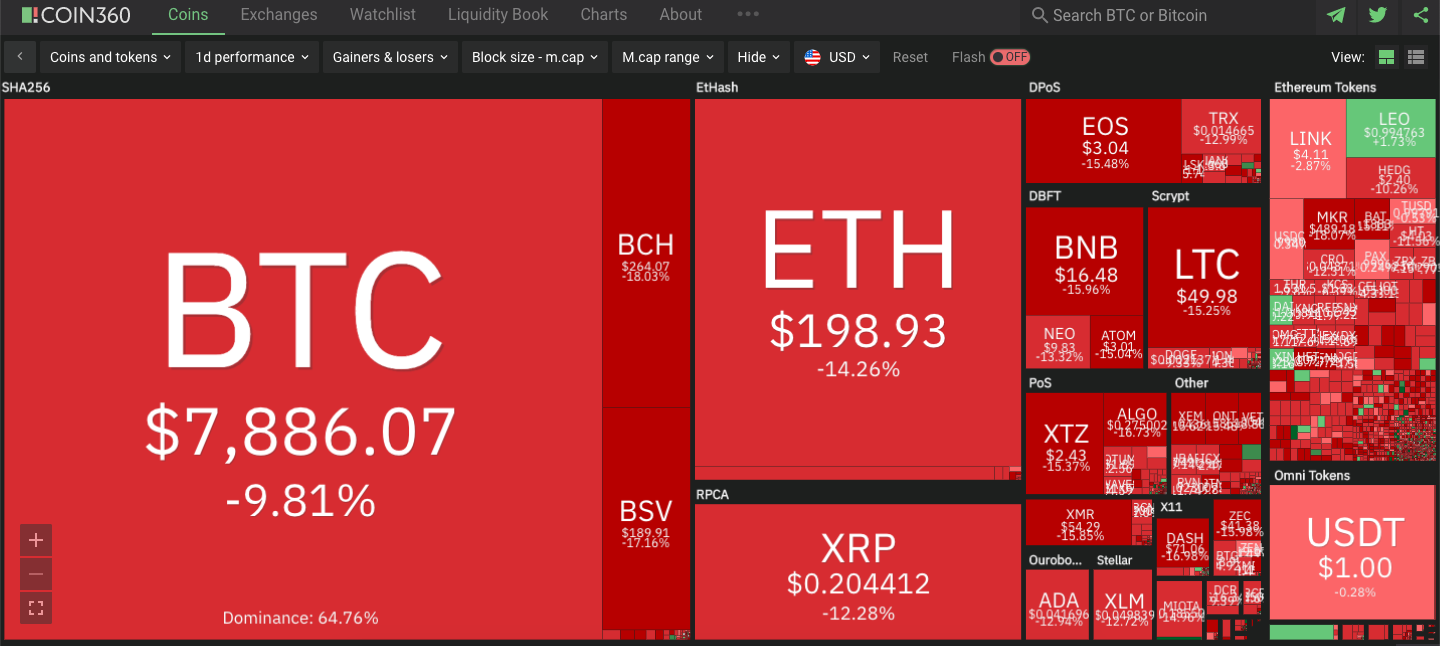
According to BitUniverse data, in the past 48 hours, the encryption market has been hit hard, plummeting across the board.
Bitcoin dived from a high platform, once falling to $7,837 during the session, and the largest drop in 48 hours reached 14.6%. "Bitcoin fell" also appeared on the Weibo hot search list today. For mainstream currencies including ETH and BCH, the biggest drop in 48 hours exceeded 20%.
The "halving market" that had been highly expected before was also ridiculed: the original halving market refers to the halving of prices and halving of assets.
secondary title
1. Market review: Bitcoin hits the largest one-day drop in half a year
On March 8, just after zero, Bitcoin started to attack from $9,100 to $9,200, but finally stopped at $9,187. The price then started to move downwards and finally fell below the $9,000 mark at 1 am.
Throughout the day, the price of Bitcoin has been consolidating and fluctuating around $8,700. But from 20 o'clock, the market took a sharp turn for the worse, and fell below the important support level of $8,400 within four hours. In the end, Bitcoin closed down 7.84% on the day, the biggest one-day drop in nearly half a year (since September 25, 2019).
In the investment group, some investors shouted: Bitcoin has reversed and came back to pick us up, leverage Stud, it will not fall again.
However, the downtrend did not stop there.
BitUniverse data shows that at 7 am Beijing time today, Bitcoin fell to the $8,000 mark, and the three major exchanges all held this important mark. But at 12:00 noon today, Bitcoin fell again, falling below the $8,000 mark. As of press time, the price of Bitcoin was temporarily reported at $7,889, with the largest drop of 14.5% within 48 hours.
Bitcoin's weakness has also driven down other cryptocurrencies. In the past 48 hours, the largest declines of mainstream currencies led by ETH and BCH were around 20%.
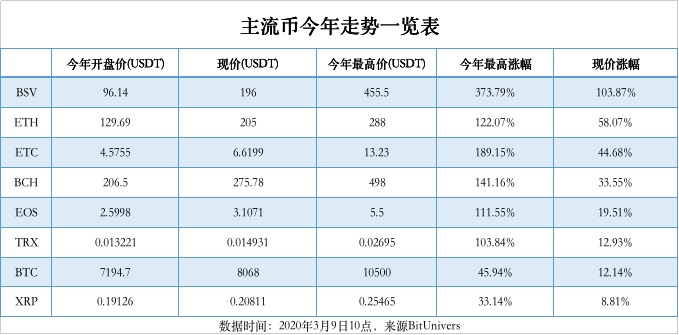
Since the decline of Bitcoin on February 13, Bitcoin has fallen by 25% in the past month, and the accumulated income this year is only 12%. The income of other mainstream currencies this year is also not optimistic. The previous strong "halving three fools", currently only BSV still maintains a yield of 103%, and the income of ETC and BCH has shrunk sharply.
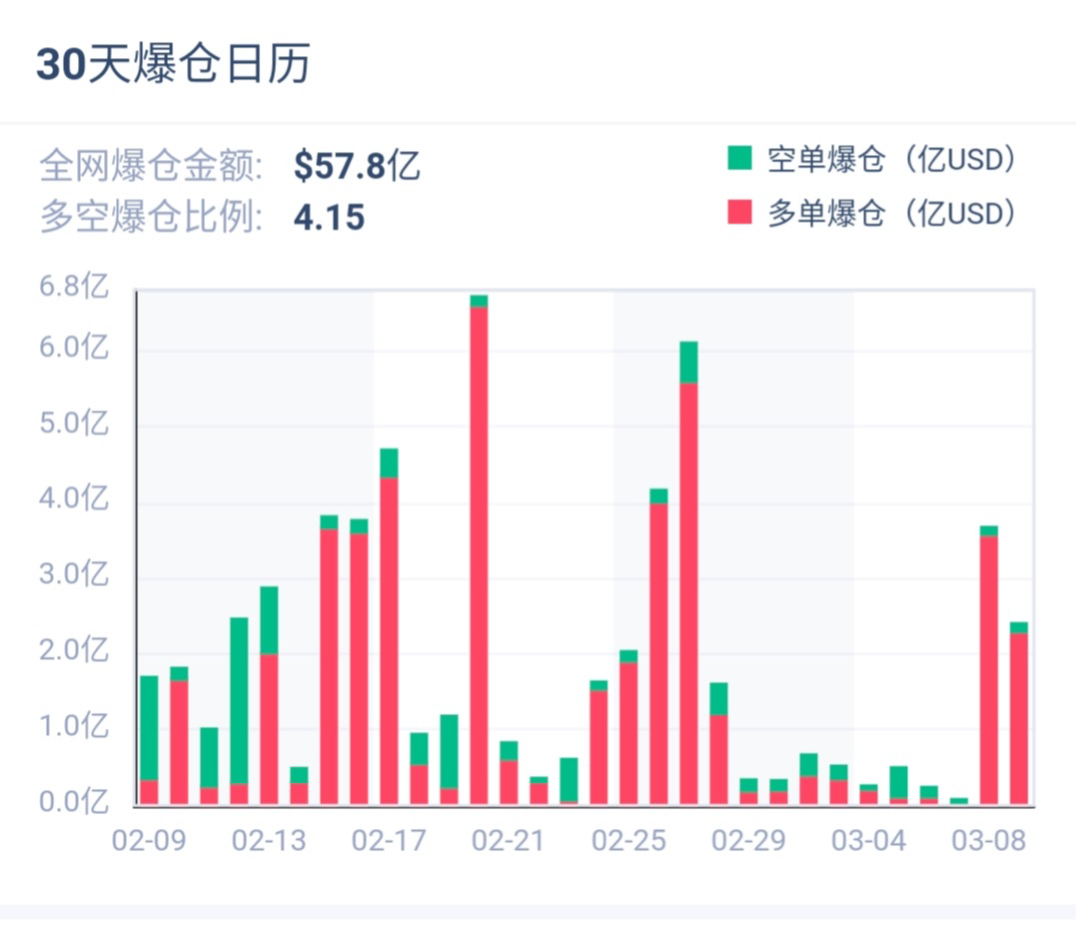
The futures market was even worse. Data from Coin Coin shows that over the past 24 hours, more than 500 million US dollars have been liquidated across the network, and more than 36,000 investors have become "victims" of liquidation. Among them, the 24-hour liquidation of BTC was 310 million U.S. dollars, the 24-hour liquidation of ETH was 67 million U.S. dollars, and the liquidation of EOS and BCH exceeded 35 million U.S. dollars.
The poor performance of encrypted assets is also reflected in the securities market. A-shares opened this morning, the blockchain sector fell 2.01%, and the Shenzhen Stock Exchange Blockchain 50 Index fell 2.24%. Among the 236 concept stocks, 218 fell, accounting for more than 90%. In terms of Hong Kong stocks, Ooke Cloud Chain (01499.HK), a subsidiary of Ooke Group, reported at HK$0.234, down 5.26%; Huobi Technology (01611.HK) reported at HK$3.910, down 6.68%.
secondary title
2. Reasons for the plunge: epidemic, crude oil plunge, PlusToken sell-off?
With the market plummeting, all investors have a common question: Why did Bitcoin start to fall again?
(1) The cause of the news
Odaily sorted out and found that, in terms of news, there are three possible causes: PlusToken sell-off funds, the sharp drop in crude oil prices, and the release of water from the global economy under the influence of the epidemic.ErgoBTC He tweeted that the decline in BTC was due to the selling of Bitcoin by the PlusToken team. "In the past 24 hours, PlusToken has transferred approximately 13,000 bitcoins directly to mix services (for money laundering)."
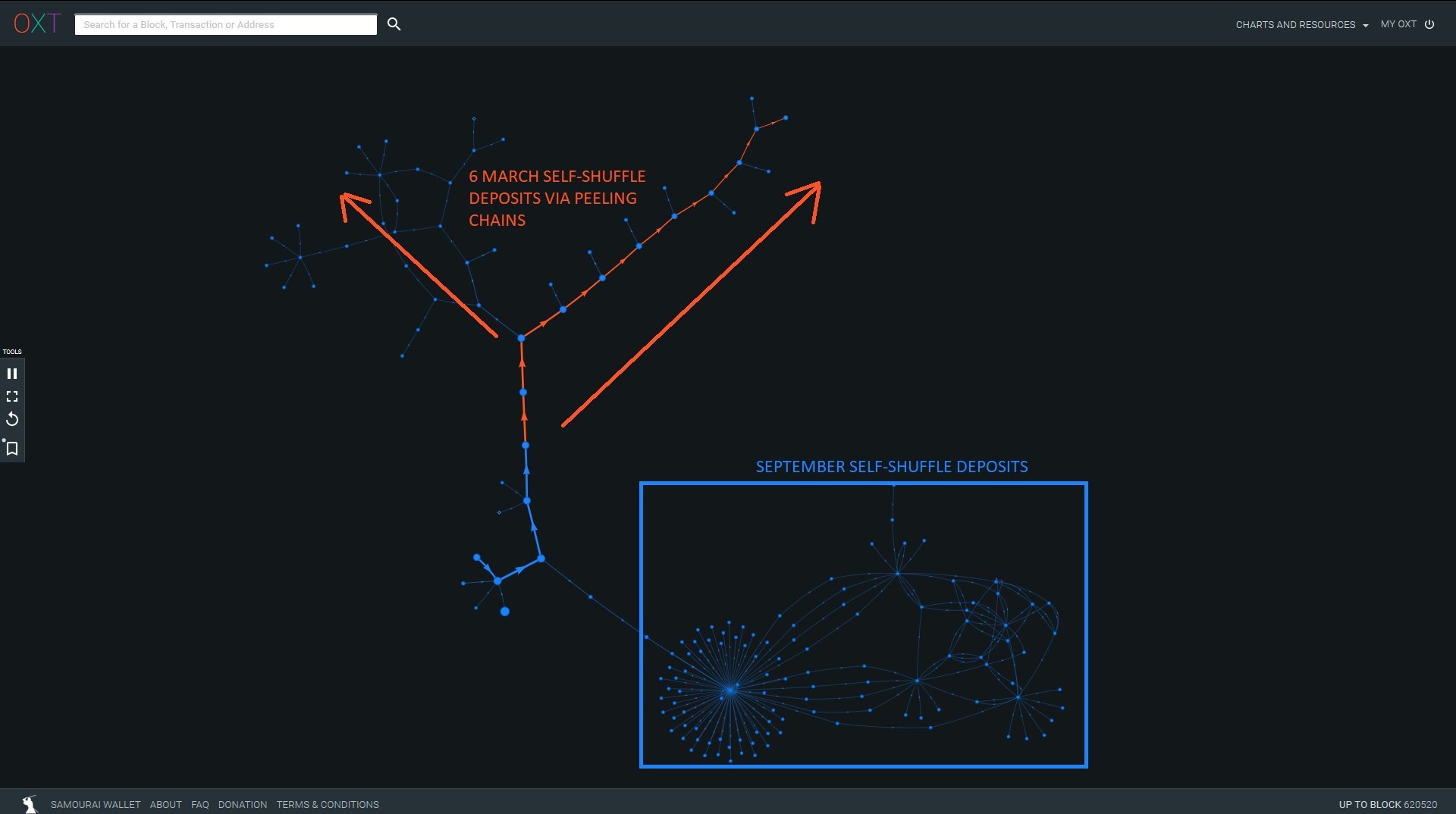
image description
(Schematic Diagram of Mixed Services)
The so-called Bitcoin "mixing service" refers to allowing users to mix their coins with other coins, thereby enhancing privacy and making it impossible for blockchain explorers to track. "Mixed services" usually use exchanges without KYC certification. Users can exchange their bitcoins for other tokens and transfer them to different wallet addresses to avoid tracking. "Mixing services" are also considered an illegal activity in connection with dark web transactions.
ErgoBTC’s words are not groundless. In fact, as early as March 6, PeckShield issued an early warning.
According to data from CoinHolmes, a digital asset visualization tracking platform under PeckShield, since 12:00 on March 6th, Beijing time, the funds on the addresses starting with 15Z1sT and 1CkuKa have changed again, and 13,112 BTCs have been split into several addresses by small amounts. Among them, it is possible to flow into the exchange or sell it through OTC.
Now it seems that it seems reasonable for PlusToken to sell BTC and cause the price to plummet. After all, in December 2019, they sold 790,000 ETH, causing the price of ETH to be seriously oversold.
Another possible factor is the plunge in crude oil prices.
According to the Financial Associated Press, Saudi Arabia launched an oil price war last Saturday. On the one hand, it announced price cuts, significantly lowering the price of crude oil sold to markets such as Europe, the Far East, and the United States. The discount was the largest in more than 20 years; Production, even reaching a record level of 12 million barrels per day (9.7 million barrels per day this month).
As soon as the news came out, crude oil futures suffered an "epic plunge." Brent crude oil futures gapped sharply this morning, falling 25% to $34.52/barrel at the opening; WTI crude oil fell more than 33% to $27.59/barrel, a drop exceeding the biggest drop in the 1991 Gulf War.
"If you look at BTC as an asset class, compared with global real estate, bonds, stocks, and commodities, it is the asset class with the smallest volume, the largest volatility, and the highest risk premium. It has an impact, especially the oil price war launched by Saudi Arabia last Saturday, which led to a 30% plunge in crude oil at the opening of last night.
The last reason that everyone has felt recently is the global economic release under the influence of the new crown epidemic. Bitcoin has not been able to play the "safe-haven" attribute that people expect.
according toaccording toWorld Health Organization
According to news, as of 17:00 Beijing time on the 8th, the number of countries and regions affected by the new crown pneumonia epidemic outside China has reached 101.Under such circumstances, the global economy has been hit hard, and the market lacks incremental funds. Neither the stock market nor the currency market is immune. As early as two weeks ago,US stocks, European stocks
The Dow suffered its biggest one-day drop in two years on February 25. At 8 o'clock this morning Beijing time, the US S&P 500 index futures plummeted to 2819 points, triggering trading restrictions.
"Affected by the global outbreak of the new crown pneumonia, almost all asset classes, stock markets, bond markets, crude oil and even gold have plummeted. As a risky asset, BTC is also difficult to avoid alone.” Lorry, director of industry research at Amber Group, explained.
Yang Mindao, founder of dForce, said: The financial market is all connected, and everyone is equal before liquidity. In fact, digital currency assets such as Bitcoin are more sensitive to liquidity, and the transmission path is very short, which can be seen immediately.
Bitcoin should verify the thesis in 2009 through the economic crisis, this time is a better opportunity. From the observation point of view, Bitcoin can avoid the risks of capital control countries and geopolitics, but it is obviously helpless in the face of global liquidity risks.
Now many digital currency hedge funds, positions and stock positions are fully linked. Under the current situation, funds in US stocks will flow to cash and US bonds, and life-saving is critical.
This is the same as many people do not understand why Buffett has 20-40 billion US dollars in his account for a long time. The allocation of cash and U.S. debt has an investment function. The financial crisis reincarnation every 7-10 years can basically be 30 billion dollars each time. Assets can be bought at a price of %-50%; the option value of this part of cash can be calculated, and the annualized rate should be about 8%. Adding the cash income, the total return is 10%.
"Cash is a perpetual put option." Yang Mindao concluded.
(2) Technical analysis
In addition to the news, there are also many technical indicators that indicate a sharp drop.
Odaily once reported that due to the strong long-term sentiment before, the USDT of major exchanges appeared in a panic. When things go against extremes, it is reasonable for bears to counterattack.
"This round of halving market is a leverage bull, and the rate of perpetual long is high, and the spot USDT has been repeatedly borrowed short. As I said before, in the absence of incremental funds, it is impossible to let most people in the stock game Profit,” said Lorry.
Su Ye, CEO of BlockArc, also agrees with this view. He said that this year is a typical leverage bull. "Everyone has 10,000 yuan in their pockets, and they can buy 100,000 yuan with 10 times leverage. The characteristic of a leveraged bull is that it consumes quickly. Once there is no incremental capital, it is easy to rise and fall quickly."
OKEx trading big data shows that the long-short ratio of BTC leverage once reached 32.9. After several days of decline, the current BTC leveraged long-short ratio has dropped to 5.59.Aayush Jindal NewsBTC Analyst
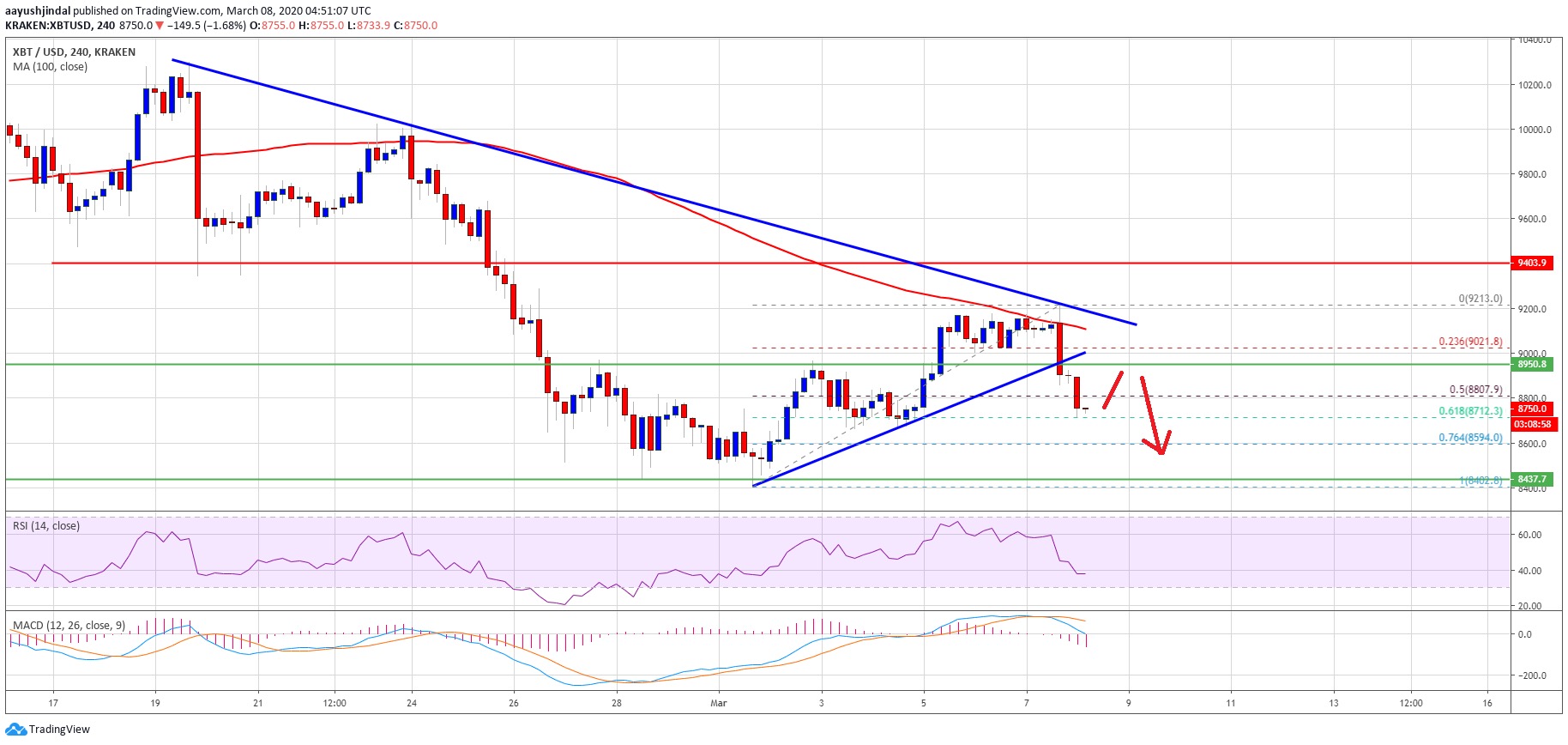 However, BTC failed to break through $9,200 and fell below the important support level of $8,700, which has already heralded the coming of a sharp drop.
secondary title
3. Outlook
For panicked investors, the most concerned question at present is: Will there be a bull market? When will the currency price rebound?
Li Zhe is very optimistic about this. He said: "The epidemic will always end, and there will always be peaceful development after the dispute. The decline in the return rate on the asset side will continue to force the central banks of various countries to release water. The long-term outlook is optimistic that the pattern will remain unchanged."
"I think the big bull market will come after all. It is only a matter of time before it breaks through 20,000 US dollars, and short-term adjustments are needed." Su Ye is also optimistic about the market outlook, "but the short-term peak of 10,500 US dollars will start a correction, and the correction will rise again in 3-5 months .”
He added that after the big bull market, the necessary and sufficient condition for attracting incremental funds outside the market-a moving story. The ten-year story of Bitcoin is over. This is the biggest crisis and a new story is needed. The next story may revolve around the golden age of DeFi opened after Ethereum 2.0, or the global payment of digital currencies brought about by Libra, DCEP, etc.
Lorry is relatively pessimistic. He believes that from a technical point of view, this round of halving market has probably peaked, and the next step is the process of consolidation and bottoming out. "Whether there will be a bull market this year is still determined by the long-term supply and demand relationship of BTC."
OKEx analyst Yan Song believes that since the cost of crude oil extraction in Saudi Arabia is significantly lower than that of other countries, we may see crude oil prices below $30 per barrel in the future, and Bitcoin may continue to follow suit.
"The last time we saw crude below $30 a barrel was in late 2015-early 2016, when Saudi Arabia launched a price war on U.S. shale fields, and the collapse in crude caused the S&P 500 to retreat within a month. Looking back at the price of Bitcoin from mid-December 2015 to mid-January 2016, it was also quite weak, falling from around $460 to above $350, a drop of 25%.
He added that it is still necessary to continue to observe the subsequent trend of oil prices and whether its impact on various markets can be digested. "In the past few weeks, we have been able to clearly observe that the attribute of Bitcoin as a risk asset has been emphasized by the market, and this attribute will continue in the short term. In the medium and long term, Bitcoin, as a non-interest-bearing asset, is under pressure from falling interest rates and holding costs. There may be returns in a reduced environment. In addition, there are fewer and fewer asset classes with relatively stable yields in the market, and many funds will pursue excess returns by tolerating greater risks.”





