Author | Qin Xiaofeng
Produced | Odaily
Produced | Odaily

1. Overall overview
1. Overall overviewVitalik ButerinOn February 25th, the co-founder of Ethereum
Second, the secondary market
Second, the secondary market
1. Spot market
image description
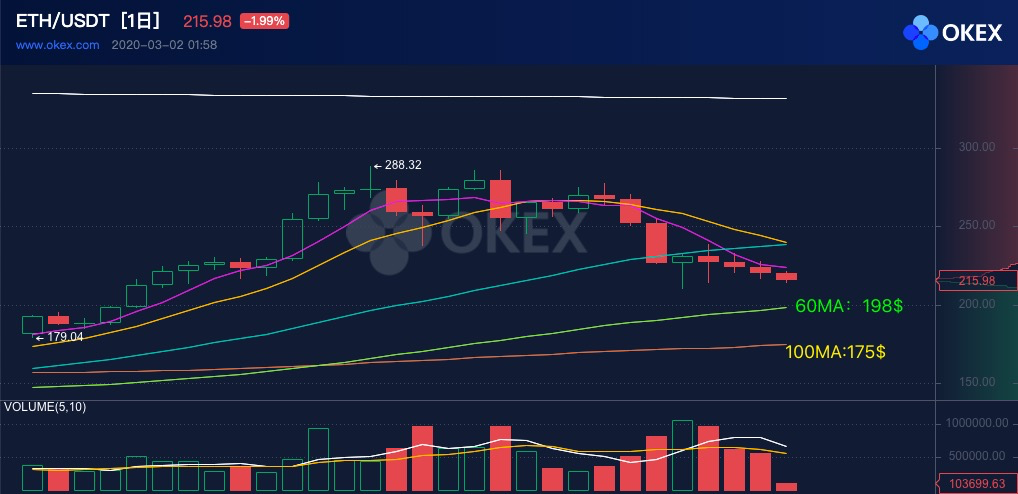
(ETH daily chart, picture from OKEx)
image description
2. Fund flow

(data from BiNuNiu)
(data from BiNuNiu)
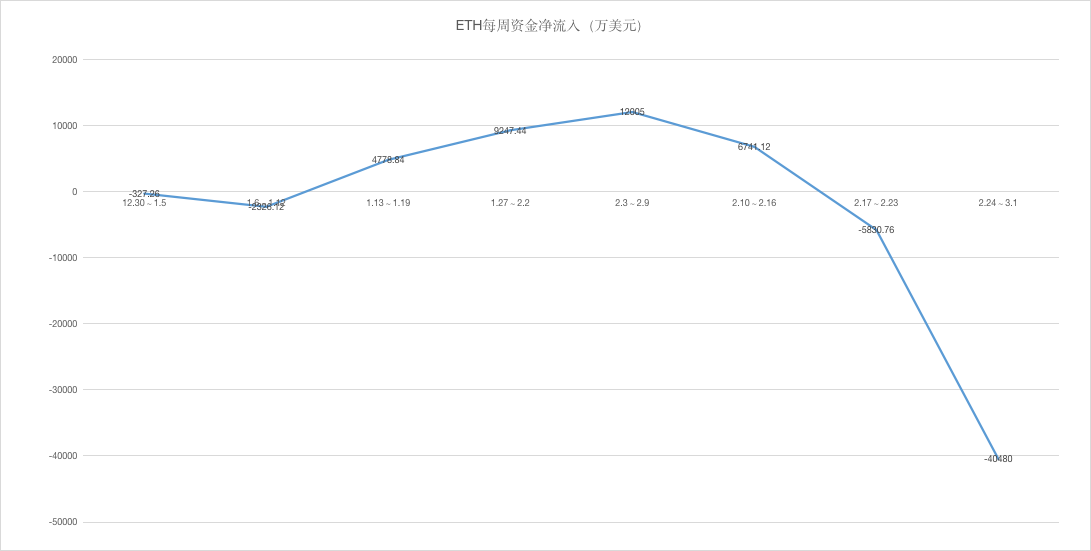
(data from Tokenview)
3. Large transaction
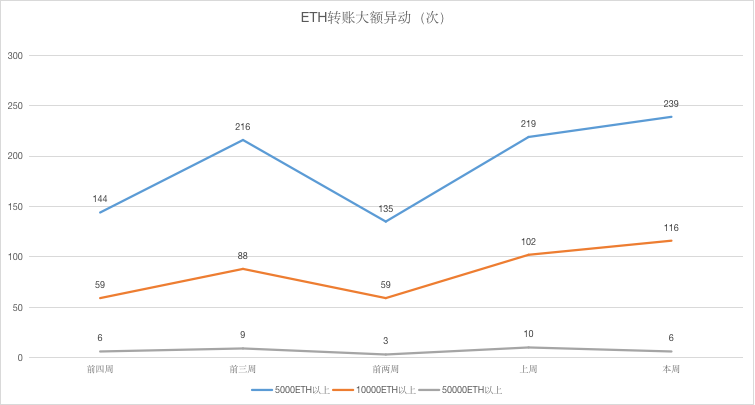
(data from Tokenview)
Tokenview dataimage description

(more than 50,000 ETH transfers)
3. Ecology and technology
3. Ecology and technology
1. Development and technology
1. Development and technology
(1) ProgPoW sparked constant controversy in the Ethereum community
On February 21, an individual developer of ETH 1 suddenly announced: "Ethereum core developers are promoting ASIC-resistant ProgPoW, and the hard fork upgrade is tentatively scheduled for July." However, in fact, the core developers of Ethereum have not reached a consensus on ProgPoW, nor have they tentatively set a hard fork upgrade time. (Odaily note: ProgPoW aims to convert Ethereum's hash algorithm into an ASIC-resistant solution)Vitalik ButerinHe criticized the way some community members "approved" the ProgPoW proposal "quietly". God said he was neutral on the proposal and only criticized the decision-making process. But he has also implicitly expressed his disapproval of the proposal several times over the past two years.
February 26,February 26,Ethereum community member
A petition was published indicating that stakeholders have objections to the activation of ProgPoW. The petition and the full list of signatories are available on GitHub. The signatories of the petition (including Uniswap CEO and founder Hayden Adams, Truffle Suite CEO Tim Coulter, and DARMA Capital co-founder Andrew Keys, among others) believe that the change will bring Ethereum's split to a new level. steps.Péter SzilágyiOn February 27, Ethereum core developers
Discuss the recently controversial ProgPoW proposal in the Ethereum community on Twitter, and propose the possibility of a hybrid solution between the Ethash algorithm and the ProgPoW algorithm. Péter Szilágyi said that the Ethash algorithm and ProgPoW algorithm hybrid scheme will make it possible to mix Ethash/ProgPoW (initially 100% Ethash/0% ProgPoW). Either way, each block increases the rate by 0.1%. And this ratio defines the PoW of the next block. The advantage of this is that Ethash and ProgPoW miners can solve the problem themselves without having to split the Ethereum network. Péter Szilágyi also made it clear that the hybrid solution is only under discussion for the time being). (Comprehensive report by The Block, Trustnodes, CryptoBriefing)
(2) Ethereum anonymity solution ZeroPool launched an early beta version
Ethereum's anonymous solution ZeroPool launched an early beta version, but its developer Igor Gulamov reminded that this is a very early version, and many parts have not yet been implemented. The team stated that ZeroPool is an advanced privacy solution that users can use to hide the amount, source of funds, and destination address from any external observer, store or execute the exchange of ETH and any other ERC-20 tokens. (Ethresear)
(3) Hyperledger Besu releases version 1.4 to improve compatibility with other Ethereum clients
The Hyperledger Besu project led by the Linux Foundation released version 1.4, which is an open-source client compatible with the Ethereum mainnet, developed based on Java. Besu is developed by PegaSys, the Ethereum blockchain solution team of ConsenSys. ConsenSys said that Besu provides the most reliable, scalable and easy-to-use platform for Ethereum mainnet and enterprise customers, and Besu implements the Enterprise Ethereum Alliance (EEA) technical specification. (Consensys.)
Dapper Labs, the development team of CryptoKitties, launched a test version of Drip, an application platform for gamification exploration of Ethereum and DeFi fields. The game allows users to complete the challenges of unlocking different applications and improve their scores. The game will include game elements such as weekly tasks and inviting friends to interact. Currently, the test version can unlock the challenges of 11 Ethereum applications, such as in Compund can get 100 points for lending a sum of funds, and get 100 points for one transaction on Uniswap, etc. (Dripscore)
2.DEX
according toDAppTotal.com DEXaccording to

according to
3.Dapp
according toDappreview dataimage description
4. Mining
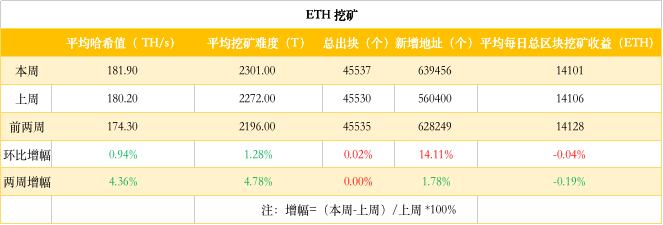
(data from etherchain.org)
etherchain.orgThe data shows that the average computing power increased by 0.94% month-on-month, temporarily reported as 181.9 TH/s; mining difficulty increased by 1.28% month-on-month, temporarily reported as 2301 T; the activity of miners increased significantly last week, and the number of new addresses increased by 14% month-on-month.

4. News
4. News
1. FTX’s Ethereum futures volume hits all-time high
text
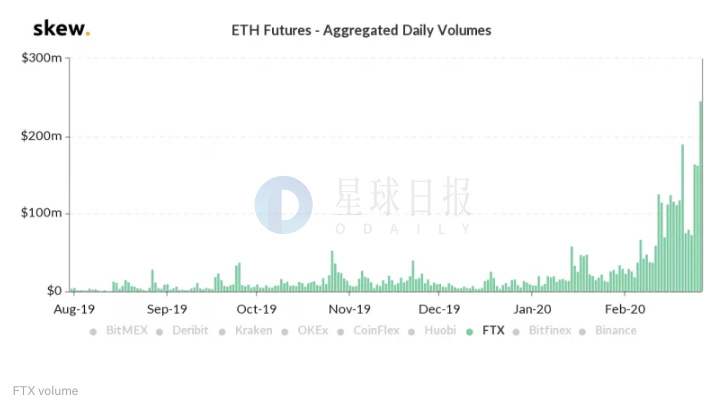
Total daily trading volume of ethereum futures on Hong Kong-based cryptocurrency derivatives exchange FTX jumped to an all-time high of $245 million on Feb. 28, up 51 percent from $162 million on Tuesday, according to Skew Markets. The previous record of $189 million was set on February 20. (CoinDesk)
2. Ethhub founder: The mining pool is ready for the transition of ETH to PoS
On February 29, Eric Conner, the founder of Ethhub, tweeted that the behavior of miners who want to prevent the transition of ETH 2 to PoS needs to stop. Such behavior is not only baseless, but also completely contradicts the evidence before it. The current top mining pools are already investing time, manpower and resources to prepare for ETH 2. Spark Pool (which holds 31% of the Ethereum network hashrate) has a site dedicated to PoS that discusses the benefits of PoS and how the chain can continue to grow, among other topics. Spark Pool also stated that they are running an ETH 2 test node; Ethermine (with 23% of the hashrate) has started building an ETH 2 testnet block explorer; f2pool (with 10% of the hashrate) has also expressed support. Finally, Eric Conner emphasized that the consensus of Ethereum switching to PoS has won the hearts of the people. Mining pools have seen their prospects and their future and are ready for it. (Twitter)
3. If DeFi continues to play a role, ETH may develop into a trillion-dollar market
Recently, Nick Cannon, founder of EthereumPrice.org, discussed Ethereum’s long-term transformation from a $1 billion market industry to a $1 trillion industry. Cannon used the term "economic bandwidth" in Ethereum's ability to support DeFi applications. Cannon highlighted the long-term growth of DeFi and explained that Ethereum’s current lending process requires a “collateralization ratio” of 150%. This means that, taking into account Ethereum’s current market cap of around $30 billion, the network would allow loans of up to $20 billion if every ETH was used. Assuming that the total number of ethereums will not exceed 120 million (calculated according to the expected supply inflation rate of ethereum), he believes that about 10% of the total ethereum supply will provide economic bandwidth for a $1 trillion derivatives market. According to calculations, each of these 12 million ETH units would need to be worth $80,000. Such a sharp increase in valuation might make the most optimistic even a little skeptical. However, Nick Cannon also said: "Ethereum financing needs to do a lot to grow from $1 billion to $1 trillion, and the scaled-down version of this prospect is still difficult to reconcile with today's valuation." (AMBCrypto)
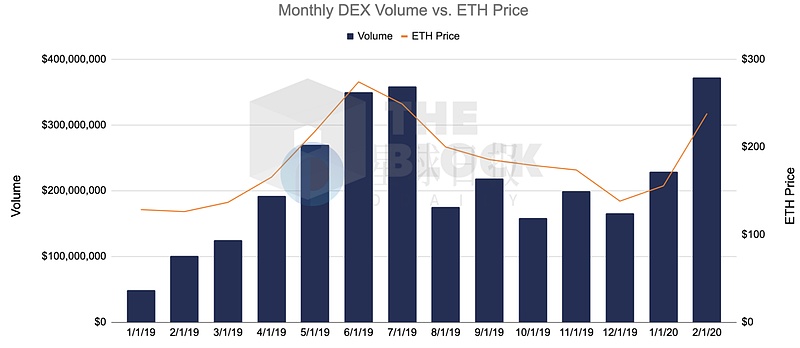
4. The monthly trading volume of Ethereum-based decentralized exchanges hit a record high