






What DeFi "Locked" $1 Billion Means for the Crypto Industry


This article comes fromBitcoin.com & Yahoo! Finance, Original Author: Kai Sedgwick & Brady Dale
Odaily Translator |

Odaily Translator |
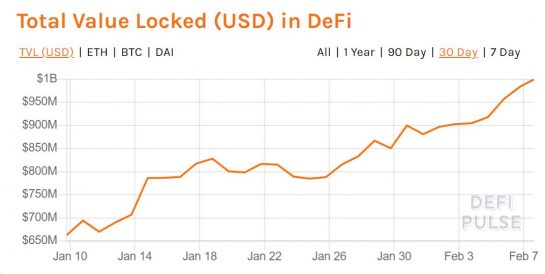
For the Ethereum community, there has been a lot of excitement recently: the total value locked in decentralized finance (DeFi) applications has surpassed $1 billion! You know, this figure was less than $700 million in December 2019, which means that it has increased by 43% in less than two months-it is estimated that those who are skeptical of the blockchain industry are now Shut up, numbers don't lie after all.
So how did the $1 billion figure come about? DeFi Pulse, which was the first to disclose this information, revealed that they evaluated and measured the amount held in projects such as lending, hedging, and swapping using Ethereum smart contracts for structural "betting" as of 8:00 UTC on February 7th. of all cryptocurrencies and got this result.
To be clear, $1 billion is not money people make in DeFi, but money they put in, as the collateral they lock up is used in a variety of protocols, from simple lending to complex derivatives. People make all kinds of "bets" on these protocol products.
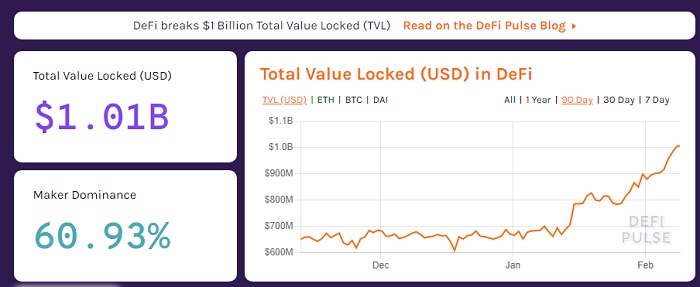
Rune Christensen, the creator of the MakerDAO protocol, said through his spokesperson that the total value locked in DeFi exceeds US$1 billion, which proves that people all over the world want more efficient and decentralized financial services. MakerDAO has been sitting firmly on the "top spot" of the DeFi Pulse ranking. They are the DeFi protocol with the most mortgages on Ethereum, accounting for 60.78% of the total locked value of DeFi at the time of writing. Many decentralized lending, derivatives instruments, and trading protocols draw liquidity from Maker’s sai and dai stablecoins, which in turn draw liquidity from Ethereum. (Odaily Jun o-daily Note: At the time of writing this article, the total value locked in DeFi has reached 1.01 billion US dollars)
“In terms of developer mindshare, application tools, and infrastructure, no smart contract platform can match DeFi, so much so that I feel that DeFi can exist anywhere. Perhaps most surprisingly, we are finally seeing A solid use case that would allow Ethereum to generate a long-term monetary premium, compared to Ethereum being currently the most used collateral in the decentralized finance space.”
secondary title
Centralized exchanges are also "eyeing" the DeFi market
This week, Binance launched Phase 13 of its lending product, with USDT at 6%, BUSD at 8%, and ERD at 15%. There are also DeFi lenders such as Cred and Squilla Loans, even if users know nothing about decentralized financial protocols, they can easily get started through their excellent user experience. In the case of Squilla, borrowers and lenders simply enter the amount they are looking for and the desired loan term to receive an instant quote. Although many decentralized financial applications are also working hard to optimize user experience and provide more attractive rates, there may still be a gap compared with "rich and powerful" centralized exchanges.
secondary title
Unlock "$1 Billion"
DeFi Pulse aggregates all Ethereum and ERC-20 tokens locked in all public DeFi protocols every hour and displays the "Total Value Locked" (TVL) figure in a chart at the top of its website.
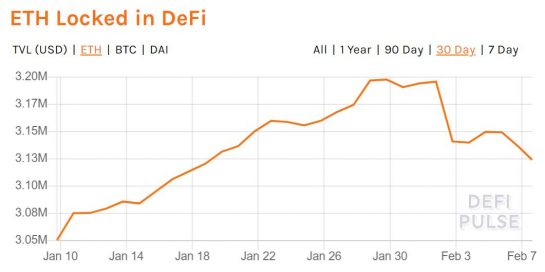
Of course, a large part of the "$1 billion" figure is due to Ethereum, because about 70% of the value locked in DeFi currently uses ETH tokens. But on the other hand, DeFi Pluse’s choice to use U.S. dollar-denominated numbers is easily affected by the volatility of cryptocurrency prices, which is actually one of the reasons why we see this number fluctuate frequently-in other words, even if there is no People invest more ETH tokens, as long as the price of Ethereum rises, it will push up the "total locked value". In the last week alone, the price of Ethereum rose by 21% in a single week.
In fact, if we evaluate not in terms of US dollars but in terms of the amount of locked ETH, we will find that the locked value of DeFi has actually shown a downward trend in the past seven days. In response, Jake Brukhman of CoinFund said:
“Obviously, some of the milestones in DeFi have been driven by the rise in the price of Ethereum, but regardless, we have passed the inflection point of the bear market in 2018 and 2019 and are ready for the bull market in 2020.”
Cryptocurrency investor and Ethereum promoter Ryan Sean Adams also wrote on Twitter:
"Software eats money. Software eats banks. The next decade is going to be crazy."
Of course, for Bitcoin believers, this milestone of DeFi is not commendable, because they feel that the appreciation of the entire cryptocurrency market is led by Bitcoin. Bitcoin developer Peter Todd said:
“Decentralized smart contracts make people not responsible for their debts, so you need to be careful.”
Another anonymous Bitcoin supporter pointed out that what percentage of the "billion dollars" locked in DeFi is made up of illiquid initial coin offerings (ICOs)? How many percentages are ConsenSys/Ethereum Foundation/Ethereum founders bragging about?
Cryptocurrency law commentator Preston Byrne even bluntly pointed out that there must not be $1 billion locked in DeFi, because if the existing stable currency Dai is correct, there will be at least $300 million in Ethereum locked in Dai, because Early investors did not want to pay taxes so did not sell these tokens. DeFi is not locking $1 billion, it is actually locking physical ETH tokens, because many early investors do not want to sell these tokens, they are waiting for the arrival of the bull market and expecting the appreciation of Ethereum.
Preston Byrne gave a more vivid example:
"There's a difference between saying Amazon founder Jeff Bezos is worth $100 billion and saying Jeff Bezos has $100 billion in cash."
In addition, whether the rapid growth of the DeFi market can continue is still unknown. Take the well-known crowdfunding website Kickstarter as an example. The company was established in 2009. In 2014, the amount of project financing on its platform reached US$1 billion, but six years later it has not touched US$5 billion. Of course, the development speed of DeFi is definitely faster than that of DeFi. Traditional crowdfunding platforms are much faster,
Robert Leshner, founder of Compound, another leading DeFi protocol, said the milestone shows that users are looking for better ways to use cryptocurrencies that can reduce their reliance on exchanges. In the words of Robert Leshner, "Satoshi Nakamoto would be very proud if he saw the development of DeFi."
In fact, no matter from which angle you analyze it, "US$1 billion" is still a negligible figure, because according to the data from the market analysis company IBISWorld, the commercial loan market in the US market alone has a market size of US$800 billion, so DeFi still has a long way to go. Way to go.





