


Ethereum PlayerUnknown's Battlegrounds


Editor's Note: This article comes fromBlockchain Camp (ID: blockchain_camp)Editor's Note: This article comes from
Blockchain Camp (ID: blockchain_camp)
Blockchain Camp (ID: blockchain_camp)
, Author: Spreeha Dutta, translation: Crescent Moon, reprinted with authorization by Odaily.
Ethereum is an open-source blockchain-based platform that supports smart contracts. Ether, the cryptocurrency generated by the Ethereum platform, is currently the second-highest cryptocurrency by market capitalization.
In June 2016, Ethereum found itself under attack when an unknown hacker exploited some existing vulnerabilities to steal more than 3.6 million ETH, worth $50 million.
In order to help blockchain novice understand the whole attack process, we introduce some simple proper nouns below:
A smart contract is a computer protocol designed to digitally facilitate the negotiation of a contract, verify its authenticity, and enforce its performance. Smart contracts guarantee the reliable execution of transactions without the need for a third party. These transactions are trackable but not reversible. In short, smart contracts are codes that execute on the Ethereum blockchain and can interact with Ethereum and user wallets.
The distributed ledger is the public database of all transactions on the Ethereum blockchain and is maintained by every Ethereum node.
Ethereum uses the concepts above. These blockchains have two important properties: security and immutability. If these very core principles are threatened, stakeholders are bound to go berserk!
The Backstory of the Attack
Ethereum (Ethereum) was founded in 2015 by 21-year-old Vitalik Buterin (Ethereum founder, known as "V God"). He hopes to realize decentralization on the Internet through Ethereum. A crowdfunding campaign helped fund Ethereum’s launch (a total of $18 million worth of ether was sold).
secondary title
What went wrong?
On June 17, The DAO announced that it had found a recursive call bug, but claimed there was nothing to worry about and all funds were safe. Six days later, an unknown hacker stole $50 million worth of ether. The attacker also claimed that his actions fell within the legal jurisdiction of the law, so no criminal charges could be brought against him because all he did was exploit a loophole in the system.
What did the attacker do?
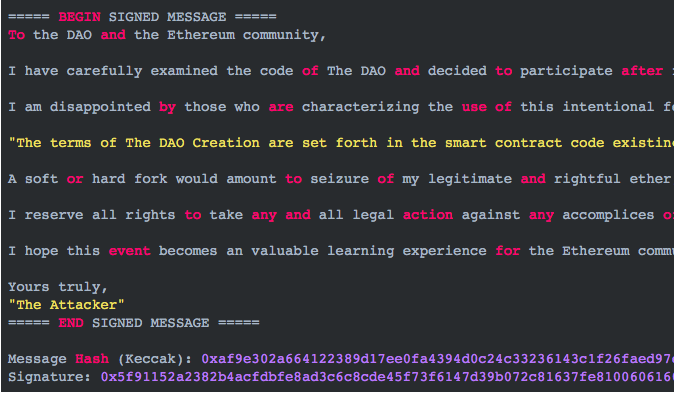
The hacker exploited the loophole to legally steal ether. Ethereum is a platform on which transactions are calculated in units of "gas", where gas is the cost required to execute smart contracts on the blockchain. Attackers exploited this vulnerability to increase the size of the Ethereum blockchain through a large number of worthless illegal transactions. This results in transaction delays that are useful to an attacker.
secondary title
Ethereum's Unresolved Drawbacks
The problem that the ethereum designers didn't solve is that all ether is stored in one address. This gives room for hacking. Of course, the idea of forking to prevent attacks did attract the attention of participants, but the time was too short to form consensus and get enough votes to fork.
secondary title
proposed solution
Now there are only two options left. One does nothing and ends up losing tens of millions of dollars. The second solution is to do it in two steps, first a soft fork and then a hard fork. But this violates the main principle of blockchain "immutability", so it raises a lot of doubts.
"The development community is proposing a soft fork (but no rollback, no revocation of transactions and blocks), which would invalidate all transactions of The DAO and its child DAOs, preventing attackers from withdrawing after 27 days Ether. Then do a hard fork and get all the ether back."
— Vitalik Buterin, "Emergency Update: Vulnerabilities in The DAO," June 17
However, the idea of a soft fork was shelved as it would raise many security concerns. On the other hand, a majority of Ethereum participants voted in favor and agreed to the hard fork proposal.
Finally got through this...





