






Perp DEX重新獲得市場關注:這一年,頭部項目在做什麼?


- 核心觀點:Perp DEX賽道已超越CEX合約的簡單替代,正透過擴展至穩定幣、RWA、預測市場、自有鏈及收益型保證金等領域,爭奪全球資產交易需求,其競爭焦點從加密資產轉向傳統金融資產交易。
- 關鍵要素:
- Hyperliquid通過HIP-3和HIP-4擴展至RWA與預測市場,其HIP-3頭部市場(如原油)24小時成交額接近幣安中腰部主流資產水準。
- Aster啟動自有鏈Aster Chain,引入Shield Mode私密交易,並透過Permissionless Listing Vote上架SpaceX Pre-IPO等傳統金融資產。
- StandX圍繞「收益型保證金」構建差異化,推出Maker Points激勵掛單流動性、Position Yield提升持倉資金效率及Block Trade服務大額交易。
- Lighter啟動LIT回購並推出Liquidity Partner Program,每週投入約25萬美元獎勵為RWA市場(如原油、貴金屬、股票)提供流動性的參與者。
- edgeX在Circle Ventures投資後,透過合約V2 Beta上線,支援加密、傳統金融(如黃金、原油)及預測市場等多元資產交易。
Original Author: Changan I Biteye Content Team
This week, Hyperliquid once again became the market focus.
The HYPE price surged over 40% in a week, reaching an all-time high. Meanwhile, other Perp DEX projects such as Aster, Lighter, and edgeX also experienced varying degrees of increase, bringing the entire sector back into the market's spotlight.
Over the past year, the Perp DEX landscape has undergone significant changes. They are no longer just on-chain alternatives to CEX contracts, nor do they compete solely through trading mining, points, and fee reductions. Instead, they are continuously expanding into areas like stablecoins, RWAs, prediction markets, proprietary chains, revenue buybacks, and yield-bearing margin.
This article will chronologically outline the changes in several representative Perp DEXs over the past year, examining their recent achievements and strategic directions.
1️⃣ Hyperliquid: From Trading Platform to On-Chain Financial Infrastructure
Over the past year, Hyperliquid's evolution goes beyond simply expanding trading volume; its product boundaries have significantly broadened. It has transitioned from a core perpetual contract trading platform into an ecosystem extending into stablecoins, prediction markets, and open contract deployment platforms.
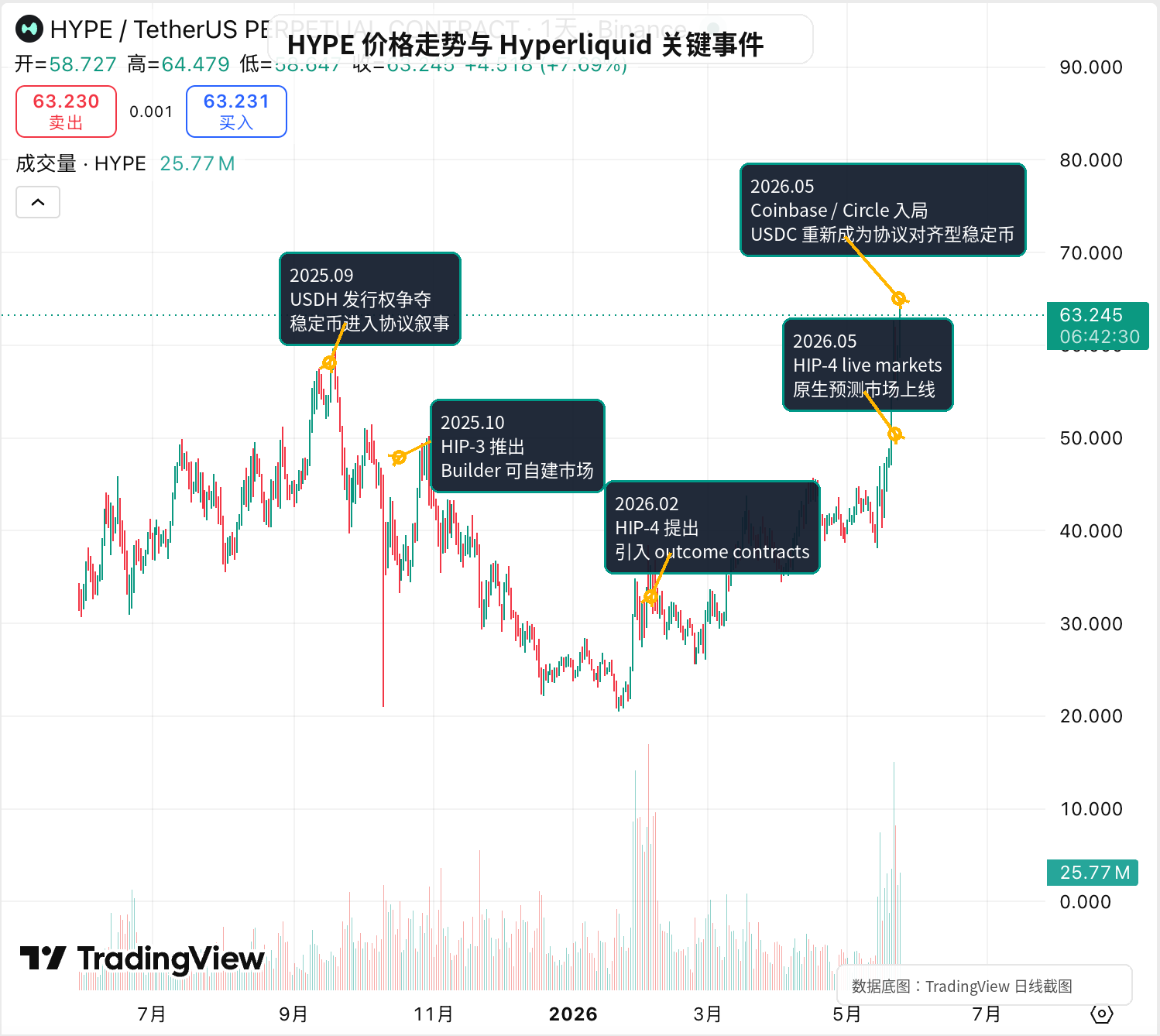
September 2025: USDH Competes for Hyperliquid Settlement Assets
In September 2025, Hyperliquid advanced its native stablecoin, USDH. What makes USDH more unique compared to typical project-issued stablecoins is its aim to become the primary on-ramp for dollar liquidity within Hyperliquid.
October 2025: HIP-3 Transitions from Official Listings to Builder-Created Markets
In October 2025, Hyperliquid launched HIP-3. Previously, Hyperliquid's perpetual contract markets were primarily determined by the official team. With HIP-3, external builders can now deploy their own Perp markets on Hyperliquid.
Currently, HIP-3 markets are beginning to cover asset classes like traditional finance, commodities, and stocks.
- WTI Crude Oil's 24-hour volume is approximately $877 million, with open interest around $209 million;
- Brent Crude Oil's 24-hour volume is about $368 million, with OI around $323 million.
To put this in perspective: the 24-hour trading volume of top HIP-3 markets is approaching the level of mid-tier mainstream assets ranked 10th to 20th on Binance's volume leaderboard.
May 2026: HIP-4 Launches, Hyperliquid Enters Native Prediction Markets
In February 2026, Hyperliquid proposed HIP-4, introducing outcome contracts. Development progressed on the testnet, with the first live outcome markets appearing in early May.
Unlike traditional perpetual contracts, HIP-4 allows users to trade on which range the underlying asset's price will ultimately fall into.
Currently, HIP-4 has launched two BTC price prediction markets, including "Will BTC be above a certain price at a specific time?" and "Which price range will BTC fall into?"
The key difference from Polymarket is that HIP-4 is not a standalone product but is directly integrated into Hyperliquid's account system and matching engine. Users don't need to switch funds; they can participate in prediction markets using the same trading account.
Based on current data, HIP-4 is still in its early stages. The top market has a 24-hour volume of approximately $32,900 and open interest of about $34,900.
For comparison, a single BTC daily price prediction market on Polymarket sees roughly $433,700 in daily volume, while Hyperliquid's current top HIP-4 market is around $32,900 — about 1/13th of that, indicating a very early stage.
May 2026: Coinbase and Circle Enter, USDC Becomes the Protocol-Aligned Stablecoin
Also in May 2026, Hyperliquid's stablecoin strategy saw a new development.
Coinbase has announced plans to act as a capital deployer, activating AQAv2 on USDC. Circle will serve as the technology deployer, responsible for CCTP and native cross-chain infrastructure. Both Coinbase and Circle have committed to staking HYPE to activate AQAv2. As part of a transitional arrangement, Native Markets has agreed to grant Coinbase the right to purchase USDH brand assets.
This signifies that the center of gravity for protocol-aligned stablecoins within the Hyperliquid ecosystem is shifting from USDH to USDC.
With Coinbase as a capital deployer sharing the majority of reserve yield income with the protocol, USDC is becoming the stablecoin that better aligns with Hyperliquid's revenue distribution logic.
In future network upgrades, the HIP-4 outcome markets will also use USDC as the quote asset.
2️⃣ Aster: From Volume Explosion to Building Its Own Trading Ecosystem
Compared to Hyperliquid's year-long expansion of protocol boundaries, Aster's growth path is more direct: first build trading volume, then progressively expand products and infrastructure.
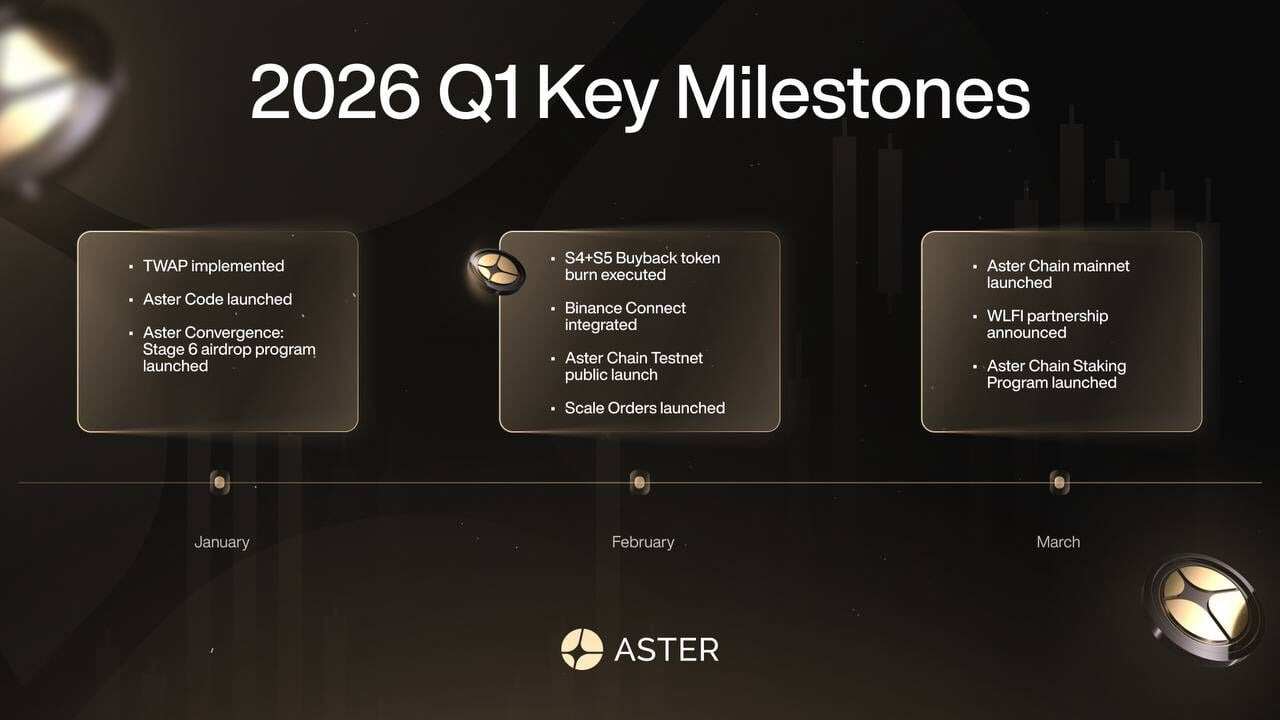
December 2025: Shield Mode Launched
Aster released its 2026 H1 Roadmap, gradually launching Shield Mode, TWAP strategy orders, and expanding into RWA perpetual markets like stocks, forex, and commodities.
March 2026: Aster Chain Mainnet Phase 1 Goes Live, Aster Moves from Perp DEX to Own L1
Focusing on private transactions, using ZK proofs and privacy addresses to conceal some transaction information, while emphasizing low latency, high throughput, and a zero-gas experience.
Aster doesn't just want to be a Perp DEX deployed on multiple chains; it aims to integrate matching, privacy, RWA assets, trading incentives, and governance into its own on-chain system.
May 2026: Continuous Listing of Global Popular Assets and Permissionless Listing Vote
Aster continues to expand its tradable assets. It is incorporating more stocks, Pre-IPO, commodities, and forex markets into its trading system, including new assets like SpaceX Pre-IPO perpetual contracts.
Simultaneously, Aster launched the Permissionless Listing Vote. This mechanism essentially opens up part of the listing authority to the community: eligible validators or ASTER stakers can propose new trading pairs, which are then voted on by the community for listing.
This is somewhat similar to Hyperliquid's HIP-3, shifting "the platform decides which assets to list" to "external participants jointly promote new markets."
Based on current data, some traditional finance-related markets are starting to show trading activity. For example:
- Crude Oil (CLU) 24-hour volume is approximately $8.37 million,
- Silver (XAG) is about $7.48 million, Gold (XAU) is around $3.3 million;
- In the Pre-IPO market, the SpaceX contract has a 24-hour volume of about $1.5 million.
3️⃣ StandX: Turning Perp Margin into Yield-Bearing Assets
Most Perp DEXs compete solely on matching, leverage, and trading fees. StandX's approach is more interesting: it attempts to turn idle or dormant funds during the trading process back into yield-generating assets.
January 2026: StandX Launches Maker Points.
It rewards not the execution itself, but order book liquidity. Users can earn Maker Points simply by submitting limit orders, even if they haven't been filled; after an order is filled, they further earn Trading Points.
In other words, StandX turns passive liquidity in the order book into an incentivized asset.
March-April: StandX Consecutively Launches SIP-1 to SIP-4
The product direction is becoming clearer: building a more capital-efficient Perp trading layer centered around DUSD, position yields, and large trade execution.
- SIP-1 is Block Trade, facilitating large derivative trades off the regular order book, supporting on-chain matching and StandX settlement to reduce the impact of large orders.
- SIP-2 is Position Yield, allowing eligible perpetual positions to participate in yield distribution.
- SIP-3 further strengthens DUSD's native yield by channeling a portion of StandX Perps trading fees to the DUSD yield pool.
- The latest SIP-4 expands Block Trade to TP/SL scenarios. It's not just adding a take-profit/stop-loss button; it creates a position-linked execution right, allowing users more flexible trade arrangements around future exit prices, protection prices, and reservation fees.
Viewed together, StandX's product narrative is quite comprehensive: DUSD addresses margin yield, Maker Points incentivize order book liquidity, Position Yield improves position capital efficiency, and Block Trade and TP/SL cater to larger, more professional trading needs.
This makes StandX less like a pure Perp DEX and more like a trading system built around "yield-bearing margin." Its differentiation isn't offering higher leverage, but minimizing capital idleness before, during, and after a trade.
4️⃣ Lighter: Since 2026, Shifting from Airdrop Expectations to Revenue Buybacks, RWAs, and ZK Security Narratives
January 2026: Initiates LIT Buyback, Tying Protocol Revenue to the Token
In January 2026, Lighter initiated its LIT buyback program. Unlike many projects that keep revenue in the treasury, Lighter stated it would use fees generated from the DEX and future products to buy back LIT on-chain.
Early reports indicated that at the program's launch, the protocol treasury already had approximately $1.35 million USDC available for market buybacks; buybacks have been executed multiple times since.
February 2026: Upgrades LLP, Designing Separate Liquidity Strategies for RWAs
In February 2026, Lighter adjusted its Liquidity Provider infrastructure, introducing independent strategies for different market types, including crypto perpetuals, forex, and RWA markets. This was done to manage the risk, liquidation, and ADL of different assets separately, rather than having all markets share a single liquidity pool.
This step paved the way for subsequent RWA expansion. Since markets for commodities, stocks, and forex have different volatility, trading hours, and liquidity structures compared to crypto assets, using a single pool to bear all risks would make scaling difficult.
April 2026: Launches Liquidity Partner Program, Focused on Boosting RWA Depth
In April 2026, Lighter launched the Liquidity Partner Program, rewarding participants who provide deep liquidity for RWA markets. The program is open to everyone, with rewards distributed via random snapshots of the order book; weekly reward amounts are announced in advance.
The program offers approximately $250,000 in weekly rewards, primarily covering markets like crude oil, precious metals, and stocks such as NVDA and Tesla.
5️⃣ edgeX: Since 2026, Moving from Pre-TGE Incentives to EDGE Chain and TradFi Perps
February 2026: Circle Ventures Investment, USDC Native Integration Becomes Key
In February 2026, Circle Ventures invested in edgeX.
With Circle Ventures on board, edgeX can now leverage USDC for margin, settlement, cross-chain operations, and institutional liquidity access, further smoothing its TradFi Perps roadmap.
March 2026: EDGE TGE, Tokenomics Officially Launched
In March 2026, edgeX first announced the EDGE airdrop terms and opened pre-market trading. It then officially set the EDGE TGE for March 31st.
April-May 2026: TradFi Perps Expansion, edgeX Adds Stock and Commodity Markets
Post-TGE, edgeX continued expanding its TradFi Perps. The platform added a significant number of stock, commodity, and bulk markets, including assets like NVDA, TSLA, AAPL, gold, silver, and crude oil.
This step is similar to Hyperliquid's HIP-3 and Aster's RWA expansion, extending Perp DEXs from crypto asset trading into traditional financial asset trading.
Based on current trading data, some TradFi markets are starting to show liquidity. For example:
- Gold (XAUUSDC) 24h volume is approximately $9.49 million
- Crude Oil (BZUSDC) is about $5.89 million
May 2026: Contract V2 Beta Launches, edgeX Transitions from Single Perp DEX to EDGE Stack
In May 2026, edgeX opened the Contract V2 Beta.
Simply put: V1 was edgeX's early trading system, primarily used to get contract trading operational. V2 is the next-generation system, designed to allow the platform to support more markets, faster matching, and more complex trading products.
This upgrade supports contracts, spot trading, prediction markets, and traditional financial assets like stocks, ETFs, gold, and crude oil.
V2 is currently in Beta, but the platform already features many new markets, such as stock and commodity perpetual contracts.
Final Thoughts
Looking back over the past year, the changes in Perp DEXs are clear: they are no longer satisfied with being just on-chain contract exchanges.
While their chosen paths differ, the underlying judgment is similar: Perp DEXs cannot remain confined to the crypto contract market.
This year, the strong performance of US stocks, tech stocks, AI-related assets, and traditional financial markets has continuously attracted capital. For on-chain trading platforms, user demand is no longer just for trading BTC, ETH, and altcoins, but also for trading crypto assets, US stocks, indices, gold, crude oil, and even Pre-IPO assets within the same account.
Therefore, Perp DEXs are competing not just for the crypto contract market, but for the broader demand for global asset trading. This is why, over the past year, several leading Perp DEXs have been aggressively focusing on TradFi assets.
The HYPE surge simply pushed Perp DEXs back into the market's spotlight. The truly deeper change is this: the competition among Perp DEXs has evolved from being substitutes for CEXs to "who can capture more global asset trading demand."


