In-depth Interview with Dr. Jiang Guofei, President of YF International: How Do the AI Engine and Web3 Infrastructure Reshape the New Paradigm of Digital Finance?


- Core Viewpoint: Web3 is transitioning from a speculation-driven "Wild West era" to a compliance and value-driven "institutionalized" and "rule-of-law era." Its core lies in achieving financial "disintermediation" through RWA and leveraging the "triad" architecture of AI, data, and Web3 to build an inclusive new ecosystem for digital asset management.
- Key Elements:
- Compliance is the ticket for institutional entry, requiring navigation of a multi-layered architecture including license upgrades, bank connectivity, KYT technology, and internal risk controls.
- The future of digital finance is supported by three pillars: data (providing information asymmetry), AI (providing cognitive asymmetry), and Web3 (providing time asymmetry).
- The combination of AI and Web3 can lower the threshold for family-office-level wealth management, achieving inclusive investment.
- The essence of RWA is a direct sales revolution in financial "disintermediation," directly connecting asset sides and capital sides through smart contracts.
- The industry's profit model should shift from short-term concept speculation to solving real financial pain points, achieving sustainable profits through efficiency improvements.
- Under Hong Kong's robust regulatory environment, Web3 projects with genuine business models can be fostered.
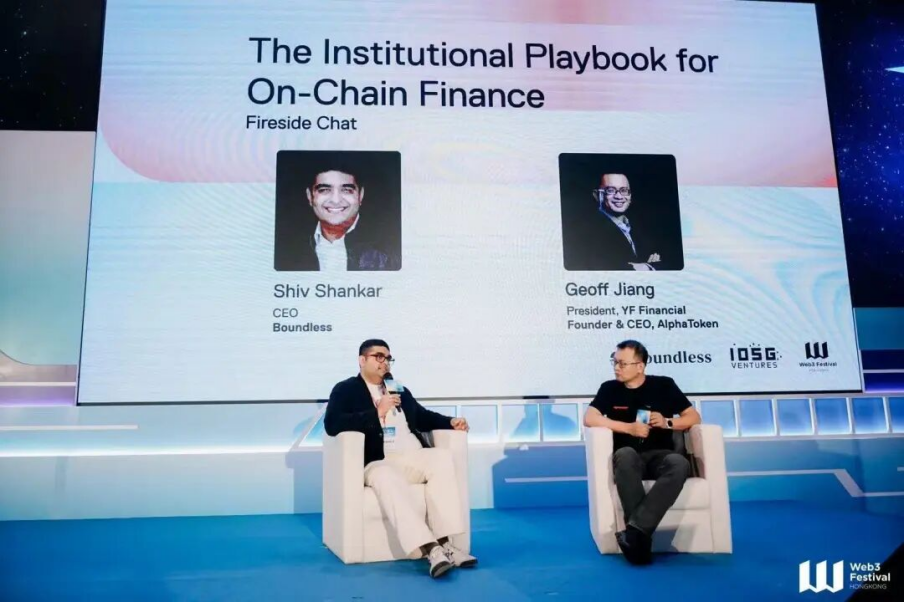
Recently, Dr. Geoff Jiang, President of Cloudbreak Financial Group (Stock Code: 00376.HK) and founder of AlphaToken, was invited by top-tier global venture capital firm IOSG Ventures to participate in the 2026 Hong Kong Web3 Carnival, engaging in an in-depth dialogue with attendees from various sectors about the future of digital finance. Drawing on his profound technical background and forward-looking financial practices, Dr. Jiang insightfully outlined the paradigm shift of Web3 from a "Wild West era" towards an era of "institutionalization" and the "rule of law."
This dialogue was not just a collision of technology and finance but also a profound reflection by Cloudbreak Financial on the new ecosystem of future asset management. The discussion revolved around the commercial essence of RWA, the convergence paradigm of AI and Web3, and the reconstruction of the industry's profit model, featuring candid and insightful exchanges on how digital finance can move from speculation towards long-term value creation.
1. From "Wild West" to "Era of the Rule of Law": Compliance is the Only Ticket for Institutional Entry
Moderator: At this year's carnival, the focus of discussion is no longer on the "disruption" of basic infrastructure, but on "deep integration" with the real financial system. How do you perceive this paradigm shift?
Geoff: This feeling is very profound. I believe Web3 is currently undergoing a qualitative change from the "Wild West" to an era of "Law and Order." In the early Wild West era, people might have valued breaking the rules more, but now in Hong Kong, the industry is entering a new, regulated phase. It's like we are laying "railways" and introducing "police" to the Wild West, establishing order and hierarchy. For Cloudbreak Financial, to truly deepen our presence in this market, we need to navigate an extremely complex four-layer architecture. The first is the access threshold, involving the compliance upgrade of Hong Kong's Type 1, 4, and 9 licenses in the digital asset space; the second is the institutional interface layer, where we need to solve the pain points of fund custody and account opening with the traditional banking system, often involving months of rigorous due diligence.
Furthermore, we must address challenges at the technical compliance layer, including necessary technical measures such as KYC, AML, and KYT for transaction monitoring. Finally, there is the internal control and risk management layer, which concerns security audits, organizational operations, and risk hedging when assets move across different systems. This transformation reflects the deep integration and磨合 between Web2's institutional rigor and Web3's technological nativity.
2. The "Golden Triangle" Architecture: How Does the AI Engine Define the Future of "Digital Finance"?
Moderator: You particularly emphasized the role of AI in your discussion. In the next phase of digital finance, how will AI, data, and Web3 jointly build the industry's "moat"?
Geoff: I have always firmly believed that the future of digital finance rests on three pillars: Data, AI, and Web3. Decision-making in digital finance relies on a large amount of high-quality data from the market, which provides an "information asymmetry"; AI is responsible for analysis and decision-making, offering a substantial "cognitive advantage". Web3 serves as the underlying programmable settlement infrastructure, enabling instant exchange of assets through smart contracts, generating significant "time advantages" during the clearing and settlement process.
When these three elements create a synergistic effect, we can realize a highly attractive vision: creating a "personalized, AI-driven family office" for every ordinary person. Under traditional logic, family offices are a privilege for the very few. However, in the future, by leveraging AI engines to precisely screen assets from the tens of billions available globally, combined with Web3's extremely low cost and high efficiency for instant settlement, this level of professional wealth management service will truly achieve financial inclusion, allowing every ordinary person access to institutional-grade asset allocation capabilities.
3. The Essence of RWA: The "Disintermediation" Revolution in the Financial Industry
Moderator: Dr. Jiang, you previously described RWA as the "Taobao model" for the financial industry. This perspective is quite vivid. How do you think it solves the industry's profit model challenges?
Geoff: The logic of RWA is essentially a "direct sales revolution" in finance. In the traditional financial chain, the distribution path for products is extremely long, with every layer of intermediary taking a cut of the profit, leading to low efficiency and high costs.
RWA, powered by Web3 technology, can achieve the "disintermediation" of financial products. It uses technology to directly connect the source of the asset with the investor, just like buying vegetables directly from the farmer on Taobao. This "financial direct sales" enabled by Web3 technology, combined with AI's asset screening and risk penetration capabilities, allows investors to directly capture a larger share of the returns from the underlying assets. This maximization of efficiency is the core driving force that can generate sustainable profits for the industry and ensure its long-term viability.
4. Focusing on Substance: Returning to Business Fundamentals, Moving Beyond the Afterglow of the "Wild West"
Moderator: What is the underlying advice you would most like to give to talents or institutions preparing to enter this field? Today's constructive communication has been very beneficial for us as well. Could you please summarize your thoughts?
Geoff: My core feeling is that the Wild West era is completely over. The current key test lies in business fundamentals: what exactly is your product, who are your customers, and is your cash flow sustainable? In a robust regulatory environment like Hong Kong's, it can actually foster the creation of truly valuable, closed-loop business models.
In summary, the second half of Web3 is no longer a virtual game; it's about deep integration with the real world. Don't constantly try to profit through short-term concept speculation; such a model won't last. The real challenge lies in whether you can solve real financial pain points using technological means within a compliant framework. Only those who can bridge the rigor of traditional finance, have a deep understanding of the regulatory climate, and truly know how to leverage technological advantages to create real value will have the last laugh in the next race of digital finance. This has been a very pleasant conversation today, and we look forward to partnering with industry peers to build this regulated, value-driven new digital finance ecosystem.
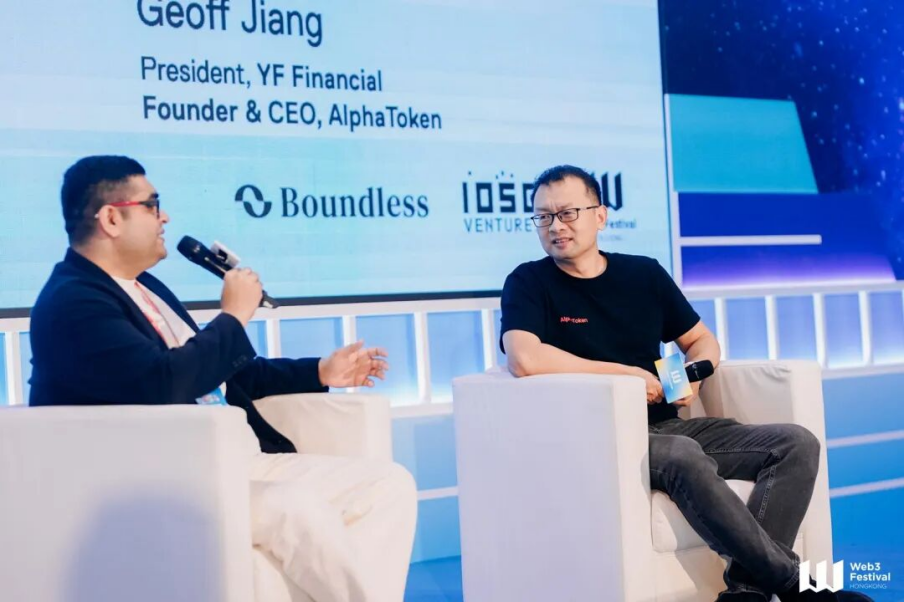
Dr. Geoff Jiang, President of Cloudbreak Financial Group and Founder of AlphaToken (Right)
Disclaimer
The information provided in this publication (the "Material") is for reference purposes only and represents the personal views of the author. Its content has not been reviewed by the Hong Kong Securities and Futures Commission ("SFC"). The content and data of this Material do not constitute a solicitation, offer, opinion, or recommendation by Cloudbreak Financial Group Limited to sell any securities, products, or investments, nor do they provide legal, tax, accounting, investment advice, or services regarding the yield or suitability of any securities, products, or investments. You should carefully evaluate and assess the benefits and risks of any investment. If in doubt, you should consult a professional advisor for this purpose. Prospective investors should conduct necessary or appropriate independent investigations, including assessing the investment risks involved. To the maximum extent permitted by law, Cloudbreak Financial Group Limited makes no warranty, representation, or guarantee regarding the accuracy, appropriateness, completeness, or validity of the information and data in this Material and expressly disclaims responsibility for any errors or omissions in such information and data. Additionally, Cloudbreak Financial Group Limited may change, delete, or replace the information and data provided herein at its sole discretion from time to time.