EigenLayer: Extending the Ethereum Trust Layer Through "Re-Pledge"
Original Author: 100 y, A 41 Alforone
Compilation and arrangement: Baize Research Institute
Last week, EigenLayer announced that it has received US$50 million in financing, led by Blockchain Capital, and well-known VCs in the industry such as Coinbase Ventures, Polychain Capital, Bixin Ventures, and Hack VC participated in the investment.
background
background
In 2009, an anonymous developer named Satoshi Nakamoto first introduced the concept of "decentralized trust" in the digital world by creating the Bitcoin network. The Bitcoin network is designed as a peer-to-peer digital currency system using UTXO and scripting language, but the limitation is that various programs cannot be built on the network. To solve this problem, in 2015, Vitalik Buterin launched the Ethereum network, allowing developers to build various decentralized applications (dApps) using the Turing-complete language Solidity.

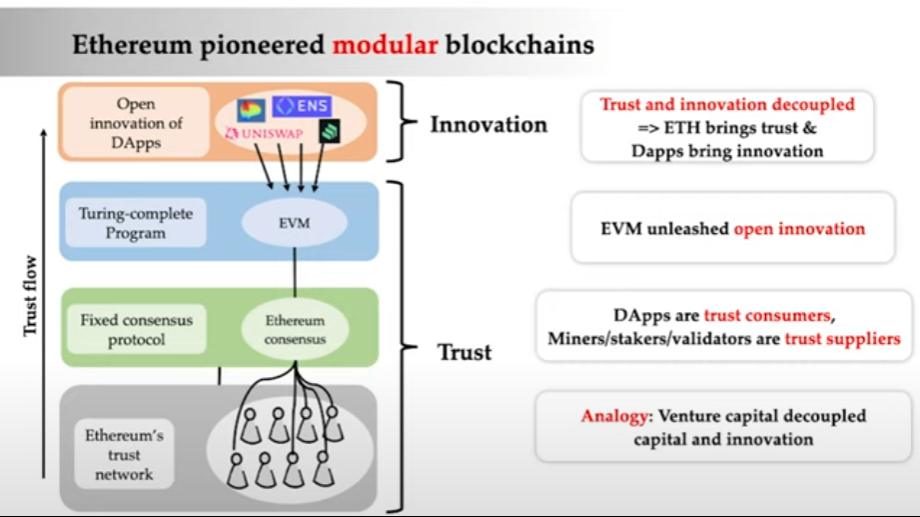
As shown in the diagram above, there are three modules responsible for decentralized trust in Ethereum:
Trust Layer: A network of decentralized block producers (validators).
Consensus Layer: Rules about how blocks are generated and which chain should be recognized as canonical in a distributed network.
Execution layer: Ethereum Virtual Machine (EVM).
Ethereum has a trust layer similar to Bitcoin, but because it uses the EVM as the execution layer, various dApps can be built on top of it. However, Ethereum has two major limitations:
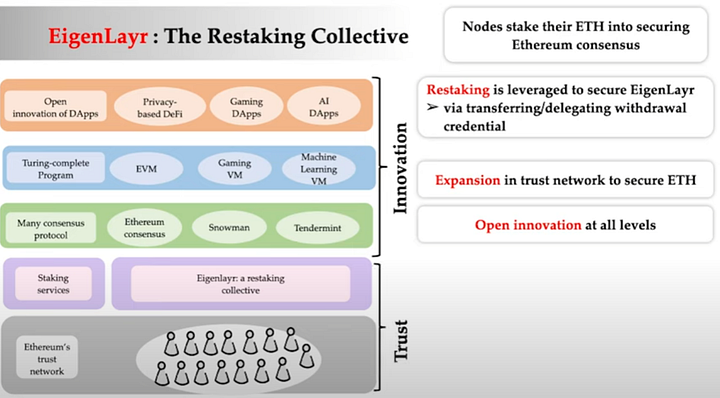
First of all, to independently build an independent consensus protocol (such as Tendermint, Snowman, etc.) and execution layer (such as Sealevel, FuelVM), it is impossible to use the Ethereum trust layer, and an independent trust layer must be built. Although it is possible to build Layer-2 solutions on Ethereum as an independent execution layer, transaction settlement ultimately occurs in smart contracts on the EVM, which inevitably relies on the execution layer of Ethereum.
Second, while dApps on the Ethereum network appear to be protected by Ethereum's strong security, they are actually heavily influenced by external security factors, such as middleware such as oracles and cross-chain bridges.
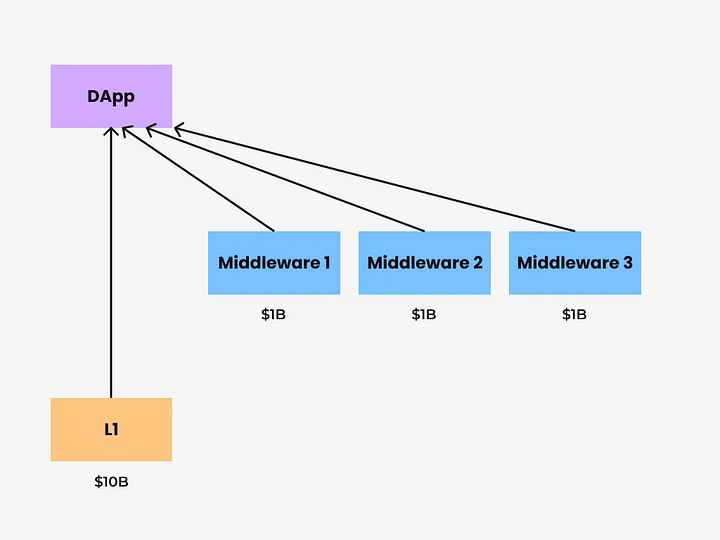
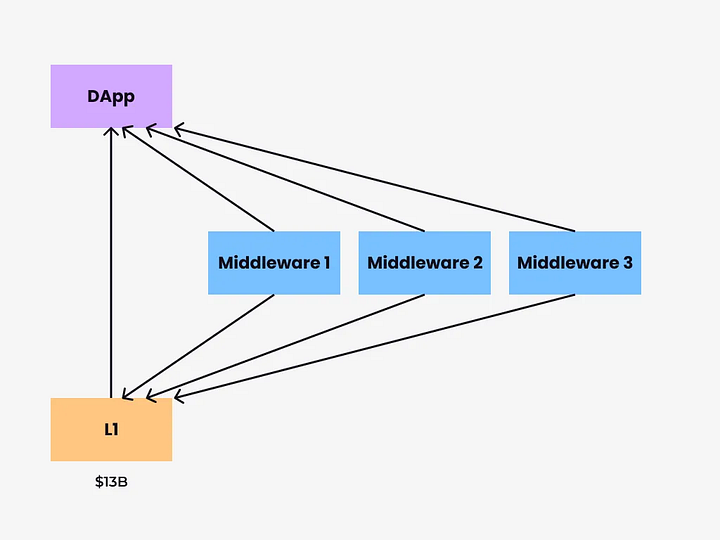
For example, as shown in the figure below, even if the L1 used to build the dApp is secured by $10 billion in ETH, if the middleware are each secured by $1 billion in ETH, then the dApp actually relies on middleware with weak security. This is easily observed in the hacking incidents that DeFi protocols have experienced due to cross-chain bridge or oracle problems.

All of the above problems stem from fragmented trust. So, is it possible to take advantage of Ethereum's strong trust layer when building dApps? That is, can we not depend on middleware?
EigenLayer is to solve these problems.
How EigenLayer works
EigenLayer is a project led by Sreeram Kannan, a professor in the Department of Electrical and Computer Engineering at the University of Washington in Seattle, with the goal of enabling other protocols and dApps to take advantage of the security of the Ethereum network.
To understand EigenLayer simply, we can think of it as the Ethereum version of Cosmos ICS (Interchain Security). The biggest disadvantage of Lisks in the Cosmos ecosystem is that they need to bootstrap a new set of validators to maintain the security of the chain. However, if a new AppChain uses Cosmos' ICS, Cosmos validators can verify the newly joined AppChain's transactions in exchange for block rewards, enabling the new AppChain to rely on the strong security of Cosmos.

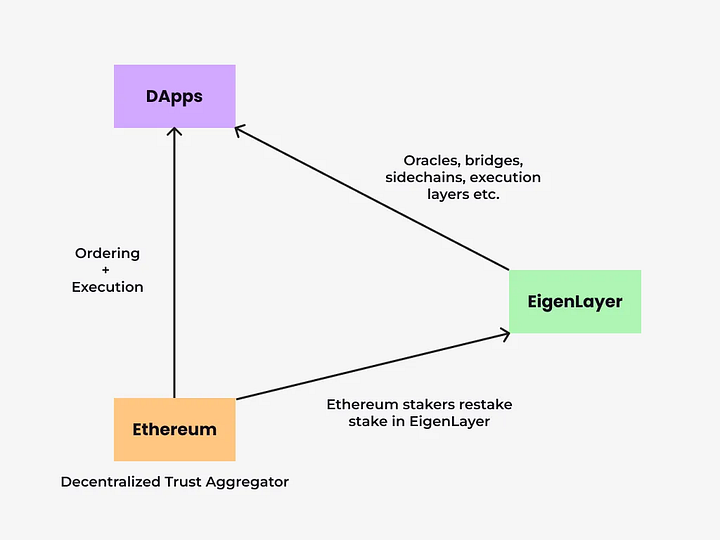
EigenLayer's goal is similar to Cosmos ICS, but uses a slightly different approach: "re-staking" as a core mechanism.
"Re-staking" refers to re-staking with tokens that have already been pledged.
Ethereum validators pledge ETH tokens to participate in the process of creating and verifying blocks, and strengthen the security of the network by confiscating part of ETH (slashing) when they have malicious behavior.
EigenLayer goes a step further by allowing already pledged ETH tokens to be re-staked in other protocols and dApps and participate in their verification process, thus enabling other protocols and dApps to take advantage of the security of the Ethereum network to a certain extent.
However, during the "re-staking" process, ETH tokens are subject to slashing imposed by other protocols as well as Ethereum. If validators participating in the re-staking process lose their staked ETH tokens due to another protocol’s forfeiture penalty, they will still lose their staked ETH tokens even if they followed the rules of the Ethereum network.
Currently, if a validator on the Ethereum network engages in malicious behavior, they can forfeit half of their staked 32 ETH tokens, or a maximum of 16 ETH. And EigenLayer allows forfeiting the remaining half.
While participating in “re-staking” doubles the risk, it also increases the total reward, since it earns not only the Ethereum block reward, but also rewards from other protocols. Therefore, verifiers can verify other protocols through EigenLayer "re-pledging" to obtain additional rewards. Regular users who stake in the Ethereum network can also benefit from these advantages.
Use Cases for EigenLayer
1. Other consensus protocols and execution environments

EigenLayer can solve this problem by introducing a new mechanism called "re-staking", which allows validators in the Ethereum network to not only provide security for other middleware such as oracles and cross-chain bridges, but also for the use of A network of new consensus protocols and execution layers provides security. If developers want to use Avalanche's Snowman consensus protocol as the consensus layer and a virtual machine optimized for game execution as the execution layer, while combining Ethereum's security to a certain extent, EigenLayer can make this possible.
2. Combine and enhance existing security
Other protocols can also take advantage of EigenLayer while maintaining existing security mechanisms.

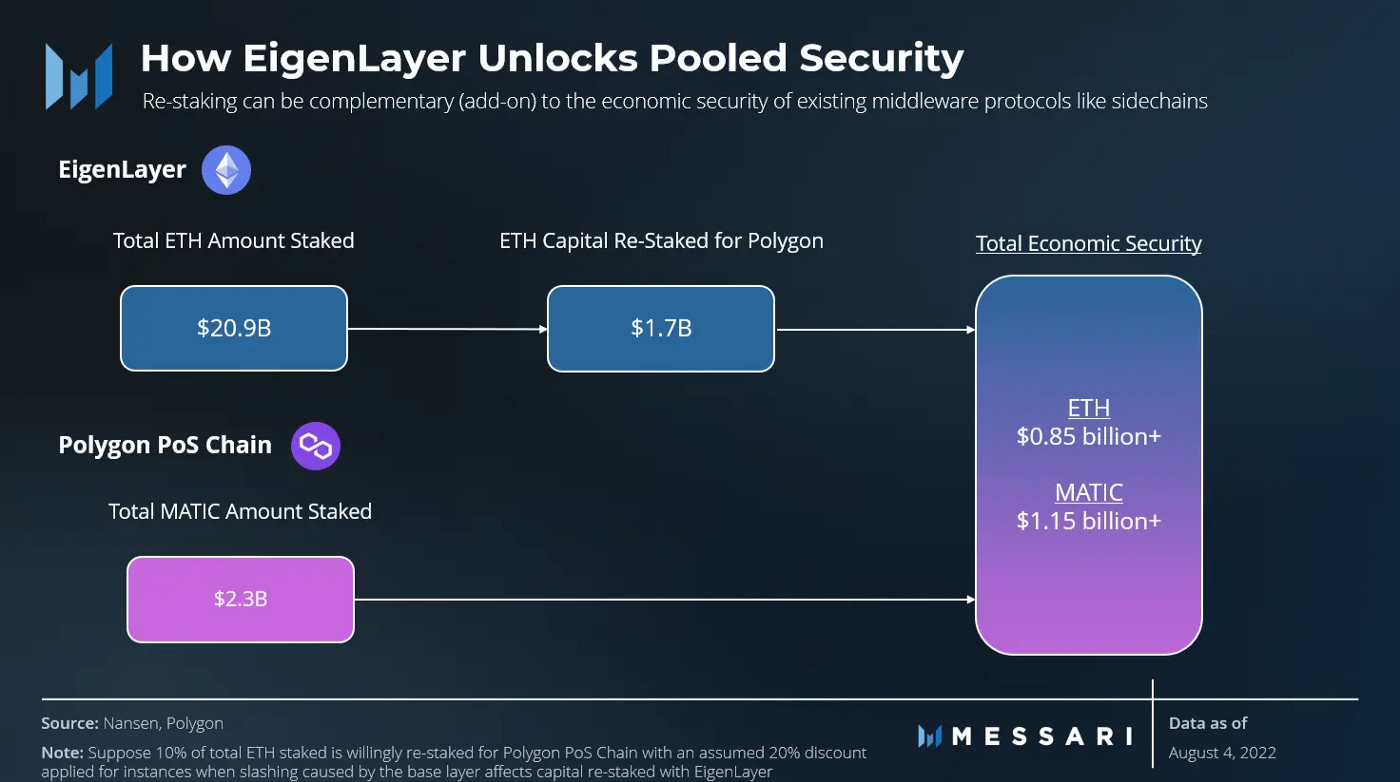
For example, suppose Polygon uses EigenLayer for network security. Assuming more than 50% of staked tokens compromise security, if the value of MATIC tokens staked in the Polygon network is $2.3 billion, the amount required to compromise the network is $1.15 billion. If $1.7 billion of ETH is "re-staked" with the Polygon network, the total economic security of the Polygon network increases by $850 million, allowing it to enjoy a higher level of security.
This can also solve the problem of weak middleware security. Even if only a small amount of ETH tokens mortgaged in Ethereum are "re-pledged" into various middleware (such as oracles and cross-chain bridges), the huge market value of ETH can greatly increase the security of middleware. In turn, increased stability of middleware can improve the stability of the DeFi protocols that depend on them.

3、EigenDA

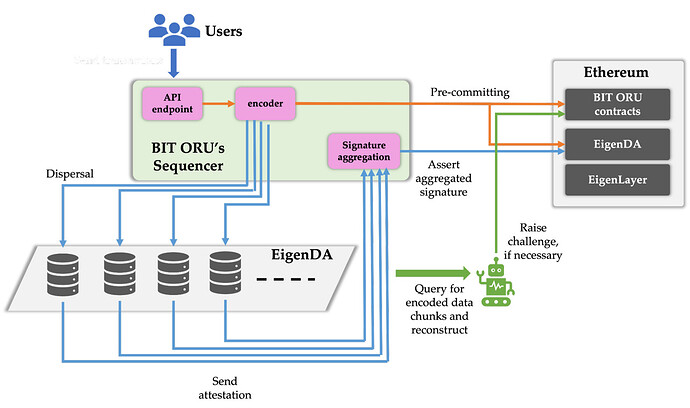
EigenDA is a data availability layer developed by the EigenLayer team. The data availability layer is a layer that only focuses on data storage and verification, and is also critical to the security and scalability of the network. Other data availability layers include Celestia and Polygon Avail, which maintain security through their own token staking mechanisms. However, EigenDA has the advantage of maintaining security through the already valuable ETH tokens in the market.
Data availability on the Ethereum network is currently the biggest limiting factor in scaling the rollup network, although the introduction of EIP-4844 and sharding is expected to improve data availability on Ethereum and the scaling of the rollup network. Therefore, EigenDA has been adopted by L2 networks like Mantle Network. Mantle decided to use EigenDA for data availability while forking the settlement layer from the Ethereum network.

From an L2 network perspective, using EigenDA is easier to say it gets security from Ethereum than using other data availability layers.
Some disadvantages of EigenLayer
However, there are several problems with using EigenLayer.
First, users may be less willing to use EigenLayer's native token. This is because users can participate in EigenLayer and earn rewards by "re-staking" ETH without the need for other protocols' native tokens. Therefore, the token economics of EigenLayer may be greatly affected.
Second, security incidents are worrying. If a significant portion of ETH staked on the Ethereum network is used to "re-stake" in other protocols, a security hole in one of the protocols could result in a large amount of ETH being forfeited. This could lead to a decrease in the security of the Ethereum network. To prevent this, users should be vigilant when investigating and selecting protocols for "re-staking". Moreover, the confiscation conditions should not be too harsh.
Third, token reward distribution for protocols using Eigenlayer should be considered. When adopting EigenLayer, the protocol must distribute its native token as an incentive to existing participants and "re-staking" participants. If too much reward is given to “re-staking” participants, it will affect the token economics of the protocol and cause existing participants to leave. Conversely, if the reward is too low, participation in “re-staking” may decrease.
epilogue
epilogue
EigenLayer introduces a new concept called "re-staking" that allows the use of Ethereum's trust layer. EigenLayer has the potential to add "decentralized trust" by allowing other protocols to leverage Ethereum's security.
As the protocol's demand for EigenLayer increases, more users will be encouraged to pledge ETH, which will contribute to the network security of the entire Ethereum and the token value of ETH.
According to the "Notice on Further Preventing and Dealing with the Risk of Hype in Virtual Currency Transactions" issued by the central bank and other departments, the content of this article is only for information sharing, and does not promote or endorse any operation and investment behavior. Participate in any illegal financial practice.
risk warning:
According to the "Notice on Further Preventing and Dealing with the Risk of Hype in Virtual Currency Transactions" issued by the central bank and other departments, the content of this article is only for information sharing, and does not promote or endorse any operation and investment behavior. Participate in any illegal financial practice.