Web3 Growth Handbook: How to use the Web2 growth framework to expand more successful products?


Original compilation: Captain Hiro
Original compilation: Captain Hiro
This is a series of articles exploring how Web3 founders and builders are using some of Web2's growth frameworks to scale more successful products.
The growth model of Web3
Create a durable growth strategy for Web3
Build Your Web3 Growth Team
image description
Source: Galaxy Digital
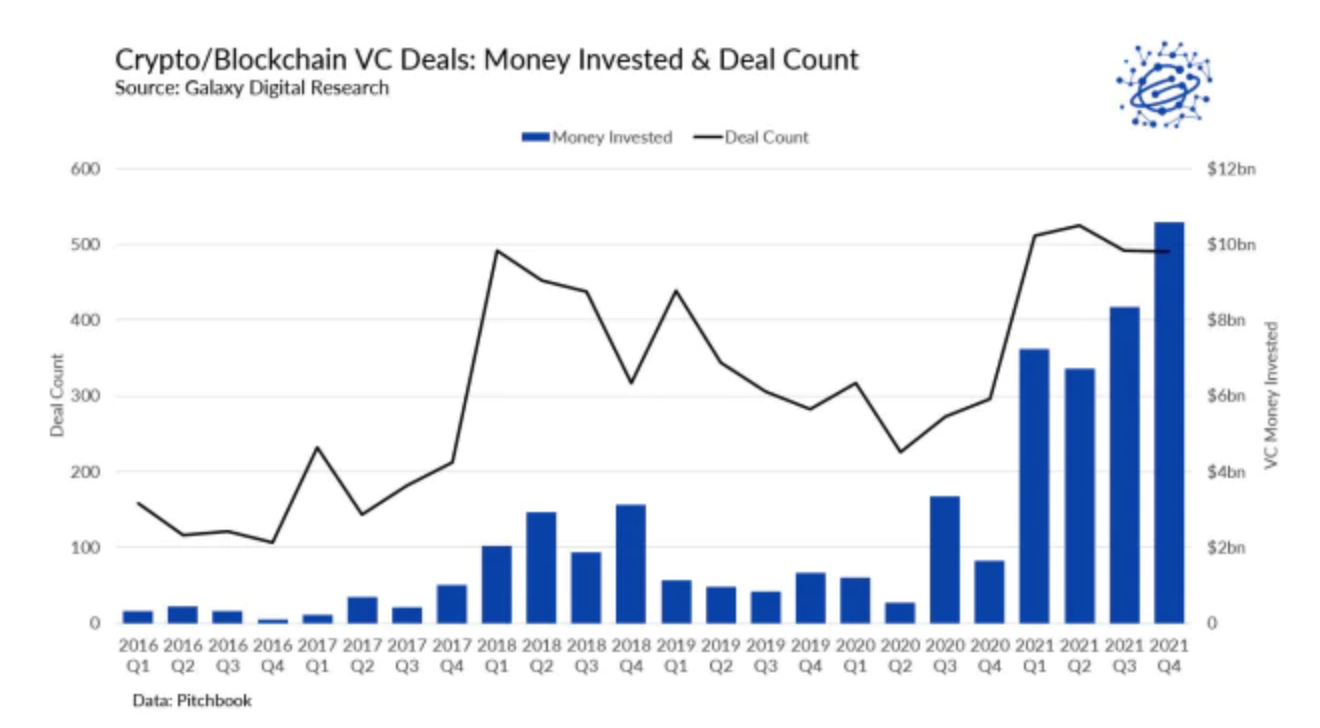
I don't think the cryptocurrency space will slow down in 2022, because we have seen some investment funds raise a lot of money and prepare to deploy in this field. The most important announcements of the year include: Paradigm's $2.5 billion fund, Andreessen Horowitz (a16z) $2.2 billion fund, FTX's $2 billion investment fund, and Crypto.com's just-announced $500 million fund.
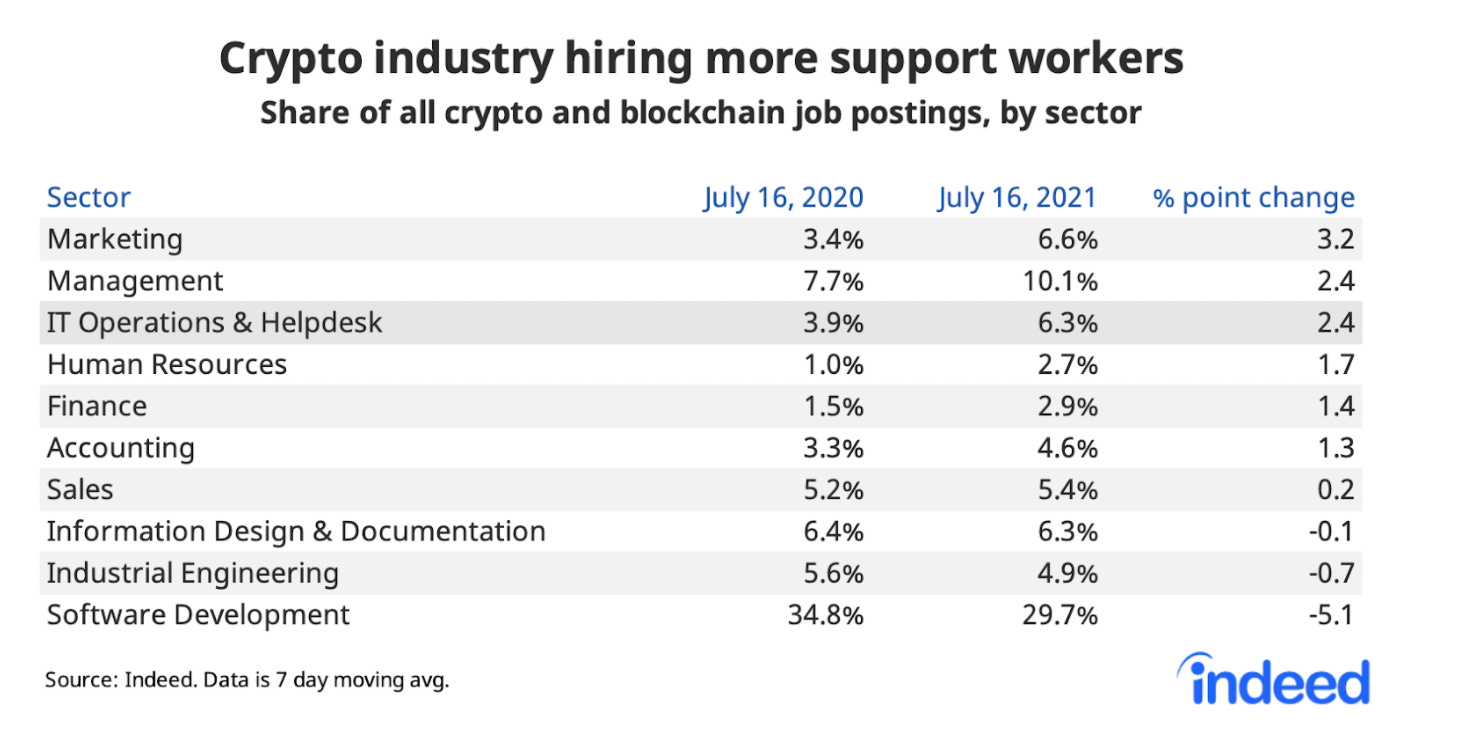
With investors throwing big bucks behind the cryptocurrency ecosystem, expectations will get higher, and Web3 companies will have to go all-in on growth. This scenario is somewhat similar to what happened in the Web2 space a decade ago, and we should expect to see companies in the cryptocurrency space rushing to hire for growth roles (already appeared), and scrambled to build teams that could scale a successful growth model.
I believe that Web3 enables a completely different approach to growth at every level - from acquisition channels and tactics, user experience and onboarding experience, to user retention and engagement leverage (more on this in a future article). But Web3 also adds a different set of challenges in an area where decentralization, anonymity, protocol ownership, and user-owned data are the new norms.
andframeandmanualis being rewritten.
But what principles and systems from Web2 can we bring into this new thriving ecosystem?
Briefly describe the growth of Web2
Before we dive into what growth means for Web3, let's give a high-level overview of what's been around the growth framework for Web2 companies over the past decade.
Andy JohnsThere is one of the best quotes that can be used to explain what growth really means at its most basic level:
If finance means owning the cash flow in and out of the company, growth means owning the flow of customers into and out of the product.
As you may have heard before, growth cannot be defined by a specific set of tactics, silver bullets, or exact roles within your company, and this holds true for both Web2 and Web3 products.
Growth is a system that sits between your company mission, values and business model and helps you define:
1. How should our product grow?
andandReforgeThe team did a fantastic job breaking it down into four questions that help us answer the above;
1. How do we acquire users? 2. How do we retain users? 3. How do we monetize? 4. How do we build our own moat?
Looking at these questions through the specific growth cycle in your business will help you build a holistic growth model for your company.
Not only the product-market fit, a well-structured growth model also needs to find four basic points of fit: market-product fit, product channel fit, channel model fit, and model-market fit.
Once we understand how our product will grow and fit with our community/market, channel and business model, then we can then define a sustainable, scalable go-to-market or growth strategy.
As more and more companies put their teams together to drive unique go-to-market and growth strategies, winning in growth requires not only the best approach but also the best team structure, to deploy this strategy as quickly as possible.
casey winters(Former Head of Growth at Pinterest/Grubhub) in hisdefinition of growthThese fields are separated in:
The purpose of growth is to expand the use of products with product/market fit. To do this, you create a playbook (playbook) on how to expand the use of the product, which can also be called a growth pattern or cycle.
He went on to add:
Most product teams are built to create or improve core value delivered to customers. Growth is about connecting more people to existing value.
We could spend hours delving into exactly what growth means, and howProduct, Company and Team, and there's already good content out there for you to dig deeper into the topic.
So, now that we have a basic understanding of how growth can act as a system and provide answers for your product, let's look at the growth model of Web3.
The Growth of Web3 Companies
How does your Web3 product scale?
We can break down this problem statement into four core questions we need to answer so we can lay the groundwork for our growth model.
How do we acquire users?
Lattice Capital has done a good job on how the now proven Web3 companies can start to develop their acquisition strategiesSegmentationimage description
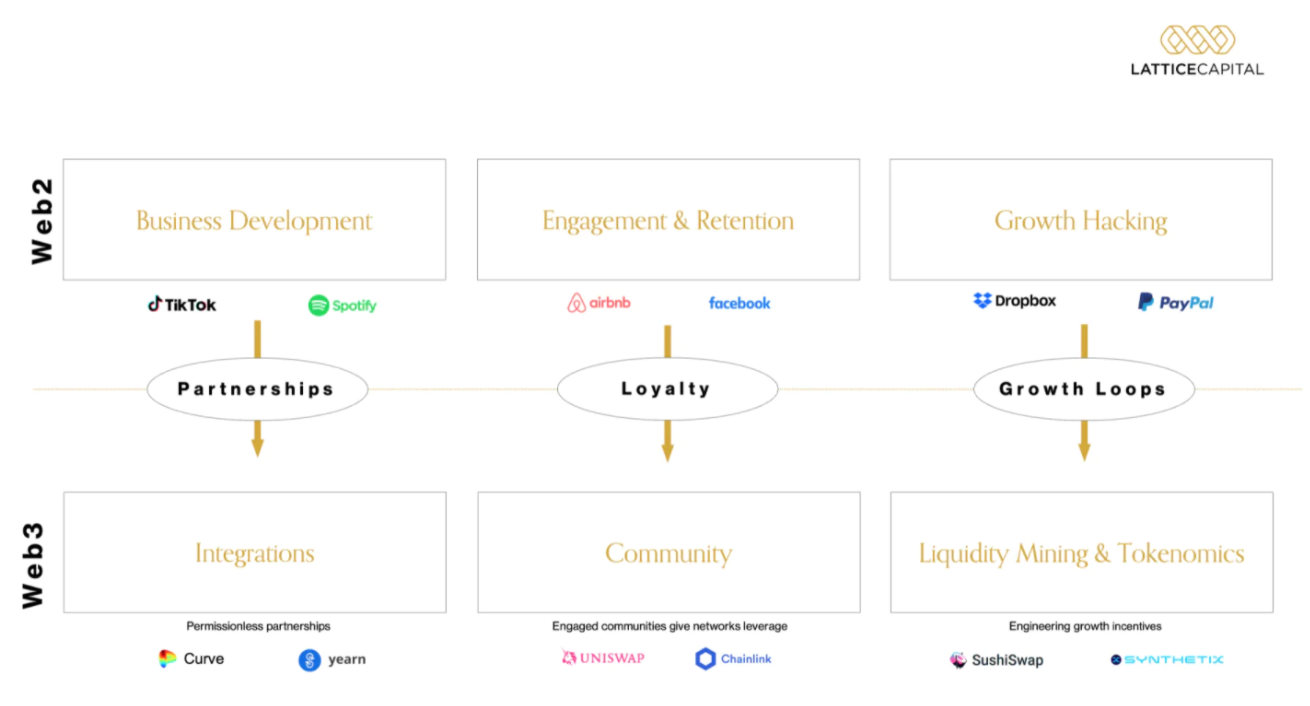
The Web3 Growth Playbook
However, the above tactics rely on the assumption that their target users are already familiar with or have entered the Web3 ecosystem, it does not necessarily have any insight into how or who will help access the next billion users.
The current playbook for crypto company acquisitions is still very volatile and full of unknowns, especially given the inherent friction a newcomer must go through when starting out on Web3, from joining Discord, to building Metamask, buying NFTs, sourcing open bounties, etc. . The system remains fraught with friction and barriers for the “regular user” to easily join and participate in the space, and we’re seeing a rapid increase in competition between companies to capture the current crypto-educated consumer.
The winners in the Web3 space will be those who can clearly define:
Where does this product stand on the spectrum of centralization and decentralization?
Is this a network effect driven business?
What does success look like? (user growth, total locked stake, developer activity, transaction volume, connected wallets, etc.).
How do we retain users?
User retention is the foundation of any growth strategy. For Web2 companies, user retention rate is the basis for measuring product-market fit, and usually a positive retention rate helps drive the company to more acquisitions and revenue.
One of the biggest challenges I see between Web2 and Web3 growth is user retention and how we think about it. Why? Because in Web2 we're mostly driven by email, push, in-app retention of users or customers, which is basically lifecycle marketing driven by the ability to attract and "resurrect" specific users. But in Web3, there is no concept of "users" (they are identifiable individuals), and we cannot lock them through traditional life cycle policies.
exist
existDefinition of "identity" in Web3The implication is one of the most challenging and interesting attempts in the field in the coming years. User ownership and governance, on-chain activity, community engagement are proving to be some of the fundamental mechanisms shaping the future of Web3 corporate loyalty/retention programs.
My guess is that many of these questions will start to be answered this year. Vertical industries that have risen in the past two years, such as NFT (non-fungible tokens), DeFi (decentralized finance) and DAO (decentralized autonomous organizations) will have to quickly iterate and discuss how to solve user loss and user retention. Innovate so that they can sustain their current growing trajectory, as macroeconomic conditions may have an impact on the current bullish sentiment in the cryptocurrency market.
How do we achieve monetization?
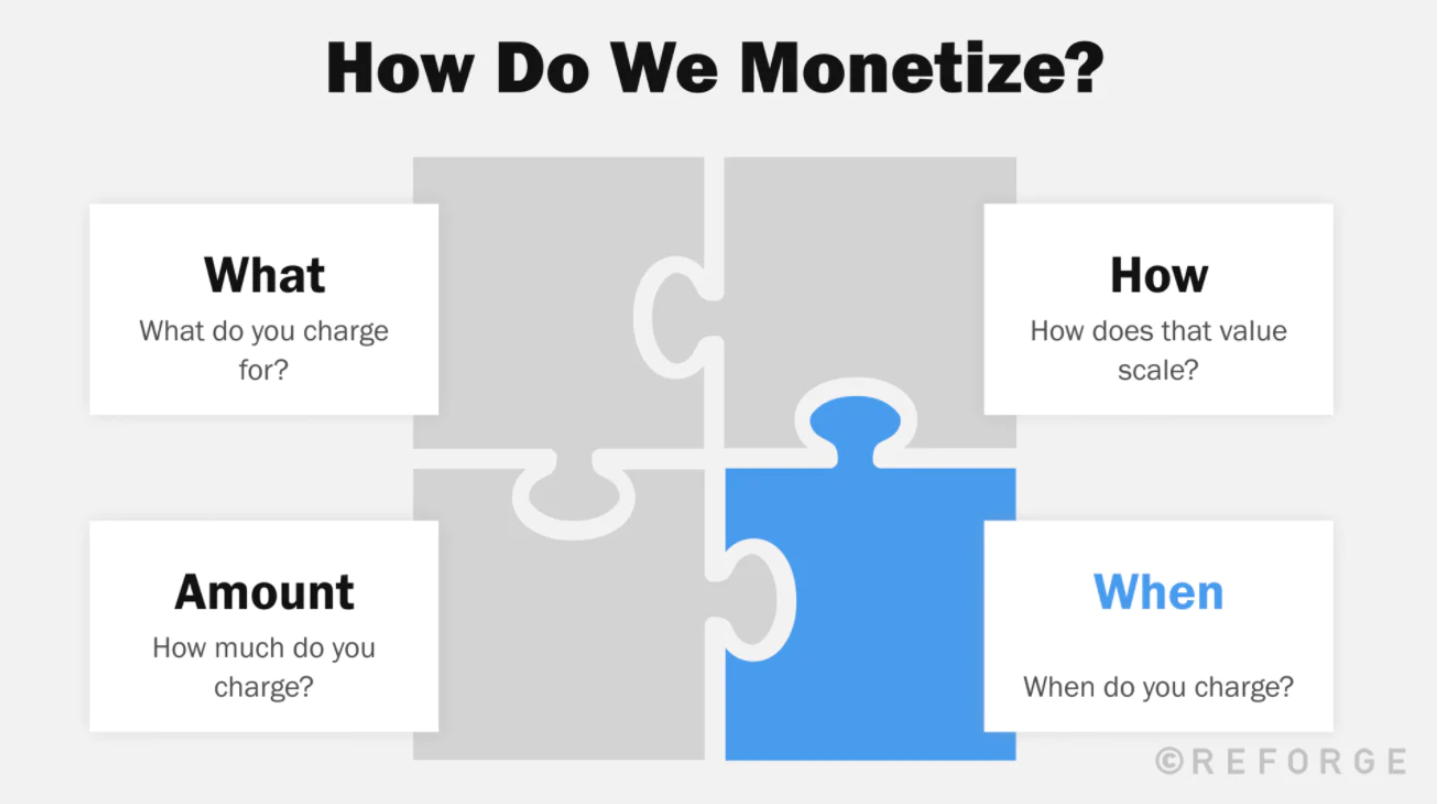
For Web2 and Web3 companies, "monetization is more than price," as Reforge'sExperiment + Test Planimage description
Source: Reforge.com
When we think about all the elements of a monetization strategy, we need to realize that our decisions around each specific element will create more or less friction for someone to become a paying customer or user of our product, unlike Web2 and Web3 companies It's all about.
If the thing we want to charge is really well-known to users and is very easy to understand, it is low friction, but if the thing we want to charge is a new product in the market, and it is not well understood by users, it is an unknown, then it High friction will result - Reforge
So far, large centralized Web3 companies like Opensea or Coinbase have leveraged "high-profile and well-understood" monetization strategies (such as transaction fees or listing/selling fees) to reduce the friction for new users to join and use their platforms .
But Web3 opens up a broader possibility for decentralized organizations, namely new revenue streams. For example, see how "free-to-X" DAOs, games, Web3 social networks, etc. will monetize their treasury through DeFi strategies and break down the common thinking that "if you don't pay for the product, you are the product" , which would be interesting.
How do we build a moat?
This one is fromStatistaimage description
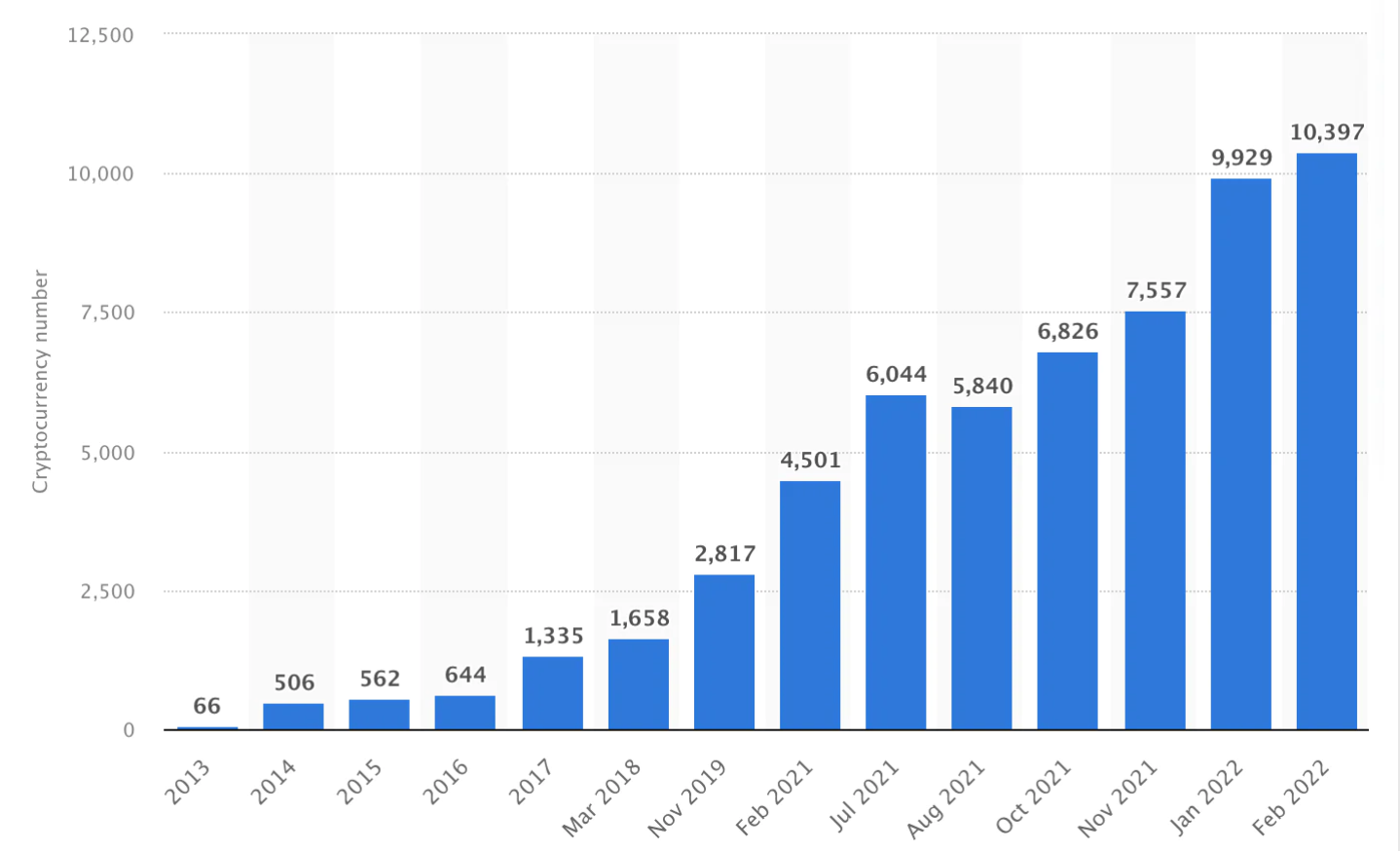
Number of cryptocurrencies worldwide from 2013 to February 2022
Although Web3 and cryptocurrencies are still very young industries, they have the courage to compete and be the first. For example, LooksRare drove a$100 million in NFT sales, the platform is currently a serious competitor of Opensea.
"Growth = speed and speed is the competitive advantage in today's market - Matt Biphons"
As more competition enters the space, current distribution channels will become less effective. Right now, everyone is somewhat discord tired, and distrusts most airdrops.
We're seeing some really interesting things happen around user ownership, network participation, token economics, etc. But a defensible moat in the Web3 ecosystem will have a foundation very similar to what we've seen drive the growth of some of the most successful Web2 companies: network effects, strong communities, andBuild our growth model。
Build our growth model
In short, your growth model is a system or cycle that represents a qualitative or quantitative means of informing the growth of your product.
Answering our traversal questions will set a path for your company, clearly defining and communicating strategy, goals, metrics, priorities, and teams, helping to scale sustainably and rapidly.
This is one of the most common mistakes founders make when I ask 'how will your product grow? ’ The answer is usually a long list of linear tactics. This is often due to not assuming what the growth bearer engine is, so, they make it up by trying to cobble together a lot of little things. – Brian Balfour (Founder/CEO of Reforge, former VP of Growth at HubSpot)
exist
existSafary(a community of web3 growth experts), we are defining what Web3 growth looks like.
grateful
gratefulJiekeOriginal link