


Global Payments Weekly | 2026W44


Author / Editor: WANG TAI
1. This Week's Highlights
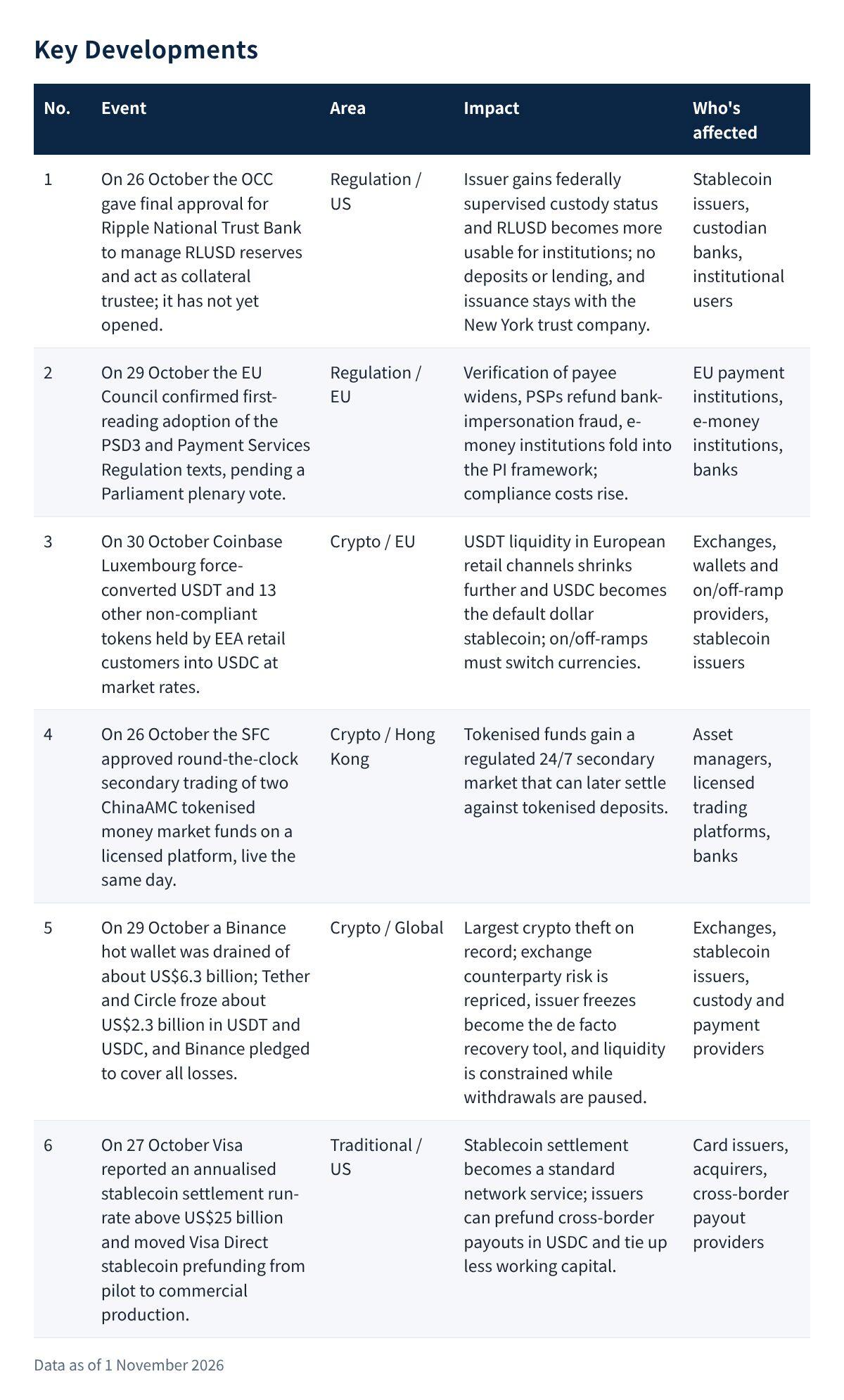
The week's defining change is that stablecoin freeze powers were used as a system-level safety valve for the first time. On 29 October a Binance hot wallet was drained of roughly US$6.3 billion; within hours Tether and Circle froze about US$2.3 billion in USDT and USDC, and Binance pledged to cover all losses. In the same week the OCC gave final approval to Ripple's national trust bank, the EU Council confirmed first-reading adoption of PSD3 and the Payment Services Regulation, and Visa disclosed an annualised stablecoin settlement run-rate above US$25 billion. Regulators are tightening who may issue and custody; networks are pushing stablecoin settlement into commercial use.
The first signal is that an issuer's freeze power is now the industry's last line of defence and a new due-diligence item. About US$2.3 billion of the stolen assets sits frozen; recovery depends on issuers and law enforcement working together. For any payment company holding stablecoin balances, the issuer's freeze policy, response time and appeal path now matter as much as reserve quality.
The second signal is that US issuers are acquiring federal institutional status. Ripple National Trust Bank received final approval on 26 October, and the same day the OCC publicly encouraged community banks to apply as payment stablecoin issuers. Issuance is moving from state trusts to federal supervision, though the application window opens only after the rule takes effect in January 2027.
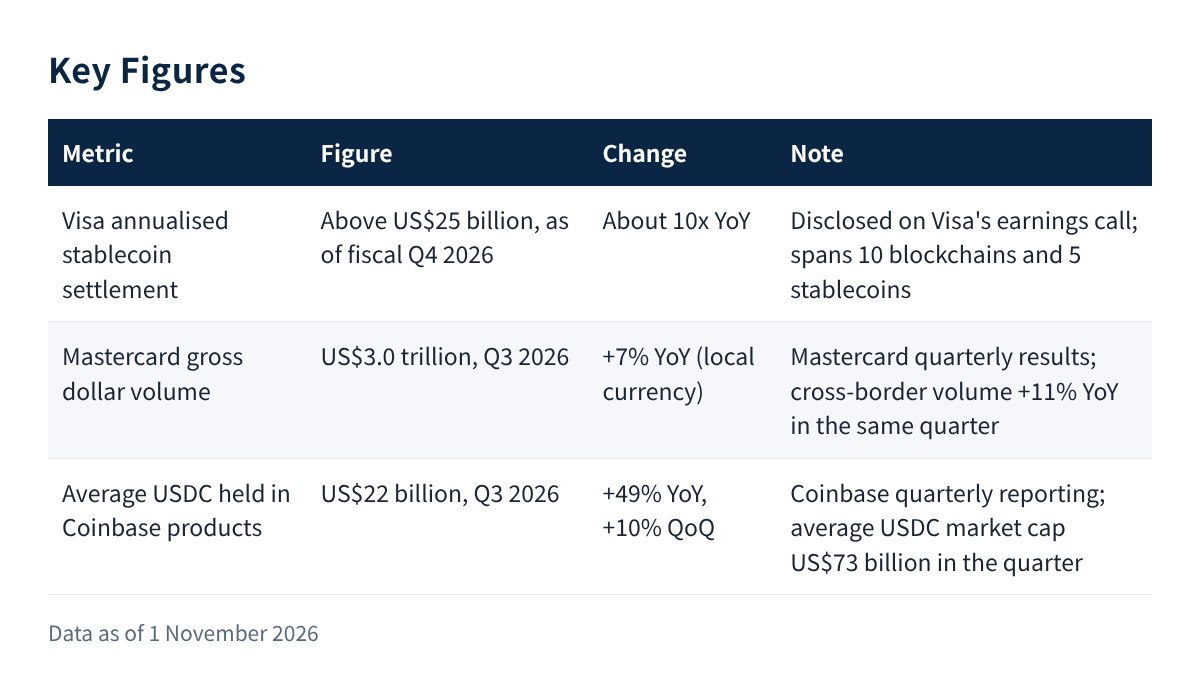
The third signal is that card networks now report stablecoin settlement as an operating metric. Visa said on 27 October that its stablecoin settlement run-rate grew roughly tenfold year on year and that Visa Direct stablecoin prefunding moved from pilot to commercial production. Mastercard said on 29 October it had connected the Global Money Platform built on BVNK to Mastercard Move, so stablecoin balances can be paid straight into local bank accounts. For issuers and acquirers, stablecoin settlement is now a standard network service.
All three items flagged last week resolved. Visa, Mastercard and Coinbase reported on schedule, with the two networks' payment volume growing 7–9% rather than slowing as American Express did; the HKMA's designation of 12 offshore renminbi primary liquidity providers took effect on 27 October; and after the EBA's MiCA penalties consultation closed on 26 October there was no further public step this week.
Key Figures
2. Key Developments
3. Analysis
Traditional payments
The Council's first-reading adoption of PSD3 and the PSR landed in the same week Wero went live for e-commerce in the Netherlands with 11 banks, aiming to migrate about 15 million iDEAL users by end-2027. The new rules put refund liability for bank-impersonation fraud on PSPs and extend verification of payee to more transfers, which is exactly the compliance base an account-to-account scheme needs. Account-to-account share in European e-commerce will keep rising, and card transactions in the Netherlands, Belgium and France face more substitution pressure.
Visa now reports stablecoin settlement volume in its results, and Mastercard has wired stablecoin-to-bank-account payouts into Move. Issuers that prefund in USDC hold less idle cash and settle around the clock, while the networks collect settlement and payout fees. Cross-border payout firms that earned spread from prefunding and time-zone gaps see that margin compressed; issuers' funding costs fall, but their dependence on the networks deepens.
Crypto payments
Tether and Circle froze about US$2.3 billion within hours because each issuer unilaterally controls its contract blacklist. For a payment company holding stablecoin balances, the real counterparty is the issuer, not the exchange, so appeal routes for wrongful freezes, response times and unfreeze conditions all belong in the contract. After Coinbase force-converted 14 tokens into USDC in Europe, retail dollar stablecoins there rest on almost a single issuer, and concentration risk rises.
Ripple's final trust-bank approval, the OCC's call for community banks to issue, and the SFC's 24/7 tokenised-fund trading all point the same way: reserves and custody are moving inside federally supervised or licensed institutions. As the bar for issuance rises, non-bank payment firms can compete for distribution, acceptance, on/off-ramps and freeze-related compliance services, while the economics of issuance accrue to licensed custodians.
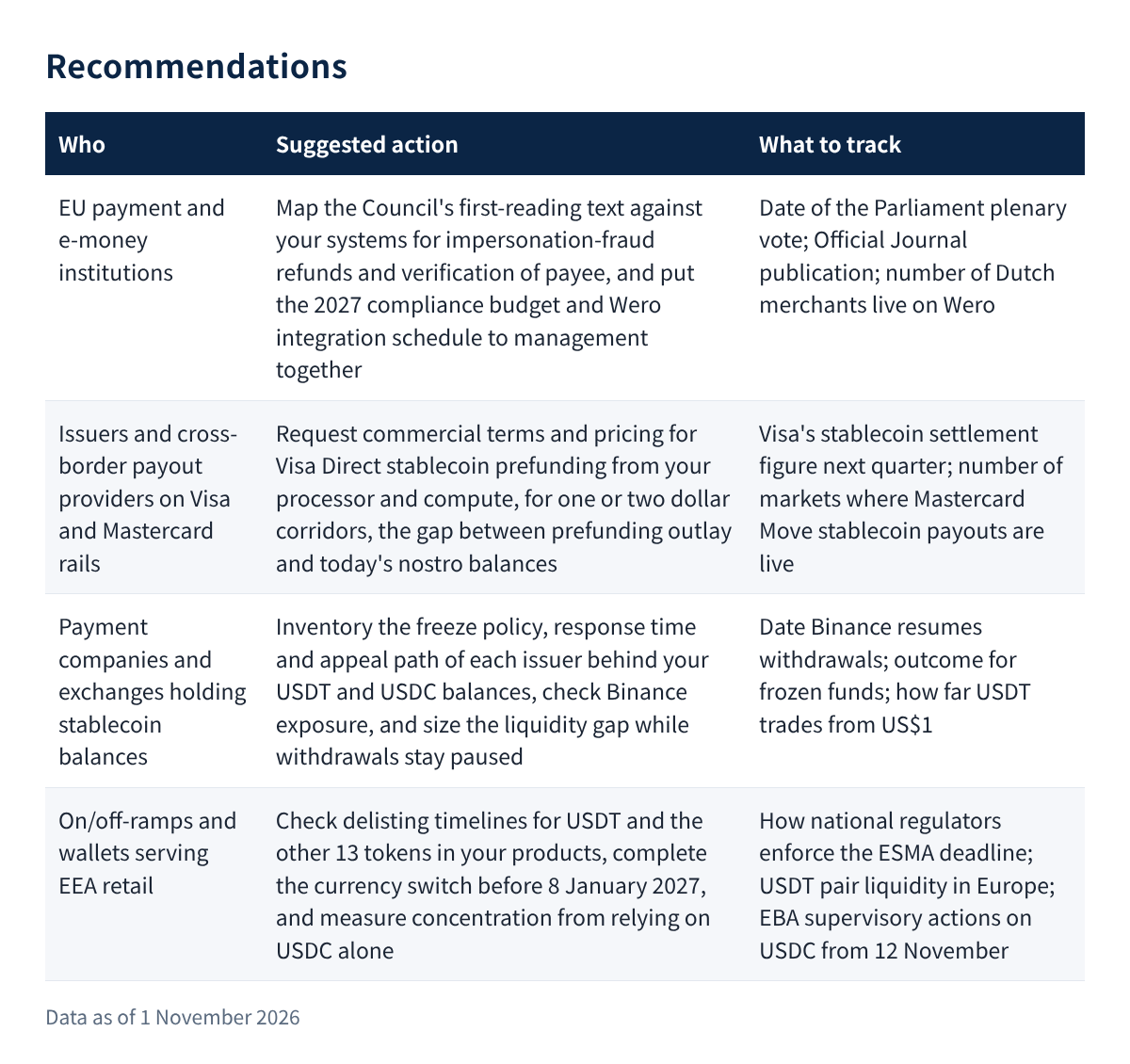
4. Recommendations
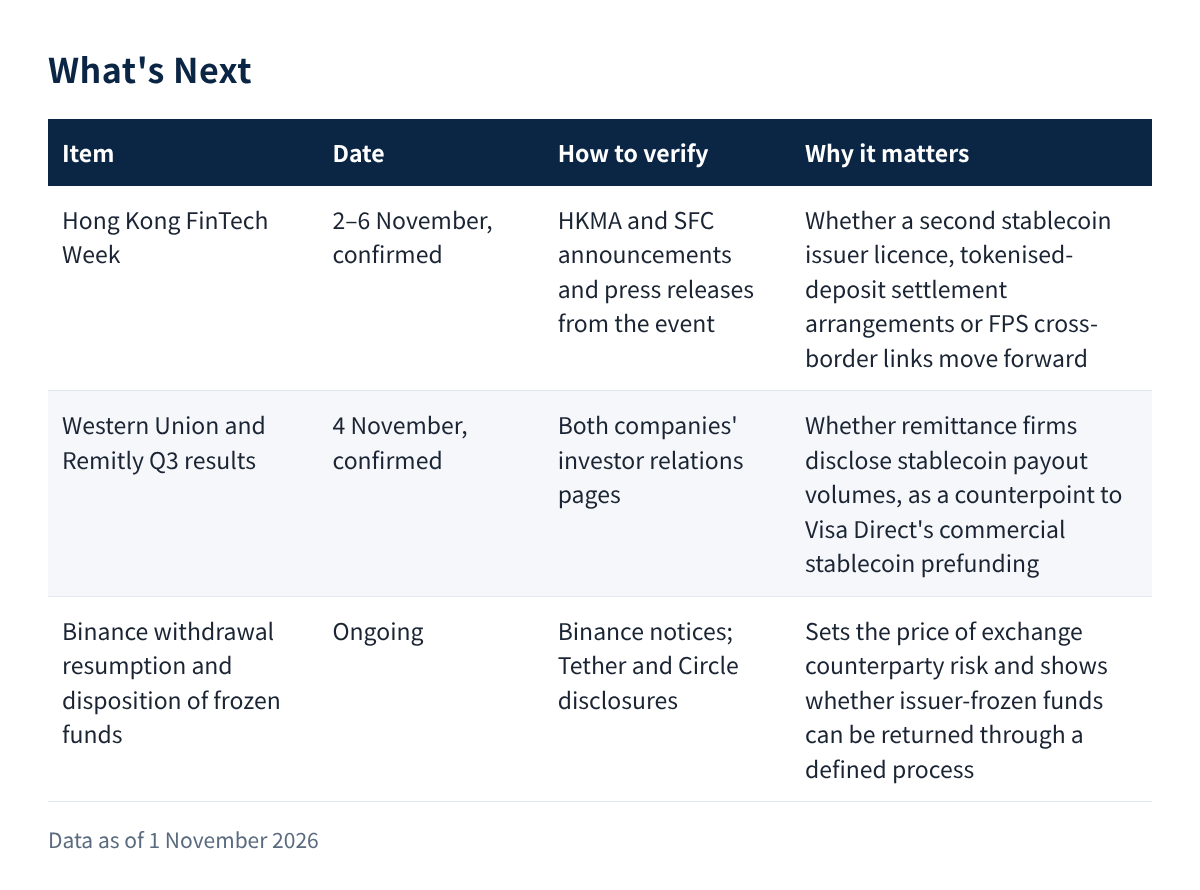
5. What's Next
Covers 2 – 8 November 2026.
6. Deep Dive | After US$2.3 billion in stablecoins was frozen, who controls settlement finality?
This week's evidence
On 29 October a Binance hot wallet was drained of about US$6.3 billion. Tether and Circle froze about US$2.3 billion in USDT and USDC within hours; Binance said that night that total freezes were around US$3 billion, pledged to cover all losses from its SAFU fund and company money, and paused withdrawals. On 26 October the OCC gave final approval to Ripple National Trust Bank, whose role is to manage RLUSD reserves and act as collateral trustee for holders. On 30 October Coinbase Luxembourg converted 14 non-compliant tokens held by EEA retail customers into USDC at market rates. The same day, Tether disclosed a Q3 net operating profit of US$1.5 billion, total assets of US$191.45 billion and excess reserves of US$7.95 billion as of 30 September.
How the money moves and who gets paid
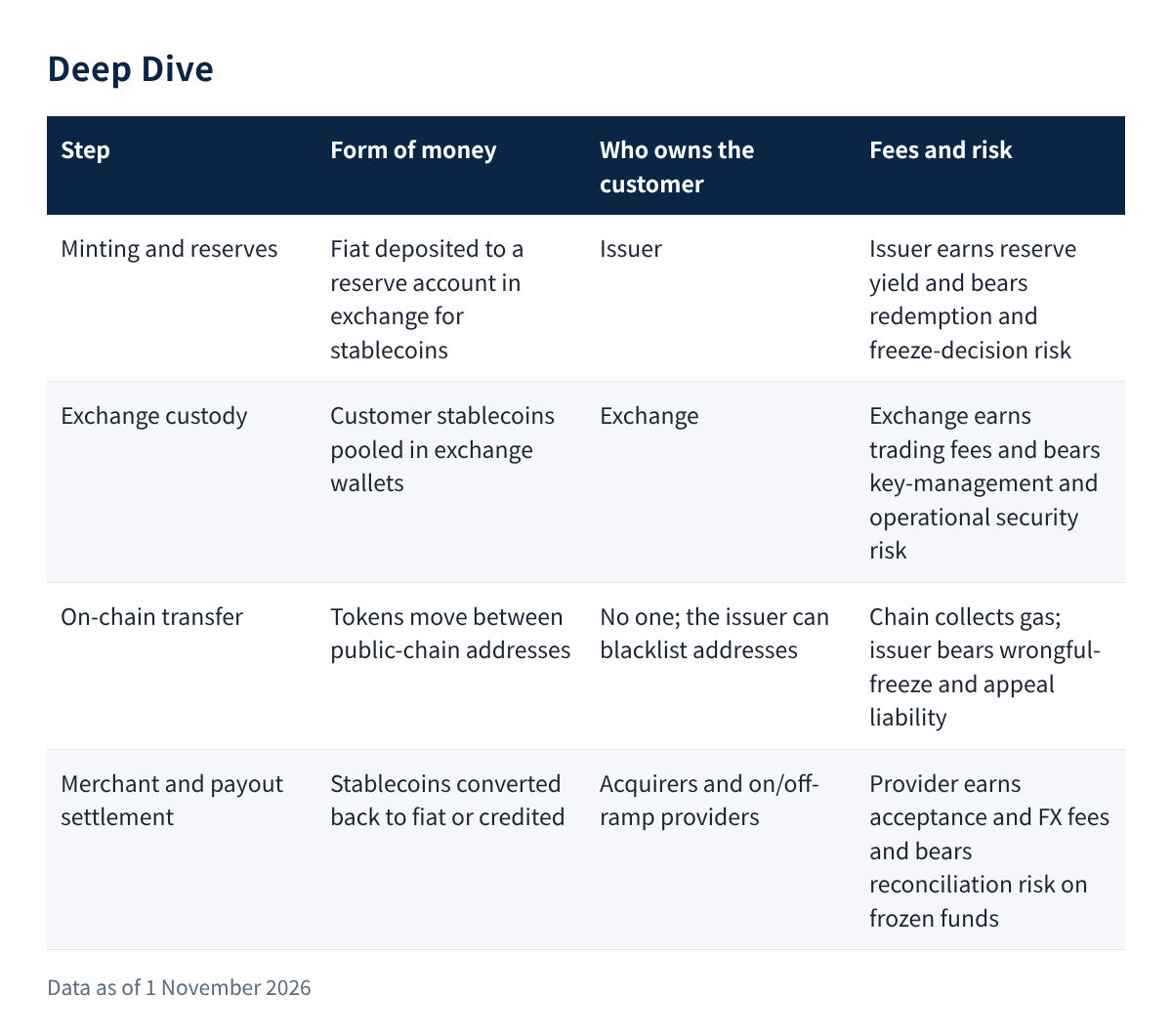
Settlement finality for a stablecoin does not live on-chain. A user deposits fiat into the issuer's reserve account to receive tokens; the tokens move between exchange wallets and public-chain addresses; an acquirer or off-ramp eventually converts them back to fiat. A confirmed transfer cannot be reversed, but the issuer holds the contract blacklist and can make any address's balance immovable. Here the exchange held customer assets but could not protect its keys; the issuers held no customers but controlled where the money could go.
What it means for both sides
For traditional payment institutions, the control point for stablecoin settlement risk is the issuer, not the clearing layer. With Visa's stablecoin settlement at a US$25 billion annualised run-rate, card issuers' prefunded balances already sit partly under stablecoin issuers' freeze and redemption terms, so contracts need freeze notification, wrongful-freeze appeal and redemption deadlines. For crypto payment firms, the freeze power cuts both ways: stolen funds may be recovered, but any customer balance can be stopped by a third party at any time. Ripple placing reserves inside a federal trust bank and Coinbase keeping only USDC in Europe both show compliance pressure pushing issuance toward a few licensed institutions, narrowing payment firms' bargaining room.
What is still missing
There is no public timetable for whether or how the roughly US$2.3 billion frozen will be returned; Binance has not set a date to resume withdrawals; Tether's reserve data runs to 30 September, with post-incident redemptions undisclosed; and Ripple has not said when the trust bank will open or whether RLUSD trusteeship will migrate to it.
How to verify
Watch three things: whether issuers publish a procedure and timeline for disposing of frozen funds; whether net redemptions of USDT and USDC in the week after Binance resumes withdrawals run well above normal; and whether USDC euro-pair liquidity absorbs the volume USDT used to carry in European retail channels. The first two depend on issuer and exchange disclosure; the third can be read from major exchanges' pair data.
7. Around the World
Malaysia: On 28 October PayNet and Alipay+ launched outbound DuitNow QR payments, letting Maybank, CIMB and Hong Leong mobile-banking users pay in mainland China, Hong Kong, South Korea, the Philippines and Laos.
Mainland China: On 29 October Tencent and Visa signed a memorandum to explore inbound and outbound traveller payments across Weixin Pay and the Visa network; no launch date was given.
Japan: On 27 October SBI, Startale and BlackRock signed a memorandum to explore linking tokenised money market funds with the yen stablecoin JPYSC.
Thailand: On 29 October the Bank of Thailand governor set out a timetable: baht stablecoin rules in March 2027 and a buy-now-pay-later licensing framework in December.
Brazil: On 30 October the central bank's authorisation deadline for virtual-asset service providers passed; firms that neither applied nor sit in the queue may no longer operate through regulated institutions.
Global: On 30 October the FATF plenary removed Bulgaria, Côte d'Ivoire, the DR Congo and Monaco from its grey list and launched a targeted review of jurisdictions with material virtual-asset activity.
Author / Editor: WANG TAI
Compiled from public reports and official announcements; analysis and recommendations reflect the editorial team's views.





