Global Payments Weekly | 2026W42


- 核心观点:Visa与Mastercard同周将稳定币从试点转为商用,欧盟同步把美元、欧元稳定币纳入持牌机构直接监管,稳定币的“前门”正围绕持牌机构快速整合,卡网络成为分发入口而发行方退为资产供应商。
- 关键要素:
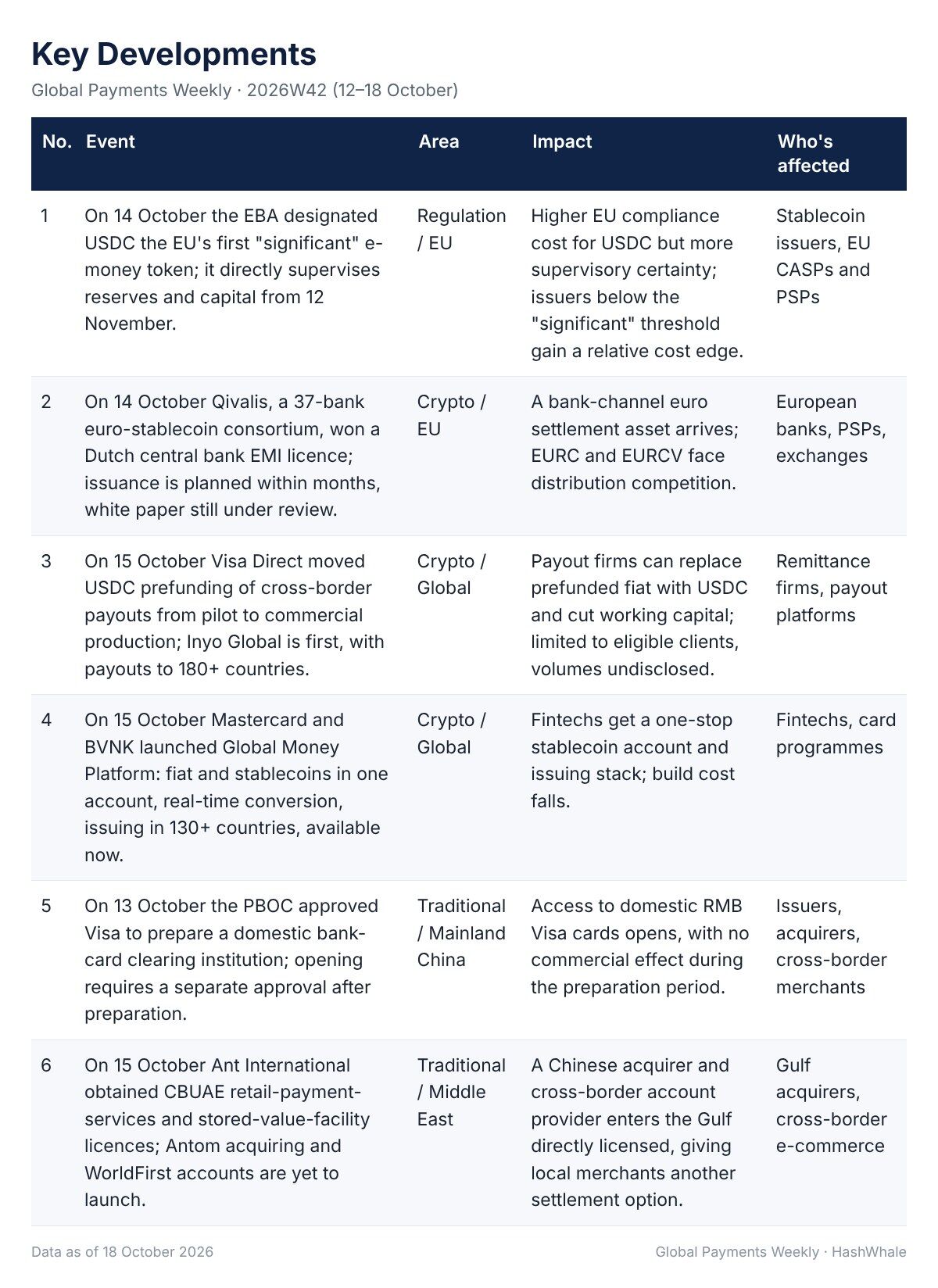
- 10月15日Visa Direct的USDC预融资进入商业生产,Mastercard与BVNK同日推出覆盖法币与稳定币账户、兑换、发卡及支付的Global Money Platform。
- 10月14日EBA将USDC认定为首个“重要”电子货币代币并自11月12日直接监管其储备;同日37家欧洲银行组成的Qivalis获荷兰电子货币机构牌照。
- 中国批准Visa筹备境内银行卡清算机构,蚂蚁国际获阿联酋央行两张支付牌照,均体现“牌照先于业务”的准入逻辑。
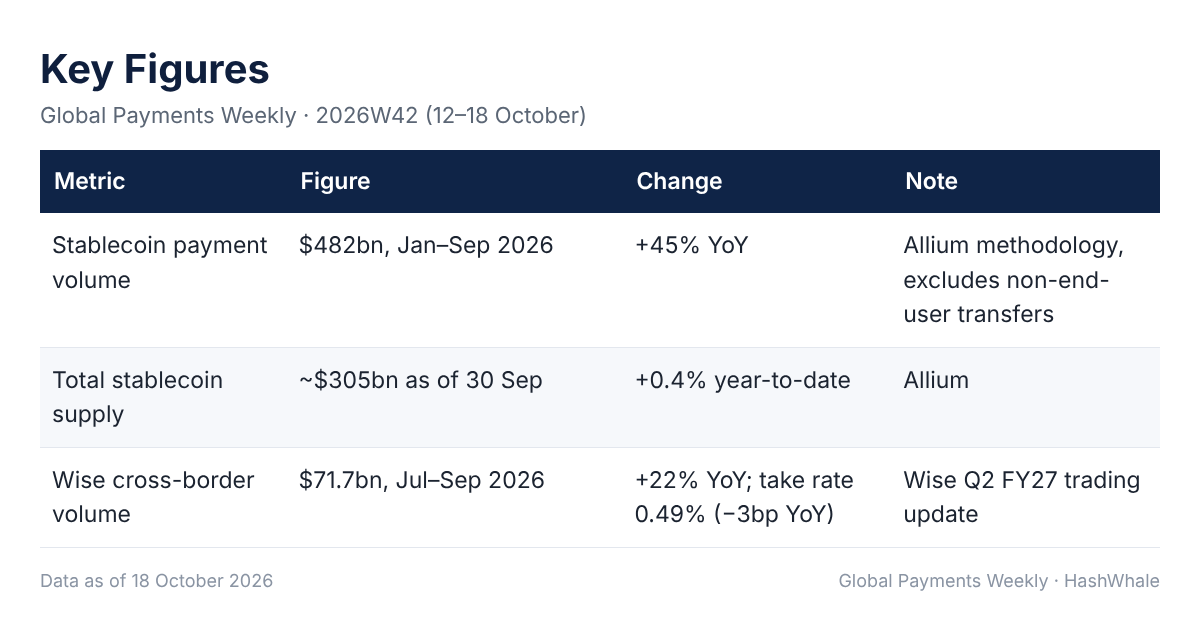
- Allium三季度数据显示,终端用户稳定币转账仅占链上总量的2.5%,稳定币卡消费39亿美元,约为Visa季度交易量的0.03%。
- 卡消费增长中84%来自50美元以下小额交易,或含较多试用性质;Visa与Mastercard均未披露客户数与交易量。
- 克莱夫兰联储9月底调查显示148家企业中仅1家使用稳定币,美国主流商业需求仍薄弱。
Author / Editor: WANG TAI
1. This Week's Highlights
The change worth remembering from this week is that stablecoins became a line item in the product catalogues of card networks and banks. Visa and Mastercard both moved stablecoin money movement from pilot to commercial use within the same week, while the EU put USDC's reserve supervision directly under the EBA and licensed a euro stablecoin backed by 37 banks. Distribution and supervision tightened at once, and the stablecoin front door is consolidating around licensed institutions.
Card networks moved from pilot to production. On 15 October Visa Direct's USDC prefunding entered commercial production, with Inyo Global the first processor to connect; the same day Mastercard and BVNK launched Global Money Platform, one API covering fiat and stablecoin accounts, conversion, issuing and payouts. Payment firms can now use stablecoins as payout liquidity without building onchain capability, and the networks become the distribution gateway.
The EU brought dollar and euro stablecoins under licensed, direct supervision at once. On 14 October the EBA designated USDC the EU's first "significant" e-money token, taking direct charge of its reserves and capital from 12 November; the same day Qivalis, a consortium of 37 European banks, received a Dutch e-money institution licence, with issuance expected within months. For any stablecoin business in Europe, compliance costs and counterparty choices will concentrate around licensed issuers.
Market-access windows opened in China and the Gulf together. On 13 October the People's Bank of China approved Visa to prepare a domestic bank-card clearing institution; on 15 October Ant International obtained two payment licences from the Central Bank of the UAE. In both cases the licence came before the business: licences, not products, are becoming the entry ticket for cross-border payments.
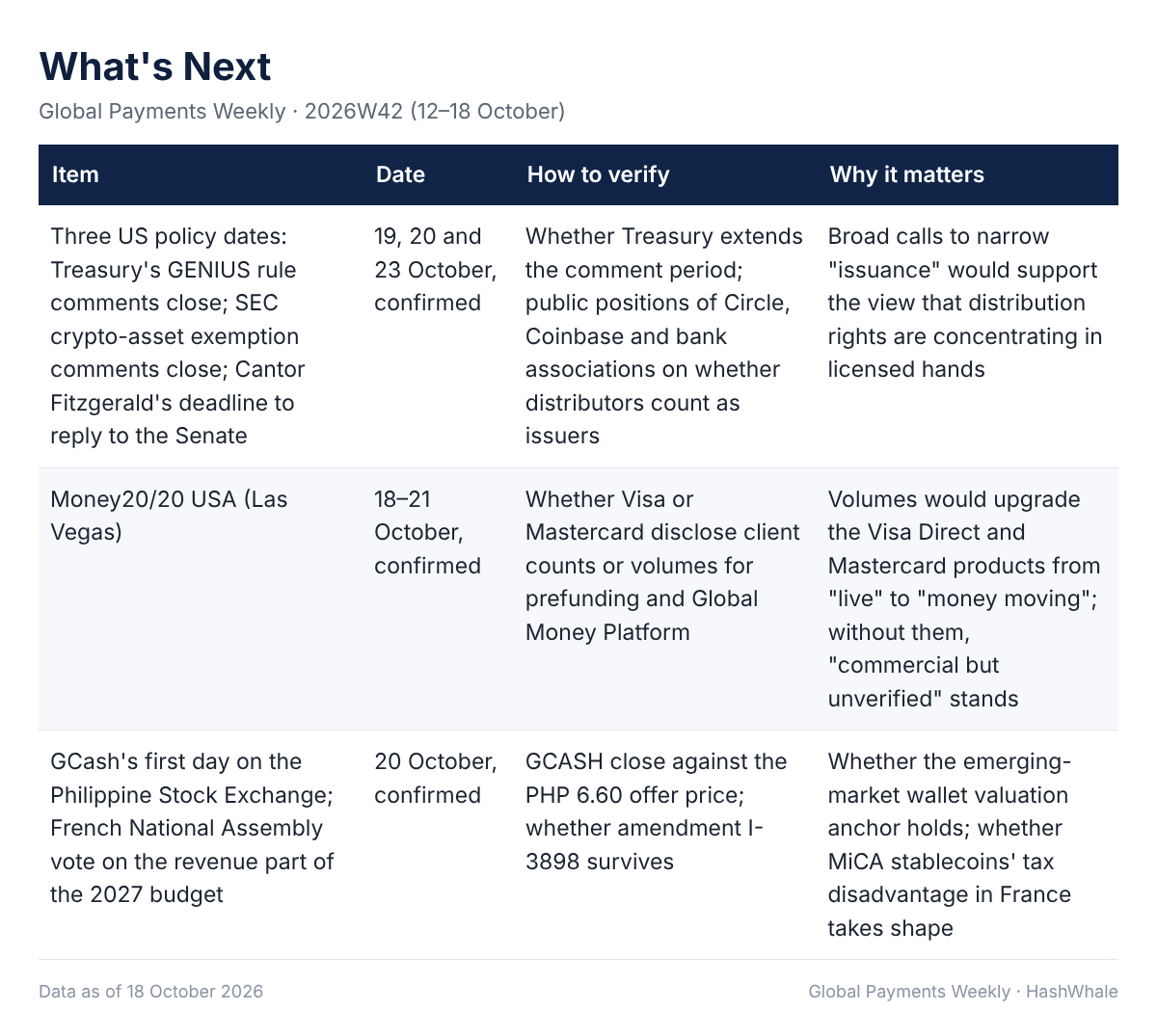
On last issue's What's Next items: in the US, GENIUS rule comments only close on 19 October and Money20/20 opened on the 18th, so nothing verifiable landed before cut-off. In Asia, Visa's China approval arrived on the 13th as expected, GCash does not list until the 20th, and NPCI still says only that the UPI merchant fee will start "after Diwali". In Europe, France's National Assembly adopted the crypto-to-MiCA-stablecoin tax amendment on the 16th, earlier than the 20 October vote we had flagged, and Wise reported on the 15th as scheduled.
Key Figures
2. Key Developments
3. Analysis
Traditional payments
Visa Direct's prefunding and Mastercard's Global Money Platform look like two products but change the same thing: stablecoins become a payment firm's liquidity tool and account product while merchants and payees keep receiving fiat. A remittance firm can hold USDC instead of prefunding fiat over weekends and holidays; a fintech gets accounts, conversion, issuing and payouts through one API. Whoever owns the acceptance network and the payout endpoints still owns the customer — that has not moved; the stablecoin issuer has simply stepped back into the role of asset supplier. Expect lower cross-border liquidity costs and deeper dependence on the networks.
What Visa got in China and Ant International got in the UAE were licences, not products. China granted a permission to prepare, with opening still subject to a separate approval; the UAE granted two licences ahead of any live service, and Antom's acquiring has not launched. In both markets the compliance spend is itself the barrier, and incumbents have a year or more before new entrants really bite. For payment firms operating there, a partner's licence status deserves checking before its product features.
Crypto payments
The EBA taking direct charge of USDC and Qivalis winning its licence happened on the same day, and together they show the EU fixing stablecoin issuance responsibility and cost on licensed entities: the dollar coin's reserves, capital and liquidity move to EU-level supervision, while the euro coin goes to a bank consortium. For distributors, counterparty risk and supervisory certainty rise together. When exchanges, wallets and PSPs in Europe choose a settlement asset, USDC's compliance premium and Qivalis's bank channel become new points of comparison, and incumbent euro coins such as EURC and EURCV face channel dilution.
Allium's third-quarter data gives the networks' commercial push a sense of scale: end-user stablecoin transfers are only 2.5% of onchain volume, and stablecoin card spend of $3.9bn is still small. Yet at exactly this scale the networks have already placed the conversion, FX and issuing revenue of the stablecoin-to-fiat leg inside their own stack. Going forward, stablecoin card programmes will depend more on network and processor pricing, and the issuer's share of spending growth will not grow with it.
4. Recommendations
5. What's Next
Window: 19–25 October 2026.
6. Deep Dive | Once stablecoin cards and prefunding sit in the networks' catalogue, who owns the customer?
The evidence this week
Both networks moved on 15 October. Visa Direct's USDC prefunding entered commercial production, with Inyo Global as the first enabler and payouts reaching 180+ countries, though no volumes were disclosed. Mastercard's Global Money Platform became available the same day, offering fiat and stablecoins in one account, real-time conversion and issuing in 130+ countries. Also that day, StraitsX said it was extending stablecoin-backed card issuing with Visa to 100+ markets and reported more than $6bn in annualised card volume across its Asian programmes — a company figure.
Allium's third-quarter report, published 18 October, supplies the scale. In January–September 2026 end-user stablecoin transfers totalled $2.4tn, just 2.5% of $97.9tn in raw onchain transfers. Stablecoin card spend reached $3.9bn, roughly ten times a year earlier, but 84% of the increase in transactions came from purchases under $50. Allium estimates second-quarter stablecoin card spend at about 0.03% of Visa's $4tn in volume.
How the money moves, and who gets paid
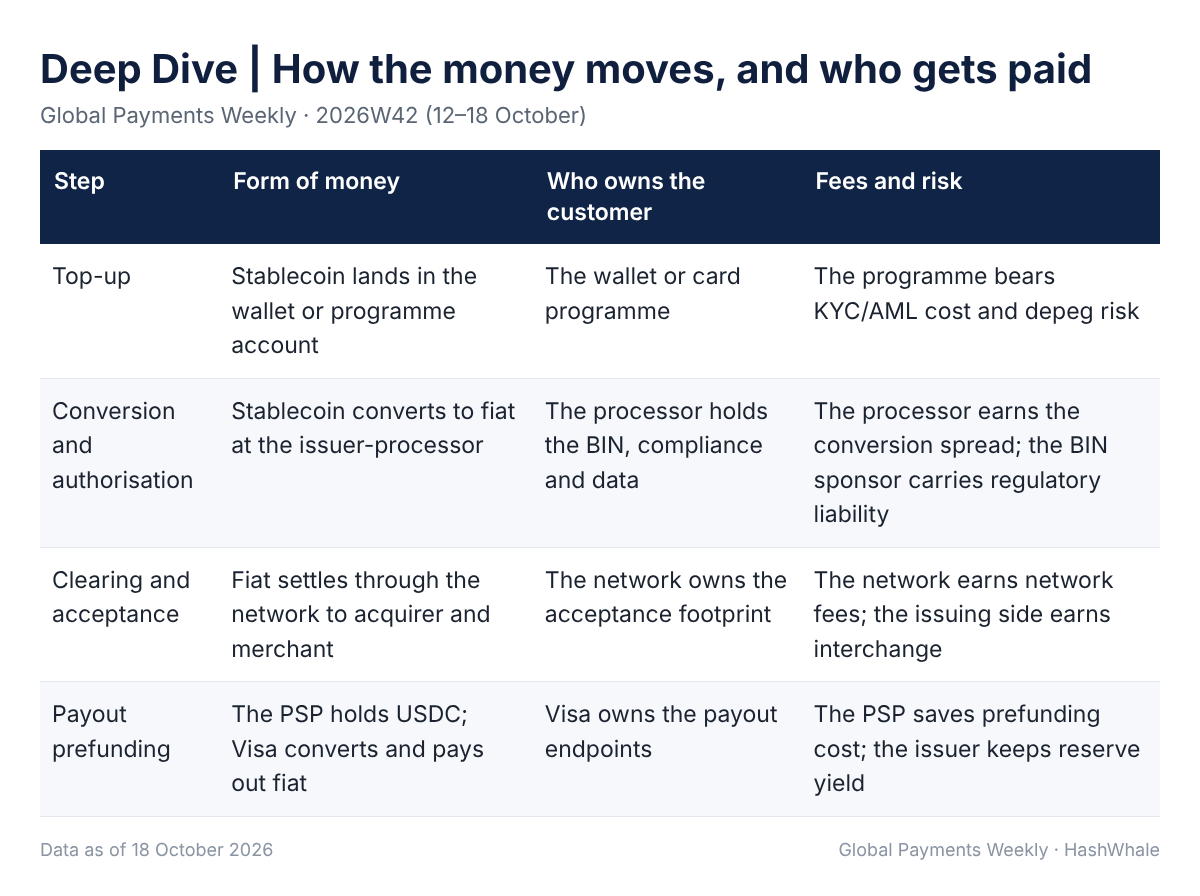
Money stays in stablecoin form at the programme or PSP and converts to fiat the moment it is spent or paid out, then travels on network rails. The issuer never faces the customer at any step and earns reserve interest; networks and processors set pricing and own acceptance; wallets and programmes own the user but pay for that traffic.
What it means on each side
For traditional practitioners, stablecoins in this structure are a funding source, not a rival rail. The opportunity is BIN sponsorship, issuer processing and payout connectivity; the risk is that once the networks run their own one-stop stacks, programme managers and processors lose pricing power. For crypto practitioners, wallets and exchanges keep the user but pay the network and processor on every purchase, so differentiation can only come from distribution and rewards. Issuer supply does not grow with card spend either — Allium's data show USDT and USDC supply contracting in 2026.
What is still missing
Card spend of $3.9bn is about 0.03% of Visa's quarterly volume, and 84% of the growth came from small tickets that may include a good deal of trial use. Neither Visa Direct's prefunding nor Global Money Platform disclosed client counts or volumes; "live" is not the same as money moving at scale. StraitsX's $6bn is a self-reported annualised figure with no stated observation window or method. Mainstream US business demand is also thin: a Cleveland Fed survey in late September found one company out of 148 using stablecoins.
How to tell
First, whether Visa and Mastercard disclose client counts and volumes at Money20/20. Second, whether Allium's fourth-quarter card spend, average ticket and under-$50 share move from trial toward everyday use. Third, whether processors report active cards rather than "programmes", which are easy to inflate. Fourth, whether prefunding is used on weekdays — if it only appears on weekends and holidays, it remains a liquidity tool rather than a structural replacement.
7. Around the World
Japan: On 16 October MUFG, Mizuho and SMBC published the results of their joint yen-stablecoin issuance trial, confirming the feasibility of a multi-bank issuance model using a specified trust beneficiary structure; the banks had earlier set a goal of live transactions within fiscal 2026.
Korea: From 13 October the Financial Intelligence Unit blocked the websites of 27 unregistered crypto exchanges; as of the 18th the Digital Asset Basic Act had still not been submitted to the National Assembly, with the Financial Services Commission saying a government draft could be ready by the end of the month at the earliest.
Hong Kong: On 14 October the HKMA launched the Chongqing–Hong Kong cross-boundary data validation platform, giving banks in both cities a way to verify customer documents for account opening and loan applications; no new stablecoin-issuer licence this week.
Southeast Asia: On 16 October the Monetary Authority of Singapore opened a consultation on making FIDReC dispute-resolution membership mandatory for all payment institutions, closing 30 November; its consultation on the stablecoin issuance licence framework closed the same day.
United States: On 14 October the OCC published its review of debanking at the nine largest banks, listing digital-asset activity among restricted sectors, and the CFPB opened a follow-on investigation; the same day Polygon Labs completed its acquisition of Coinme, gaining 37 state money-transmitter licences; on 15 October Kraken parent Payward agreed to buy Saldo Bank, which holds an ECB banking licence, with closing expected in 2027.
Compiled from public reports and official announcements; analysis and recommendations reflect the editorial team's views.