Global Payments Weekly 2026W36


- 核心观点:本周(8月31日-9月6日)稳定币行业迎来结构性转折:由21家银行组成的联盟计划发行合规稳定币,直接与现有公链稳定币竞争B2B结算市场;同时稳定币总供应量收缩15亿美元,而超5亿美元资本涌入基础设施,竞争焦点从“发行量”转向“轨道与用例所有权”,关键窗口期在2027年上半年。
- 关键要素:
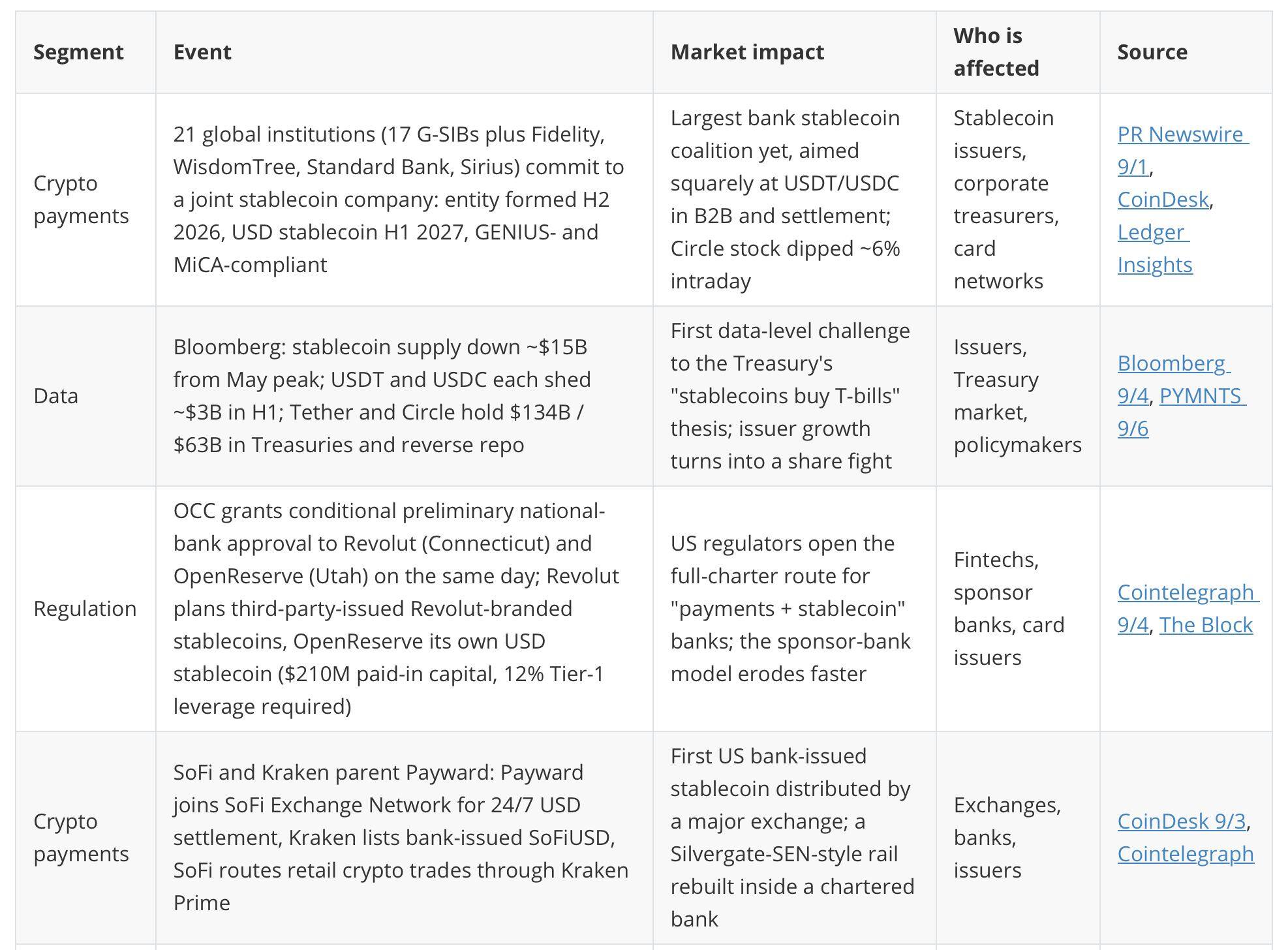
- 全球系统重要性银行中17家签署组建稳定币联盟,但摩根大通、汇丰和法国巴黎银行缺席,表明大型银行策略仍存分歧,联盟明确瞄准GENIUS及MiCA法规下的跨大西洋B2B结算,而非零售场景。
- Circle于9月3日先跌后反弹14%,市场解读为银行联盟并非Circle的终局;同时SEC于9月1日提议将区块链作为官方记录载体,并允许钱包地址替代邮寄地址,进入60天评论期。
- 稳定币总供应量自5月以来缩减150亿美元,但本周Félix、Cari、Diameter、OpenReserve和Kast等基础设施项目获超5亿美元投资,显示行业重心已向铁路(交易通道)建设倾斜。
- 美国OCC同日批准Revolut与OpenReserve银行牌照,TabaPay收购银行、SoFi发行自有币,标志着“支付处理商持有银行牌照并发行自有稳定币”正成为美国默认模式,赞助银行面临中期挤压。
- Swift分类账正式上线,花旗与FAB/OCBC、星展与花旗的周末交易在两周内落地,为“代币化存款优先于稳定币”提供实例,跨境支付商预计2027年左右面对双轨竞争。
- 新加坡金管局拟禁止稳定币计息,成为继美国和欧盟后第三个主要司法管辖区;Ethena Pay以5-6%收益率上线48国但刻意避开美欧,显示高收益稳定币产品的合规空间正在收窄。
Author / Editor: WANG TAI
Coverage period: 31 August – 6 September 2026 (Week 36) · For traditional and crypto payments practitioners · ~4-minute read
1. The Week at a Glance

2. Industry Thermometer

3. Key Events of the Week
Why it matters (editorial analysis)
- The 21-bank coalition: last week it was "JPMorgan said to be evaluating"; this week 17 G-SIBs signed. Three things stand out — JPMorgan, HSBC and BNP are absent, so big-bank strategy is still split; the JV explicitly targets GENIUS and MiCA, i.e. transatlantic B2B settlement rather than retail; and Circle fell first, then rallied 14% on 3 Sep — the market does not see this as Circle's endgame.
- Shrinking supply vs. booming infrastructure: total stablecoin supply is down $15B since May, yet more than $500M went into stablecoin infrastructure this week (Félix, Cari, Diameter, OpenReserve, Kast). Competition is shifting from "how much is issued" to "who owns the rails and use cases" — Airwallex's product VP calling the search for use cases "a dead end" is the other side of the same coin.
- Two OCC charters in one day: with Revolut and OpenReserve approved, TabaPay buying a bank and SoFi issuing a coin, "processor/fintech holds a bank charter and issues its own stablecoin" is becoming the US default. Sponsor banks face a medium-term squeeze.
- Swift ledger goes live: Citi×FAB/OCBC and DBS×Citi's weekend transaction landed within two weeks of each other, giving the BIS chief's "tokenized deposits over stablecoins" remarks a working example. Cross-border PSPs will face two competing rails — public-chain stablecoins and bank tokenized deposits — around 2027.
- MAS bans yield: Singapore is the third major jurisdiction after the US and EU to prohibit interest on stablecoins. Ethena Pay's launch in 48 countries at 5–6% yield, deliberately skipping the US and EU, shows how fast the compliant space for yield-driven stablecoin products is narrowing.
4. Crypto / Web3 Deep Dive
4.1 Stablecoin data dashboard
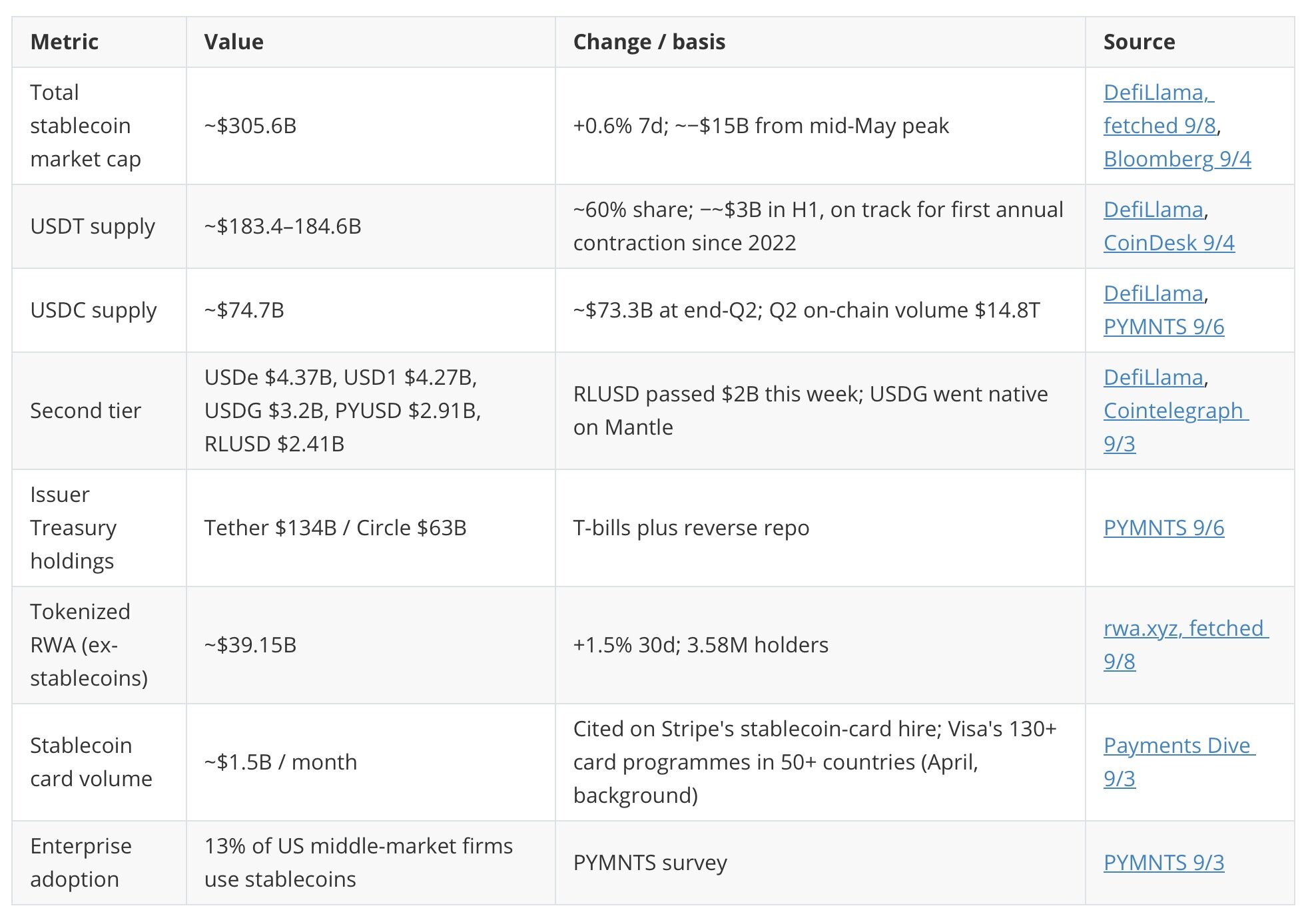
Note: no reliable public data this week on weekly on-chain stablecoin transfer volume; crypto-card top-up figures were not updated this week.
4.2 Theme of the week: banks fire on three fronts — issuance, settlement, distribution

Editorial view: after this week, "will banks enter" is no longer the question — it is which of three rails (public-chain stablecoins, bank-JV stablecoins, tokenized deposits) becomes the clearing layer. Shrinking supply says retail speculative demand has peaked, while capital and licences are pouring into B2B settlement and cross-border. H1 2027 — bank-JV launch, OCC accepting GENIUS applications, settlement chains such as Arc going live — is the window in which the structure sets.
4.3 Voices of the week

4.4 Regulatory week in brief
US: SEC proposes rewriting transfer-agent rules to accept blockchains as official records and floats wallet addresses in lieu of postal addresses, 60-day comment period (SEC 9/1); SEC sets a 17 Sep roundtable on 24-hour trading (SEC); OCC/FDIC finalise the definition of "unsafe or unsound practice", narrowing examiner discretion behind debanking (The Paypers 9/1); National Sheriffs' Association goes neutral on the CLARITY Act ahead of the 15 Sep Senate cloture vote (CoinDesk 9/4); Wyoming's FRNT adds Chainlink Proof of Reserve (Cointelegraph 9/2); two Thai businessmen sue Tether over a $42.4M USDT freeze — the first legal test of issuer freeze powers (Cointelegraph 9/2).
G20: finance ministers and central bank governors pledge "clear pathways" for digital-asset innovation, ask the FSB for findings on global stablecoins' cross-border effects, and call for longer large-value payment system hours (The Block 9/2).
Asia: MAS stablecoin consultation (see Key Events); Korea's FSC publishes a three-phase tokenization roadmap from Feb 2027 with stablecoin-linked on-chain settlement in phase 3 (FSC 9/4); Bank of Korea study finds direct fiat–stablecoin pairs on Binance weaken local currencies, with won stablecoin purchases of $64B a year, APAC's largest (CoinDesk 9/5); Japan's FSA seeks a trust-tax filing exemption for trust-based stablecoin transfers (Crypto Times 8/31); ASIC warns Australian crypto firms to hold AFS licences by 30 Sep (CoinDesk 9/3).
Mainland China and Hong Kong: no major new policy this week (background: Hong Kong's stablecoin licences remain with HSBC and Anchorpoint; mainland activity this week was UnionPay's and Ant International's overseas expansion). EU/UK: Revolut completed its USDT delisting in the EEA and Switzerland on 31 Aug, auto-converting balances to fiat (The Paypers); no new stablecoin rules from the ECB, EBA or FCA this week.
5. Traditional vs. Crypto Payments

6. Regional Watch

7. Action Items for Practitioners
Traditional payments
- Re-examine sponsor-bank dependence: TabaPay buying a bank, Revolut/OpenReserve winning OCC approval and SoFi issuing its own coin all point the same way — if your business relies on a sponsor bank's BIN or settlement account, evaluate owning a charter, switching correspondents or connecting to bank tokenized-deposit networks (Kinexys, Swift ledger) before 2027.
- A2A and real-time payments enter a "risk + rebate" phase: Visa's A2A Protect and the Fed's FedNow credits landed in the same week, showing networks and central banks both fighting for the control layer of account-to-account payments; acquirers and gateways should put A2A fraud scoring and dual FedNow/RTP enablement on the 2027 roadmap.
- Read UPI's and Pix's "more volume, flat value" carefully: both systems are saturating in small tickets while pushing into NFC and cross-border (Pix drops its NFC cap, UPI enters Uzbekistan, ECB–Pix link) — the defensive priority for card businesses in emerging markets is shifting from online to offline low-value.
Crypto payments
- File with MAS by 16 October: the proposed yield ban, 100% segregated reserves and 5-day redemption will reshape how XSGD/USDC-type products are distributed in Asia; licensed or applying firms should take a clear position on the foreign-stablecoin recognition clause.
- Lock in distribution and settlement slots before the bank JV launches: with the 21-bank coin due H1 2027 and the Swift ledger pilot ending in December, smaller issuers and infrastructure providers should secure exchange listings (see SoFiUSD×Kraken), card programmes or regional bank partnerships now, or risk being pushed to the retail fringe.
- Watch the 15 Sep CLARITY vote and the Tether freeze lawsuit: the former decides the 2026 fate of market-structure law and its stablecoin-yield provisions; the latter is the first judicial test of issuer freeze powers — products holding merchant funds should prepare freeze/appeal procedures and customer disclosures now.
8. Watchlist for Next Week
- 15 Sep Senate cloture vote on the CLARITY Act (60 votes needed): failure effectively pushes market-structure legislation into 2027; on 17 Sep the SEC's 24-hour trading roundtable will discuss stablecoins and tokenized deposits as the cash leg.
- Money20/20 Middle East, Riyadh, 14–16 Sep: expect clustered SAMA open-banking/instant-payment, Gulf stablecoin and cross-border announcements; track PayTabs–Amazon deal details and Standard Chartered's UAE expansion.
- Circle Arc mainnet (16 Sep) and whether stablecoin supply stops shrinking: Arc is Circle's direct answer to the bank coalition; also track DefiLlama's weekly total and whether NPCI formally unveils its AI-agent payment protocol at Global Fintech Fest, Mumbai, 9–11 Sep.
All data and events are drawn from public reporting; links point to original sources. Editorial analysis reflects judgement based on public information only and is not investment advice.