BTC
ETH
HTX
SOL
BNB
View Market
简中
繁中
English
日本語
한국어
ภาษาไทย
Tiếng Việt

A Deep Dive into Ethereum Alignment: Ethereum’s Great Mission and the Trust Paradox

Foresight News
特邀专栏作者
2023-10-18 13:00
This article is about 9613 words, reading the full article takes about 14 minutes
Do your best to help realize the great mission of Ethereum.
AI Summary
Expand
Do your best to help realize the great mission of Ethereum.

Original author: Abdelhamid Bakhta

Original compilation: Luffy, Foresight News

When asked how to define Ethereum alignment, are you having trouble answering? Thats just me. The concept is intrinsically important and almost everyone is aligned with Ethereum, but few can define what it actually means. This made me sit down and think systematically about what Ethereum alignment means to me, especially as I advocate its importance. Im also interested in how others in the field interpret this term, since different people may understand it differently and a universal definition is not practical.

I think Ethereum alignment is similar to the word decentralization. None of them are binary but exist on a spectrum, and both require careful scrutiny of trade-offs.

To simplify this complex concept, I propose to break down “Ethereum Alignment” into its different elements:

  • Cultural alignment: Related to Ethereum’s broader vision and mission and the important role of its social layer.

  • Technology Alignment: Covers the ongoing development of the Ethereum protocol, upcoming updates, contributions and how it aligns with these technologies.

  • Economic Alignment: The focus is on incentives aligned with the Ethereum ecosystem. When your project performs well financially, the entire Ethereum ecosystem directly benefits, and vice versa.

By studying Ethereum alignment in this way, I hope to develop a more nuanced understanding of what it means to be in tune with Ethereums diverse goals.

The mission of Ethereum in my eyes

After getting some feedback on an early draft, I realized I missed one big thing: I didn’t talk about Ethereum’s mission. How can I discuss alignment with Ethereum without first sharing an understanding of Ethereum’s mission? This is quite an oversight.

So, I want to talk about my views on the core mission and principles of Ethereum.

In my opinion, Ethereums mission is simple: provide social functions (such as money) that require honesty. To do this, we need an unstoppable platform. Starting from this core idea, we can sort out all the necessary basic attributes of this platform. Let me elaborate.

The word “unstoppable” is self-explanatory; it means that the platform cannot be stopped or tampered with.

To achieve this, Ethereum needs strong liveness and censorship resistance. Resisting scrutiny naturally requires neutrality, since you cant assess the legality of a transaction without introducing some form of bias. On the other hand, strong liveness depends on decentralization, which is crucial for both fault tolerance and accessibility.

Additionally, trust minimization is critical. It ensures that no single entity can close the protocol.

The term social function is a bit vague, but lets consider Ethereums role in providing integrity as a key aspect. This characteristic serves as a powerful catalyst for functionality that currently relies heavily on the integrity of a few key players.

Now, Ethereum is often thought of as a general-purpose programmable platform, but I also see it as a solid alternative to Bitcoin, a store of value, and even a form of currency. It may not be hard money like Bitcoin, but it offers flexibility that is easier to live with. I think its important to make this clear. In short, the use of currencies requires extremely high levels of security and decentralization. If we dont acknowledge this, people may think that Ethereum is too overkill and that other use cases dont require these levels of decentralization and security.

I believe the ultimate goal of Ethereum is to be resilient enough to withstand attacks from nation states. In my opinion, we have not fully achieved our mission until we reach this milestone.

Why is aligning with Ethereum important?

Before we dive in, let’s address the elephant in the room: why should you care about Ethereum alignment? If you skip this question, the whole concept might seem like some xenophobic group, or even a cult.

Tribalism and maximalism: It’s not all sunshine and rainbows

Cryptocurrency tribes are everywhere. It’s like an immune system that helps ward off the bad stuff (harmful effects on our core values). But keep in mind that the immune system can also reject life-saving organ transplants, which is not a win-win situation.

I find this “maximalism” uniquely attractive, especially when interacting with people new to the crypto world. Let us be clear: maximum decentralization is not optional, it is required; otherwise, we risk falling back into the very system we are trying to escape.

Im not excited when ones first exposure to cryptocurrencies is betting on the latest meme coin. Don’t think this has nothing to do with you, but the problem arises when people believe false stories. Want decentralization? Start with the Bitcoin white paper. Only then can you fully understand how Ethereum can extend the functionality of Bitcoin without sacrificing (too much) decentralization or security.

My path to becoming a Bitcoin and Ethereum minimalist

For years, I have struggled with my place in the cryptocurrency world. We all like to keep things in neat little boxes, don’t we? So here I am assuming that I am a Bitcoin and Ethereum minimalist.

The road to becoming a minimalist is not an easy one. I went through different phases, each adjusting my view of decentralized protocols.

Interestingly, these transitions often coincide with major career changes. I think my evolving understanding of blockchain is like a compass guiding my career. Thats why Im sharing this: to show how my changing beliefs impact a real-world career.

My views at different stages

Here is the step-by-step journey of my “cryptocurrency” journey:

  • Curious about Bitcoin (2010-2012): First heard about Bitcoin in engineering school. My initial thought was This looks cool! I read the Bitcoin white paper and researched the technology. At that time, I only focused on technology and missed the bigger picture.

  • Believing in Bitcoin (2012-2015): The more I mined, the more the philosophy of Bitcoin attracted me. I started questioning big questions like power dynamics, social norms. Interestingly, I was working in the fintech space, building cloud payment solutions for banks. Ironically, I often quip, Before fighting the banks, I used to work in a bank!

  • The advent of Ethereum - Apocalypse (2015): It was a game-changing year. Heard about Ethereum at a remote conference and was hooked. After reading the Ethereum white paper I knew I had to get involved. my goal? “Join the movement!” I was at a fintech startup at the time.

  • Entering the Ethereum space (2015-2018): I tried to get my fintech startup into the Ethereum space. We did some experiments, but the founders didn’t buy it. Eventually, I couldnt resist the lure of blockchain and threw myself all in, started coding more and working on side projects with like-minded people. But that wasnt enough, I took another step and joined ConsenSys. This is a big move that aligns with both my career goals and my belief in the power of Ethereum.

  • Ethereum Core Developer (2018-2021): Working with some of the best minds in the Ethereum space. I focused on the execution client and the nature of the EVM. What were the big moments? When Tim Beiko asked me if I would support EIP-1559, I casually replied Yeah, sure, why not. What ended up being an in-depth look at one of the most influential EIPs. It was a complex, high-stakes time, and I learned a lot about Ethereum’s social layer and governance. I digress here, I could easily devote an entire article to describing the fascinating journey of EIP-1559.

  • Cosmos’ Detour (2021): After EIP-1559, I felt exhausted and thought I had seen everything in Ethereum (which was a mistake!). At this time, I was curious about Cosmos and its application chain vision, so I jumped ship and joined the Cosmos project. Initially, I was amazed by the development experience with Cosmos technology - Tendermint, Cosmos SDK, IBC, and especially CosmWasm for smart contracts. But then reality hit and the Delegated Proof of Stake model was flawed. Users often just select a validator from a top 10 list, and the entire system seems to reward marketing skills rather than strong, resilient validators. One more thing: not many AppChain teams contribute back to core Cosmos technology. There is no doubt that Cosmos has great minds and solid technology. But when it comes to the social fabric that holds decentralized systems together, it’s not on the same level as Ethereum. I found a lack of strong mechanisms to defend core values. So, all in all, my experience in the Cosmos ecosystem has reaffirmed my belief that Ethereum, like Bitcoin, is the only L1 capable of achieving the ambitious goal of creating a system that is resistant to nation-state threats.

  • Back to Ethereum’s Roots – Ethereum’s Desire (2022): There’s no way to stay away from Ethereum. Reinvest in L1 or focus on L2 scalability, I chose the latter. Why? It aligns with my technical interests and my commitment to Ethereums mission.

  • Scaling Ethereum - Starknet (2022-present): Right now my focus is on scaling Ethereum. Zero-knowledge proofs caught my attention, and I found myself leaning more towards ZK Rollup than Optimistic Rollup. Starknet stands out in the ZK camp, and I will delve into why in a future article.

Difference Between Maximalism and Minimalism

As I learned more about blockchain and worked to combat a broken system, I fell into the trap of maximalism. The more I want to change the world through decentralization, the more I reject anything that doesn’t fit that narrative. I became a Bitcoin and Ethereum maximalist and nothing else mattered.

But after about a year, I started to come back to reality. While I still firmly believe that only Bitcoin and Ethereum have the ability to withstand nation-state level threats, I have discovered that not all blockchain projects need to meet such high standards. First, not every use case requires the same level of security and decentralization. Second, some other L1s are doing some really cool stuff.

In the case of Solana, although it doesnt meet my personal standards, I have to give it due credit. Solana introduces some interesting innovative features, such as the local fee market mechanism. I’m also impressed by the progress it has made on a social level, particularly in defending some of its core principles. The resilience shown by the Solana community following the FTX collapse is noteworthy. It’s clear that it’s making progress on key metrics like node count and stack decentralization. So while it may not meet my strict standards, its moving in a positive direction. I also think we can learn from and collaborate more with the Solana builders, who have a lot of engineering talent.

So, what is “minimalism” in this context? For me, this means focusing my time and energy on Bitcoin and Ethereum, the two L1s that I believe have the best potential to resist centralized power. Both are still evolving, which is why we now need to redouble our efforts to make them resilient.

There is another aspect that is important to me: the way L1 is started is also important. Bitcoins issuance is the purest, and Ethereums ICO-based issuance, while not as pure, is still good in my opinion, especially considering that it implemented PoW for many years before moving to PoS.

Why focus only on Bitcoin and Ethereum? Because right now, they are our best option against coordinated nation-state attacks. This is the metric that really matters. It seems to me that this goal of other projects may be interfered with.

The fact that Bitcoin stuck with PoW while Ethereum moved to PoS actually works in our favor. Different attack vectors make it harder for governments to neutralize them all simultaneously. This is a complementary resiliency that is critical to our larger mission.

As for where I put my time and energy, I chose Ethereum. Making a meaningful contribution to both platforms is a daunting task, and you have to make a choice. Additionally, the challenges presented by Ethereum really attracted me, and I have a soft spot for its social layer. At the same time, I still have a lot of respect for Bitcoin’s social layer.

So, there you have it: my long-winded way of explaining why I’m putting all my energy into Ethereum right now.

Ethereum and Bitcoin Resilience: A Minimalist’s Perspective

Both Ethereum and Bitcoin have demonstrated a strong commitment to upholding core values ​​such as censorship resistance and decentralization. This promise is not just theoretical, it is realistic. Its functional and has been tested against a variety of challenges. As a self-proclaimed “Bitcoin and Ethereum minimalist,” I find this resilience to be a compelling reason to align with these networks.

Overcoming challenges: The case of Ethereum

Ethereum’s recent handling of the relay censorship scare is a prime example of how it upholds its core values. The community managed to reduce the percentage of relays that review blocks from 75% to 25%. This is not a trivial move, it requires concerted effort, technical acumen and a willingness to face the problem head-on. It also shows that Ethereum will not sit still when its core principles are threatened.

Always be vigilant

It must be admitted that no blockchain ecosystem is perfect. Centralization risks are always lurking around the corner. However, what sets Ethereum (and Bitcoin) apart is the proactive steps it takes to mitigate these risks. The community is proactive and constantly works to identify potential threats and address them before they arrive.

Why minimalism matters

Being a minimalist means focusing on platforms that not only espouse strong core values, but also demonstrate a willingness and ability to defend those values. It’s not just what a platform claims to stand for, it’s how it defends those claims. Both Bitcoin and Ethereum have proven themselves capable in this regard, which is why they have earned the attention and respect of minimalists like me.

All in all, Ethereum and Bitcoin’s resilience and proactiveness in maintaining their core values ​​make them worthy of attention and alignment, especially for those who prioritize censorship and decentralization. Both Ethereum and Bitcoin have demonstrated a strong commitment to upholding their core values.

What does it mean to align with Ethereum?

After explaining why I believe Ethereum is the best general-purpose L1 (essentially the only blockchain that has the potential to withstand coordinated attacks from nation-states around the world in the future), I think it’s time to unpack the true meaning of “Ethereum alignment.” Meaning. Essentially, this term boils down to:

“Aligning with Ethereum means supporting Ethereum in achieving its mission.”

Of course, this is a rough description, but an important one nonetheless. This is a starting point, a foundation upon which we can build on our understanding of what this alignment actually means.

cultural alignment

One of the keys is cultural alignment. As I mentioned before, the social layer is a non-negotiable part of any decentralized system. This is the root of keeping core principles intact and respected. Culturally aligning yourself with Ethereum is not only a good thing, but a necessity if you truly support its mission.

Dimensions of cultural alignment

Cultural alignment is not a one-size-fits-all concept, it has multiple facets:

  • Education: Actively promote the core values ​​of Ethereum. Create or share educational content to help people understand the importance of Ethereum. Target? A community that not only understands but is able to effectively advocate for Ethereum principles.

  • Maintenance: This is the gatekeeper role, keeping an eye out for anything that might threaten Ethereum’s core values ​​and principles. If something goes wrong, sound the alarm and take action.

  • Empowerment: Give people the tools and opportunities they need to contribute to Ethereum. Whether it’s through educational resources, mentorship, or helping people get involved in governance or development, the goal is to make it easier for people to do their part in driving Ethereum’s growth.

So, cultural alignment is not just about believing in what Ethereum stands for, but also being part of a community that actively upholds and advances those principles.

educate

Education is key in the Ethereum world. It’s not just about sharing information, it’s about making that information useful to everyone. Details are as follows:

  • Content diversity: We need content suitable for beginners and experts alike, so anyone can find something that works for them.

  • Accessibility: Ethereum is global, so learning materials should be global as well. Multi-language support is necessary, not just English.

  • Inclusion: Make sure everyone gets it, whether they understand it or not.

  • Advocacy: The goal is not just to provide information, but to turn people into Ethereum advocates.

So aligning with Ethereum in education means that you dont just absorb the facts, you help spread the word, whether thats by creating a how-to guide or just explaining Ethereum to a friend.

maintain

Remaining vigilant and actively monitoring the status of the Ethereum network is critical to maintaining Ethereum’s core values. Theory alone is not enough, what really matters are practical applications and observable results. Not only must we stand up for our principles, but we also need to develop tools to measure whether we succeed in doing so. The Ethereum community has made important progress in this regard, as evidenced by several key initiatives:

  • Client Diversity: Continuous monitoring of client distribution is critical to the health of the network. This typeDashboardTools help us track and promote Ethereum customer diversity.

  • Staking concentration: Alerts need to be raised when staking becomes too concentrated, as this creates risks for the decentralization of the network.Rated NetworkSites such as Stakeholders and others provide insights into the diversity of stake pools.

  • Censorship: Another important metric is to keep an eye on the percentage of OFAC compliant blocks and MEV boost relays that may be censoring transactions. This information can be found atMEV WatchWait for tracking on the platform.

Having these monitoring tools is just a start, they are only truly useful if we act on the information they provide. Fortunately, Ethereum’s social layer is strong in this regard as well. Many in the community are actively monitoring these indicators and raising alerts when necessary, often with specific recommendations for action.

All in all, aligning with Ethereum means not only embracing its values, but also actively safeguarding those values. This involves being alert and willing to take action when those values ​​are threatened.

empower individuals

Ethereum’s power comes from its community of believers – those who believe in it, contribute to it, and defend its core values. This layer of society is vital and we cannot take it for granted. As Ethereum moves forward, we may face more resistance, including from governments (such as Tornado Cash and the fight for basic privacy rights). Therefore, people need to be equipped with the tools they need to accomplish this task effectively.

What I should focus on:

  • Neutrality: Give everyone who wants to contribute a fair chance, no matter who they are or what they like.

  • Fairness: Opportunities within Ethereum should be open to everyone.

  • Diversity: A truly decentralized system requires a diverse set of people behind it. That means different backgrounds, different locations, and different perspectives—as long as they align with Ethereum’s core values.

  • No permission required: If you want to contribute to Ethereum, you don’t have to ask for permission.

Therefore, if you align with Ethereum, you are not only a believer in its mission, but also an enabler, helping to create a space where everyone can participate and make a difference.

technology alignment

After discussing the cultural aspects, let’s talk about technology. Building Ethereum isn’t just about code, it’s also about making sure that code serves its broader mission. We have to be careful not to get lost in the “cool tech” and forget why we are here in the first place.

Also, let’s not forget that complexity has a cost: technical debt. In a system like Ethereum, technical debt can be a huge headache down the road. Fortunately, we have a community that rejects gratuitous complication.

So, how to technically align with Ethereum? Its not just a matter of coding, its also about ensuring the technology serves the communitys goals. Here are some ways to get involved:

  • Protocol Governance: An in-depth look at Ethereum governance. This could mean reviewing the EIP or joining a conference call about the future of the agreement. Protocol Development: If you want to get your hands dirty, this is where you can really make a difference. Whether it’s the execution layer or the consensus layer, your code can shape the future of Ethereum.

  • Research: There’s still a lot we don’t know, and research can help fill in the gaps. For example, work on L2 and zero-knowledge proofs may eventually find its way back into the main protocol.

  • Testing: In a major system, mistakes can be catastrophic. So, testing is important. If youre good at breaking things and figuring out how to make them better, this is the job for you.

  • Technology Education: Not everyone understands the specifics. If you can make complex technology understandable, you can make a difference.

  • Technical Assurance: Keep an eye on the health of the protocol. It might involve building tools to monitor various metrics or reviewing proposed changes to ensure they don’t harm Ethereum’s core principles.

Align your technology stack with Ethereum’s long-term roadmap

If you are developing a project on Ethereum, it is especially important to align your technical decisions with Ethereums long-term vision.

Consider the possibility of creating shared components that benefit both L1 and L2. Harnessing Ethereum’s collective intelligence and scaling it with your own projects feeds back into the entire ecosystem.

However, I dont think L1 compatibility requires uniformity in all aspects of L2. For example, in terms of execution engines, I advocate diversification beyond EVM. This not only provides a safety net against EVM failure, but also opens the door to innovation. One of the most exciting aspects of L2 is their potential for experimentation, and in my opinion the execution engine is a prime area for such innovation.

In short, there is a lot to be done with technical alignment, and whether you are in governance, coding, research, testing, or education, there is a way for you to contribute to Ethereums mission.

economic alignment

Ethereum’s economic layer is more than just a financial mechanism, it is the backbone that keeps the system secure and decentralized. As Ethereum transitioned from Proof-of-Work (PoW) to Proof-of-Stake (PoS), the economics of block production and incentives changed. This makes it even more important to understand how to align economically with Ethereum.

Economic alignment at the protocol level:

  • Denomine fees in ETH: If you are building on Ethereum, consider allowing users to pay fees in ETH. This not only increases the utility of ETH, but also contributes to the economic health of the network.

  • Settled on Ethereum: The more transactions that are settled on the Ethereum mainnet, the more secure the network becomes. This is especially true as we move toward a Rollup-centric future, where L2 will become the primary consumer of L1 block space.

  • Staking: Running a validator isn’t just about getting rewards, it’s about protecting the network. It can be said that by staking ETH, you can put your funds into practical action and contribute to the stability of Ethereum.

External Economic Alignment:

  • Fund development: If you have benefited from Ethereum, please consider giving back. Supporting development, whether through initiatives such as Protocol Associations or other financing mechanisms, is vital.

  • Fund education: Help people learn about Ethereum. Financial support for educational events goes a long way toward spreading information and deepening understanding of Ethereum’s mission.

Economic alignment isn’t just about money, it’s about investing in the future of Ethereum. Whether youre a user, a developer, or just an enthusiast, your actions have an economic impact that strengthens or weakens the network. Therefore, economic alignment is another way to contribute to Ethereum’s mission and is complementary to technical and cultural alignment.

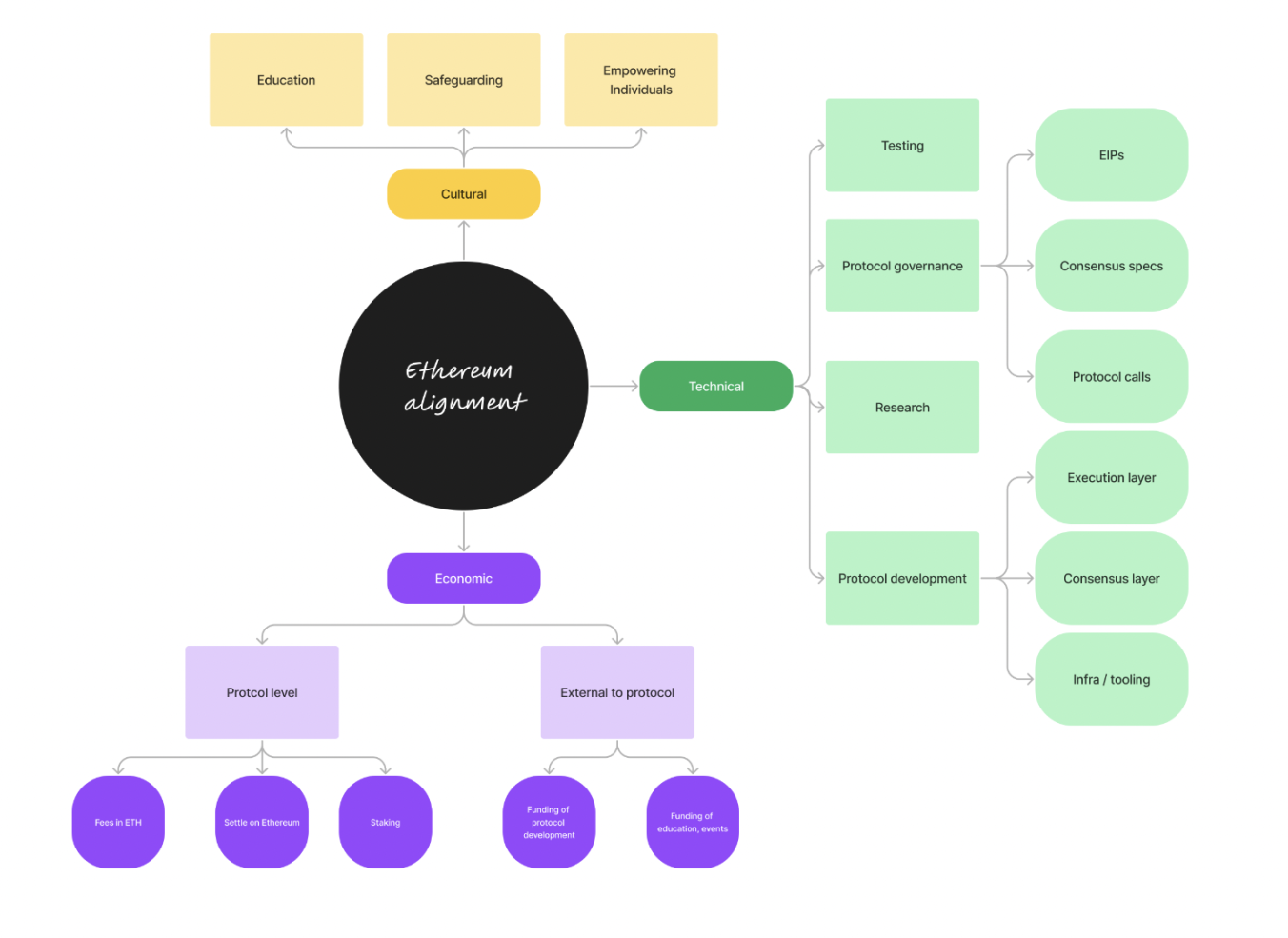
Ethereum alignment structure diagram

The chart below reviews the different aspects of Ethereum alignment we discussed:

Real-world benefits of aligning with Ethereum

community support

Aligning with Ethereum gives you access to the most vibrant community in the crypto world. This is not just a group of enthusiasts, but a collective deeply committed to Ethereum’s core values. By aligning with Ethereum, you are not only adopting a technology, but you are also joining a community that stands for something greater. The community serves as both an accountability system and a support system, enhancing your efforts and protecting your users.

economic advantage

network effect

Ethereum’s powerful network effects provide clear economic advantages. By aligning with Ethereum, you gain access to a broad and trustworthy ecosystem, making your solutions more attractive to a wide range of stakeholders. This trust involves not only technology, but also the values ​​upheld by the Ethereum community. Your alignment with Ethereum becomes a trust signal, attracting users who are already confident in the Ethereum ecosystem.

Staking rewards

Staking ETH is not only a way to earn rewards, but also to contribute to the security and long-term success of Ethereum. While staking does not guarantee an increase in the value of ETH, it does express your confidence in the future of Ethereum. This positive contribution can be financially and intrinsically rewarding.

collaborative partnership

Aligning with Ethereum makes it easier to collaborate with some of the brightest minds in cryptocurrency. The Ethereum community is a diverse group of developers, engineers, and researchers who are united by a shared vision. This alignment not only provides learning opportunities but also fosters collaboration on shared challenges and goals.

At its core, aligning with Ethereum is simply a technical decision. It’s a holistic commitment that delivers tangible benefits. Whether it’s the support of a like-minded community, the strong network effects and economic advantages of staking rewards, or the potential for synergistic partnerships, aligning with Ethereum can not only enrich your project, but also contribute to the broader Ethereum ecosystem. Make a contribution.

Trust Paradox in Trust-Minimized Systems

As you can see, I place great value on the importance of the social layer, which is the ultimate guardian of Ethereum’s core principles.

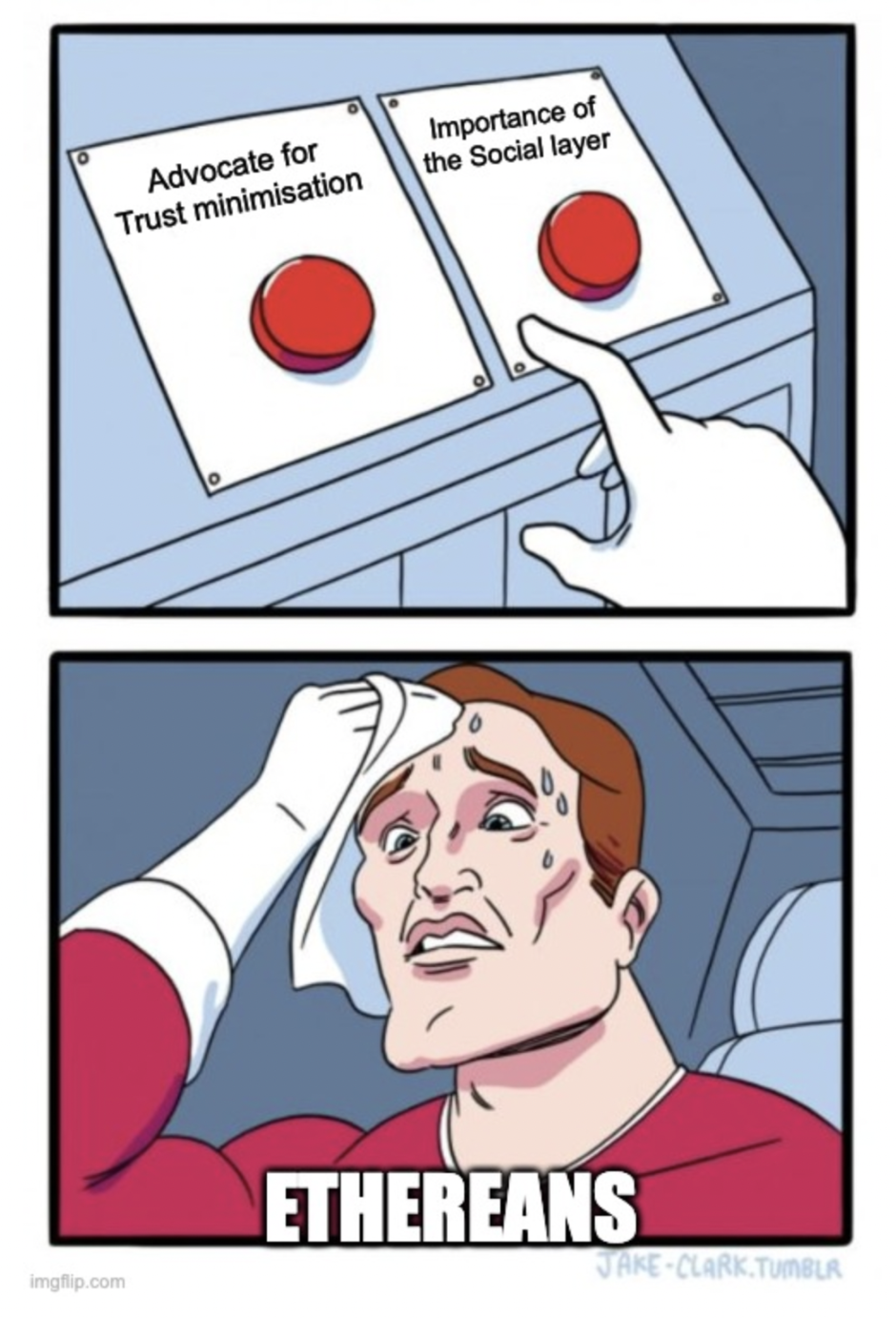
You might be thinking: “Wait a minute, isn’t this an obvious paradox of building a trust-minimized platform?”

You’ve discovered a fascinating paradox of decentralized systems like Ethereum: the tension between the goals of trust minimization and the reality of relying on a social layer. This paradox is indeed a complex issue that deserves careful consideration.

The Social Layer: A Necessary Evil?

The social layer, while crucial to maintaining Ethereum’s core values ​​and principles, does introduce an element of trust. We must trust that the community will act in the best interests of the network, remain vigilant in governance, and be resistant to attacks or manipulations that could compromise the decentralization and censorship of the system.

This reliance on the social layer seems to contradict the ethos of Ethereum: a trust-minimized environment where code is law and human intervention is either minimal or completely unnecessary.

Current Reality: Accepting the Paradox

As you rightly point out, we may have to accept this paradox for the time being. We are still in the early stages of this technological revolution, and while code and protocols are evolving rapidly, they are not yet at the point where they can completely replace the need for a social layer.

The way forward: balancing protocol and social layers

The ultimate goal should be to develop the protocol to a level where the role of the social layer is minimized without compromising the core value of the system. This may involve innovation in the following areas:


  • Automated governance mechanisms: Implement an on-chain governance model that resists manipulation but still maintains the core principles of the network.


  • Decentralized identity and reputation systems: These systems can provide a more trust-minimized way to establish credibility and authority within a network, reducing the need for verification.

  • Protocol-level protections: Prevent potential abuse at the social layer by introducing features that make it difficult for any group to exert undue influence on the network.

To be honest, the areas I mentioned are still in their infancy and are nowhere near powerful enough to completely replace the social layer. It will take a while before we can use these tools to gradually wean ourselves off our reliance on the social layer.

embrace challenges

The above paradox is not a flaw that can be ignored, but a challenge that needs to be accepted. It is a constant reminder that while we have come a long way, there is still much work to be done. The journey toward a fully trust-minimized system is fraught with complexity, but worth it. It is this challenge that makes the concept of Ethereum alignment so important. After all, who better to navigate these complexities than a community united by a shared vision and set of principles?

All in all, while the social layer may seem like an oxymoron in a trust-minimizing system, it is a necessary component—at least for now. Our goal should be to evolve the system to a point where it is no longer limited by this, while not compromising the principles of Ethereum.

Conclusion: The Complexity and Necessity of Ethereum Alignment

When I started writing this article, I thought it would be simple to define what “Ethereum alignment” meant. However, the further I researched the subject, the more I realized its inherent complexity. This is a multifaceted concept that cannot be easily condensed into a few sentences or paragraphs.

Skeptics point of view

I know the idea of ​​Ethereum alignment may seem vague or even ridiculous to some, especially those other L1 advocates. I respect these different perspectives; after all, the world is vast and diverse, and what resonates with one person may not resonate with another.

The importance of alignment in challenging times

For me, the concept of Ethereum alignment only became more important as I explored further. When Ethereum faced numerous challenges, some of which could be described as existential challenges, the idea of ​​alignment became a guiding principle. It is not an excuse for any action, but a framework to help us navigate the complexities of a rapidly evolving ecosystem.

The social double-edged sword

This exploration also brings the role of Ethereum’s social layer into the spotlight. While it is a powerful tool for maintaining the core value of the network, it is also subject to potential glitches and flaws. The ultimate goal should be to make the protocol self-sufficient, minimizing the need for social layer intervention. However, until we reach that point, the social layer remains a key component that makes Ethereum unique and powerful.

my personal commitment

Overall, the intricate journey I’ve taken through Ethereum’s alignment has only strengthened my determination to contribute to its success. I recognize the risks and challenges, but also see tremendous potential and importance in aligning with Ethereum. It’s a complex and sometimes contradictory endeavor, but one I put my heart and soul into. So, I want to align with Ethereum, and I will do my best to actively contribute to this extraordinary mission.


ETH
Welcome to Join Odaily Official Community