BTC
ETH
HTX
SOL
BNB
View Market
简中
繁中
English
日本語
한국어
ภาษาไทย
Tiếng Việt

Which node sales company is the most sincere? Data comparison of Aethir, Sopon, and CARV

星球君的朋友们
Odaily资深作者
2024-05-08 13:00
This article is about 2568 words, reading the full article takes about 4 minutes
In terms of node token rewards, CARV is the most generous, with 25% of the total reward nodes being the largest allocation among the three, and it released 12.5% of the total tokens in the first year of the bull market, more than twice that of the other two projects.
AI Summary
Expand
In terms of node token rewards, CARV is the most generous, with 25% of the total reward nodes being the largest allocation among the three, and it released 12.5% of the total tokens in the first year of the bull market, more than twice that of the other two projects.

Original author: Riyue Xiaochu, crypto KOL

First of all, let's understand node sales. Node sales are actually a new way of selling tokens. It is a way that benefits multiple parties. For projects, a decentralized network itself requires a large number of nodes. For project parties, node sales have also become a new way of financing. For us retail investors, current projects are all launched at high valuations by institutions, and it is difficult to have good money-making opportunities in the secondary market. Participating in node sales means investing in the project before it goes public.

In general, CARV is the most generous in terms of node token rewards. The 25% total reward nodes are the largest among the three, and 12.5% of the total tokens were released in the first year of the bull market, which is more than twice that of the other two projects.

From the sales situation, Sophon sold 30,000 ETH and Aethir sold 40,000 ETH. CARV is about to start, and it is expected to be not too bad. You can use this as a reference.

1 Project Introduction

Aethir is a decentralized computing platform. Aethir aims to build a scalable, decentralized cloud infrastructure (DCI) network that helps gaming and AI companies, regardless of size, deliver products directly to consumers, no matter where they are or what hardware they have. Aethir solves the problem of market fragmentation with a decentralized cloud approach.

Sophon is an entertainment-centric ecosystem built as a modular rollup using zkSync’s hyperchain technology. As a zkSync hyperchain leveraging the ZK Stack, Sophon is designed to be customized for any high-throughput application such as artificial intelligence and gaming applications.

CARV aims to build the largest modular data layer to provide data services for GameFi and AI. It revolutionizes the way data is used and shared by ensuring that privacy, ownership, and control are firmly in the hands of individuals, creating a future where data creates value for everyone. CARV already has 2.5 million registered users, 1.2 million monthly active users, and more than 750 gaming and AI companies have integrated into the CARV ecosystem.

2. Total Node Tokens

The total amount of CARV tokens is 1 billion, and the reward for nodes is 25%.

The total amount of Aethir tokens is 42 billion, 15% of which is used for node rewards.

The total amount of Sopon tokens has not yet been announced, and the rewards given to nodes account for 20% of the total amount.

The total amount of Xai tokens is 2.5 billion, of which 42.09% are given to DACs and nodes.

So 42.09% of Xai is given to nodes and DAC, but the overall reward for nodes is also relatively large. Among the recent node sales projects, CARV has the largest total amount of tokens rewarded to nodes.

3. Nodes release tokens in the first year

The first year is the most critical for the release of node tokens. Because the next year is likely to be a bull market, the price will be better. After that, it may enter a bear market, and the release of tokens is accumulating. In addition, institutions and teams have begun to unlock, so it is normal for the price of the currency to fall by 10 times. Therefore, the release of nodes focuses on how many coins can be mined in a year.

The 42.09% of Xai distribution is composed of two parts. The specific node release amount is calculated based on the official node release chart. The initial daily release of Xai is 1.712 million. When the circulation reaches 1.25 billion (official estimate is 5-6 months after TGE), 856,000 will be released daily. According to calculations, Xai will release about 440 million in the first year, of which 85% will be used for node rewards, that is, 374 million, accounting for about 14.98% of the total.

CARV's node reward is 25%, but its tokens are released faster. According to the official white paper, the release of CARV tokens in the first year is 50%, which is 12.5% of the total. It is basically the same as Xai.

The release rules of Aethir are not clear, but it is stated that there is a 4-year release period. The node reward is only 15% of the total amount, and it is expected to be around 5% to 7% in the first year. The fundamental reason for this is that Aethir has reserved a large part of the reward for the computing power providers for mining.

Sopon's node rewards are released linearly over three years, with 27.78% released in the first year, which is 5.56% of the total tokens.

As for node token rewards, CARV released 12.5% in the first year, the most among the three projects. However, the share given to nodes by Aethir and Sopon is only 5% of the total, which is much less.

4. Redemption period for node tokens

After the node mines the tokens, you will not get the tokens immediately, but esXai, vATH, veCARV. There is a certain redemption period to convert them into tokens that can be traded on exchanges.

For Xai, it takes 180 days to convert esXai into Xai. There are two options. If you convert it in 15 days, you can only get 25% of Xai. If you convert it in 90 days, you can get 62.5% of Xai.

Aethir’s rule is that if you redeem within 30 days, you can only get 25%, and the default redemption period is 180 days.

For CARV, it takes 150 days to convert veCARV into CARV. For the same two options, if you convert it in 15 days, you can only get 25% of Xai. If you convert it in 90 days, you can get 60% of CARV.

Sopon's node release has not been announced.

In general, all three projects have relatively long redemption periods, and they are basically the same. If you want to distinguish, CARV has a slight advantage, as its 150-day redemption period is one month shorter than XAI and ATH's 180 days.

5. Unlocking of other tokens in the first year

In addition to node rewards, we also need to consider the unlocking of other tokens, because the release of other tokens will increase the inflation rate.

In token distribution, in addition to the node mining part, it is often divided into three parts. One part is required by the project, such as market making, operational activities, etc. This part is often released in large quantities during TGE, so there is no need to pay too much attention. The second part is ecological rewards, communities, foundations, etc. This part often requires Dao voting due to the long-term development of the project. The third part is the release of institutions and teams. This part needs special consideration.

In this regard, Xai is not very friendly. The team and institutions began to unlock 6 months after TGE, releasing about 1.5% of the total tokens every month. The reward tokens of the nodes are open for redemption about 2 months after TGE, plus a redemption period of 6 months. This means that the team and institutions have a large number of chips that circulate in the market before the nodes.

CARV investors start unlocking their tokens 6 months after TGE, while the team starts unlocking their tokens 9 months after TGE. The unlocking conditions are better than Xai, and it should be noted that the redemption period for CARV's node mining tokens is 5 months, so the node tokens are unlocked earlier than investors.

The chips of Aethir and Sopon institutions and teams have a 12-month lock-up period. However, in Aethir's token model, 35% of the total amount is GPU, which is released synchronously with the nodes, which means that twice as many chips as the nodes are unlocked together.

6 Node Sales

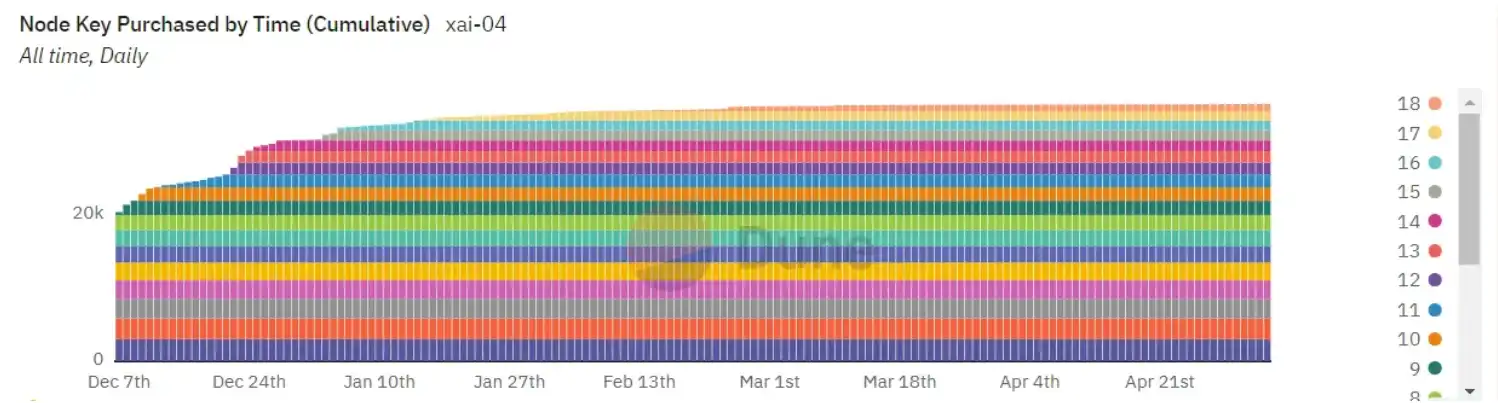
In terms of node sales, Xai has sold 35,155 nodes, with a sales amount of 13,080 ETH, worth 400 million US dollars, and the average cost of the node is 0.372 ETH. The node price has risen from the lowest 0.133 ETH to 1.43 ETH, an increase of more than 10 times.

Aethir has sold 74,040 nodes for 41,627 ETH, worth $130 million. The average cost of a node is 0.56 ETH. The node price has risen from a minimum of 0.1259 ETH to 1.8232 ETH, a 14-fold increase.

Sophon has sold 121,261 nodes, with a sales amount of 31,087 ETH, worth 96 million USD. The average cost of a node is 0.256 ETH.

For node sales, XAI can be said to be the beginning of this round. Most of the projects selling nodes are learning from XAI. However, the data of XAI itself is not good because the market was not very hot when XAI was sold. And because XAI is the first time, many people have concerns about this form. In addition, many people who participated in the GALA node in 21 years have not yet recovered their investment. However, after XAI was launched on Binance, the benefits of participating in the early nodes were lucrative, which brought many users to the projects that later sold nodes.

Aethir's node sales not only benefited from XAI's money-making effect, but also came at the peak of AI hype. For other projects with good quality, the possible results are between XAI and Aethir.

7 Conclusion

1 From the perspective of projects, Aethir, Sopon, and CARV are not in the same track and cannot be directly compared. However, each has its own advantages. Aethir belongs to the AI track and has scarce GPU computing power, which is the hottest sector at the moment. Sopon's project is more like a quick game that was put together while the market was good. However, it is a project created by the original founder of zksyc, and its popularity and resources in the circle are very rich. CARV has accumulated for many years, has grown rapidly, and has a large number of users and ecological projects.

2 From the perspective of node sales, CARV is the most generous, with 25% of the total reward nodes being the largest allocation among the three, and 12.5% of the total tokens released in the first year of the bull market, more than twice that of the other two projects.

3 From the sales situation, Sophon sold 30,000 ETH and Aethir sold 40,000 ETH. CARV is about to start and is not expected to be too bad. You can use this as a reference.

Original link


AI
ETH
Welcome to Join Odaily Official Community