BTC
ETH
HTX
SOL
BNB
View Market
简中
繁中
English
日本語
한국어
ภาษาไทย
Tiếng Việt

12-period data deciphering Binance Launchpool: BNB or FDUSD? How to choose between long-term and short-term strategies?

南枳
Odaily资深作者
2024-04-15 08:57
This article is about 1104 words, reading the full article takes about 2 minutes
Under the short-term strategy, FDUSD has a higher rate of return and risk resistance; BNB mining is suitable for users who hold for a long time and do not engage in short-term transactions.
AI Summary
Expand
Under the short-term strategy, FDUSD has a higher rate of return and risk resistance; BNB mining is suitable for users who hold for a long time and do not engage in short-term transactions.

Original - Odaily

Author - Nan Zhi

In the recent Binance new currency mining, only BNB and FDUSD can be used to participate. What is the difference in the yield between the two? Which of the two long-term and short-term holding strategies is better? Odaily will analyze the past 12 periods of data in this article to gain insight into the profits and losses under different strategies.

(Odaily Note: The short-term strategy refers to buying FDUSD/BNB at the beginning of new currency mining and selling at the end of mining. The net profit and loss is the mining income minus the price difference before and after mining; readers who only want to see the final conclusion can read directly Text of the last section of this article.)

FDUSD data analysis

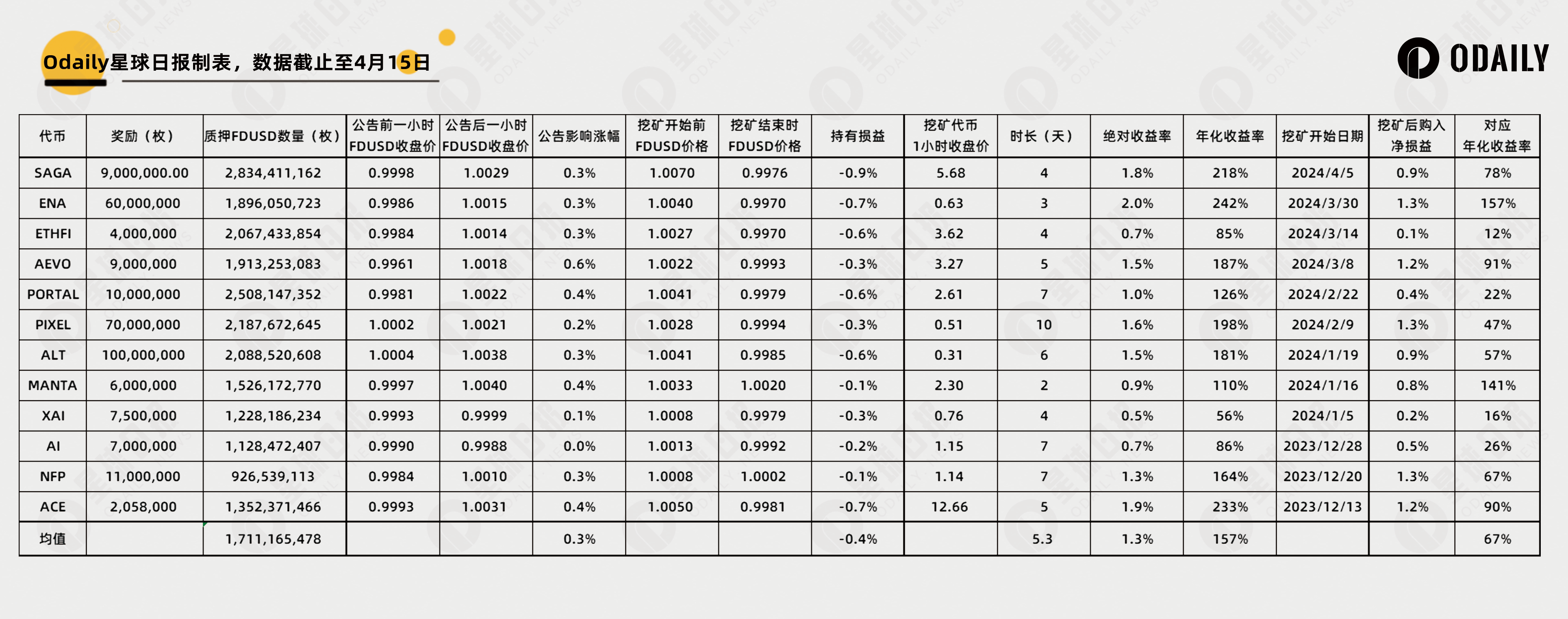
The chart below shows FDUSD-related data for the past twelve periods, including price changes before and after Binance announced new coin mining, price changes at the beginning and end of new coin mining activities, as well as the corresponding yield and short-term strategic returns. .

  • After Launchpool was issued, FDUSD rose more consistently, with an average of 0.3%;

  • During the period from the beginning to the end of mining, FDUSD dropped significantly, with an average value of -0.4%. At the same time, it means that the discount rate of FDUSD is also relatively stable, and the long-term price difference is not large;

  • Similarly, the annualized rate of return of each period also differs greatly, and the relative size between each period is basically the same as that of the BNB mining pool;

  • Using the holding profit and loss to superimpose the absolute return of mining, the absolute return under the short-term strategy, and then convert it to the annualized rate of return, the corresponding average annualized rate is 67%, and there is no negative value, that isTemporary buying also has higher returns

  • In addition, during this period of SAGA new currency mining, FDUSD issued more than 1.1 billion US dollars, but the rate of return has not declined. Whether it can be maintained needs to be verified in multiple periods.

BNB data comparison

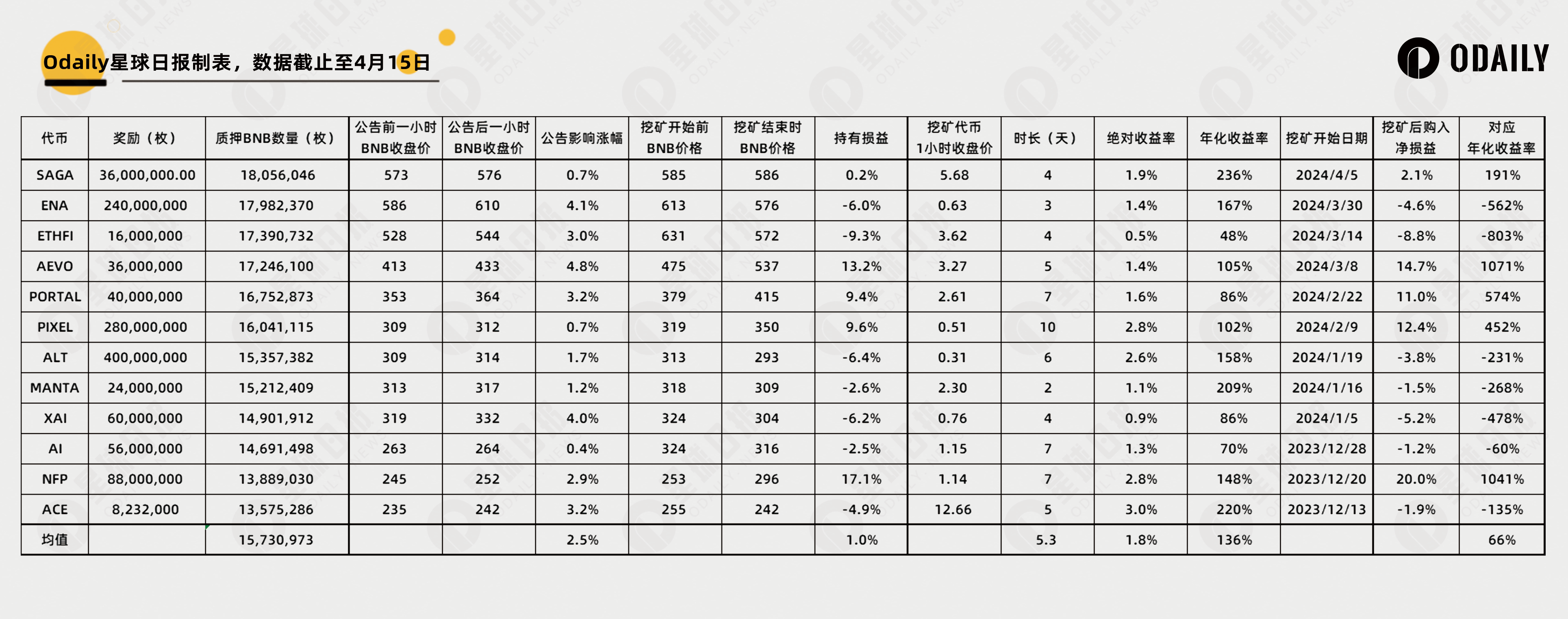
The statistical object is replaced by the BNB mining pool, and all statistical calibers remain unchanged. The specific data is as shown in the table below.

  • New currency mining has a significant boosting effect on BNB prices, with greater volatility;

  • Correspondingly, the BNB price fluctuation before and after mining is also greater, and the probability is negative. Only 4 of the 12 periods are significantly positive. This means that if you buy BNB before mining and hold it until maturity, you will most likely have to endure a certain price drop;

  • The average mining yield of BNB is 136%, which is basically lower than the FDUSD mining pool (average 157%) before the FDUSD issuance;

  • BNBs short-term mining strategy has great volatility, and the average annualized return is almost the same as FDUSD, 66% and 67% respectively. However, it should be noted that it is mainly supported by the two rounds of BNB increases in NFP and AEVO (the unit price of BNB has both increased over 40 USDT).

in conclusion

  • If I want to buy temporarily and exit after mining, which one is better, FDUSD or BNB?

    For users who only want to obtain new currency mining income, the income of the two is close, but FDUSD is more stable, and for users with a neutral strategy, there is no need to hedge BNB, and the rate of return is actually higher.

    Therefore, FDUSD is a better choice for short-term strategies.

  • For long-term holders, which one is better?

    Based on the data of the past 12 periods, FDUSD’s annualized return is only 15.4% higher than BNB. This means that for users, if it is believed that BNB can still rise by 15.4% on the current basis, BNB’s advantage will be even more obvious.

    However, the above conclusion is from a purely currency holding perspective. In fact, there are still operations such as mortgaging FDUSD to lend ETH and other assets, conducting on-chain mining activities during the window period, and transferring it back during the mining period. Therefore, it is also necessary to consider the specific situation of the user. choice.

  • How long is the mining window period?

    From the start of mining on ACE to the end of SAGA, there are a total of 118 days, and the mining period is 64 days in total, and the window period is 54 days in total, so the average interval between each period is only 4.9 days.

  • So what is the return rate of buying BNB/FDUSD at the bottom after mining ends, selling after the announcement, and not participating in mining strategy?

    For BNB, the absolute return rate of the above operation is 2.44%, which is higher than the absolute return of mining of 1.8%. Calculated based on the 4.9-day window period, the annualized return rate is 181.7%. However, reusing this strategy needs to consider the risk of BNB falling from high levels;

    For FDUSD, the return on this operation is 0.3%, which is much lower than the 1.3% yield from mining.

Binance
BNB
Welcome to Join Odaily Official Community