BTC
ETH
HTX
SOL
BNB
View Market
简中
繁中
English
日本語
한국어
ภาษาไทย
Tiếng Việt

Who is making Binance: A company without borders in 4,000 resumes

星球君的朋友们
Odaily资深作者
2023-08-17 00:33
This article is about 4428 words, reading the full article takes about 7 minutes
A company that became number one in the world within 165 days of its establishment. Who are its employees and where do they come from?
AI Summary
Expand
A company that became number one in the world within 165 days of its establishment. Who are its employees and where do they come from?

Editors Note: This article comes fromLatePost, original author: late guest author Wang Hanyang, editor: Cheng Manqi,The title picture comes from steemit.com and was taken by belenguerra.

At the end of the last cryptocurrency bull market two years ago, LatePost onceA conversation with Changpeng Zhao, founder of the world’s largest cryptocurrency exchange. This is a founder and company shrouded in the fog of blockchain cryptography composed of 0s and 1s. It has been noticed, discussed, but never fully restored due to the huge wealth effect, the erratic trail of the founder, and the mystique of thousands of employees scattered around the world.

In 2022, which has gradually entered a bear market, the average daily trading volume of Binance will also be 65 billion US dollars, which is about 1/2 of the average daily trading volume of A shares in 2022 and more than 4 times that of Hong Kong stocks. According to CoinGecko data, on one day in November last year, Binance’s daily trading volume reached $136.7 billion. One practitioner said that even after waiving some handling fees last year, Binance’s profit was still about 40,000% of the transaction volume. In these 24 hours, Binance earned more than $50 million in profits from its trading business alone. What is the concept of having a casino that everyone around the world participates in.

The ability to make money like a money printing machine and the special position of the cryptocurrency world free from regulation have also pushed Binance into the whirlpool. In June of this year, the U.S. Securities and Exchange Commission (SEC) formally sued Changpeng Zhao and Binance, which he founded, alleging that Binance allegedly made profits through an extensive network of deception, put investors at significant risk, and helped U.S. customers evade fraud. Supervision. The 136-page charging document contains 13 charges.

The SEC’s prosecution of Changpeng Zhao and Binance is still ongoing. The story of Binance and Changpeng Zhao is mixed with the new elements of this era: cutting-edge computer technology, decentralized organizational transformation; it is also mixed with the desire for wealth that has been surging in human nature for a long time, and the myth of the boundary between freedom and rules. From a business perspective alone, Binance’s unusual rise and new organizational approach also make it one of the most worthy companies to study at the moment.

Restoring the story of this company and finding Changpeng Zhao are both a huge project. Todays article is a small start: it comes from our special author Wang Hanyang. More than 4,000 resumes from people claiming to have worked or interned at Binance. Their backgrounds and experiences pieced together the tip of the iceberg of this mysterious company.

The following is the original text, this article is also published on the newsletter https://crypto4.wtf/, and the English version is published on the newsletter https://picapica.wtf/.

For most people who dont care about blockchain, Binance may just be a company that occasionally appears in the technology news. But today, Binance has become one of the most special and important companies in the two fields of finance and technology: according to reports, Binance has about 8,000 employees (recent news said that Binance is laying off employees), but This company does not have a headquarters, and its employees are remotely distributed all over the world. Many people may not have seen several of their colleagues from the time they join the company to when they leave the company. Binance may have become the largest distributed company ever. If people study the history of the Internet 30 years later (roughly the time from the birth of the Internet to today), Binance’s organizational form will definitely be a chapter that cannot be bypassed.

From the perspective of business influence and profitability, Binance is also very important. A comparison can be made with Apple, the leader in the smartphone industry: According to Tokeninsight data, Binance’s market share in cryptocurrency exchanges in Q2 2023 was 50.6%, while according to Strategy Analytics data, Apple’s smartphone market share in Q4 2022 The share is 24%, which is the first in the world and the highest Q4 market share in Apples history - but this number is much inferior to Binances share. Even in 2022, the cold winter of cryptocurrencies, according to CoinDesk data, Binances spot trading volume still reached 5.29 trillion US dollars. In 2022, the business and sales of the Apple App Store ecosystem will be 1.1 trillion US dollars, of which more than 90% will be zero commission. Binance transactions have handling fees most of the time. So if Apple is the overlord of smartphones, then Binance is the absolute overlord in the cryptocurrency market at the moment.

The absolute dominance of the entire industry and its pioneering work model make Binance one of the most important companies of our time.

But on the other hand, Binance is a mystery. Even Binance is one of the biggest mysteries on the global internet today: Rarely has a company been so important to the industry and yet so little known about it.

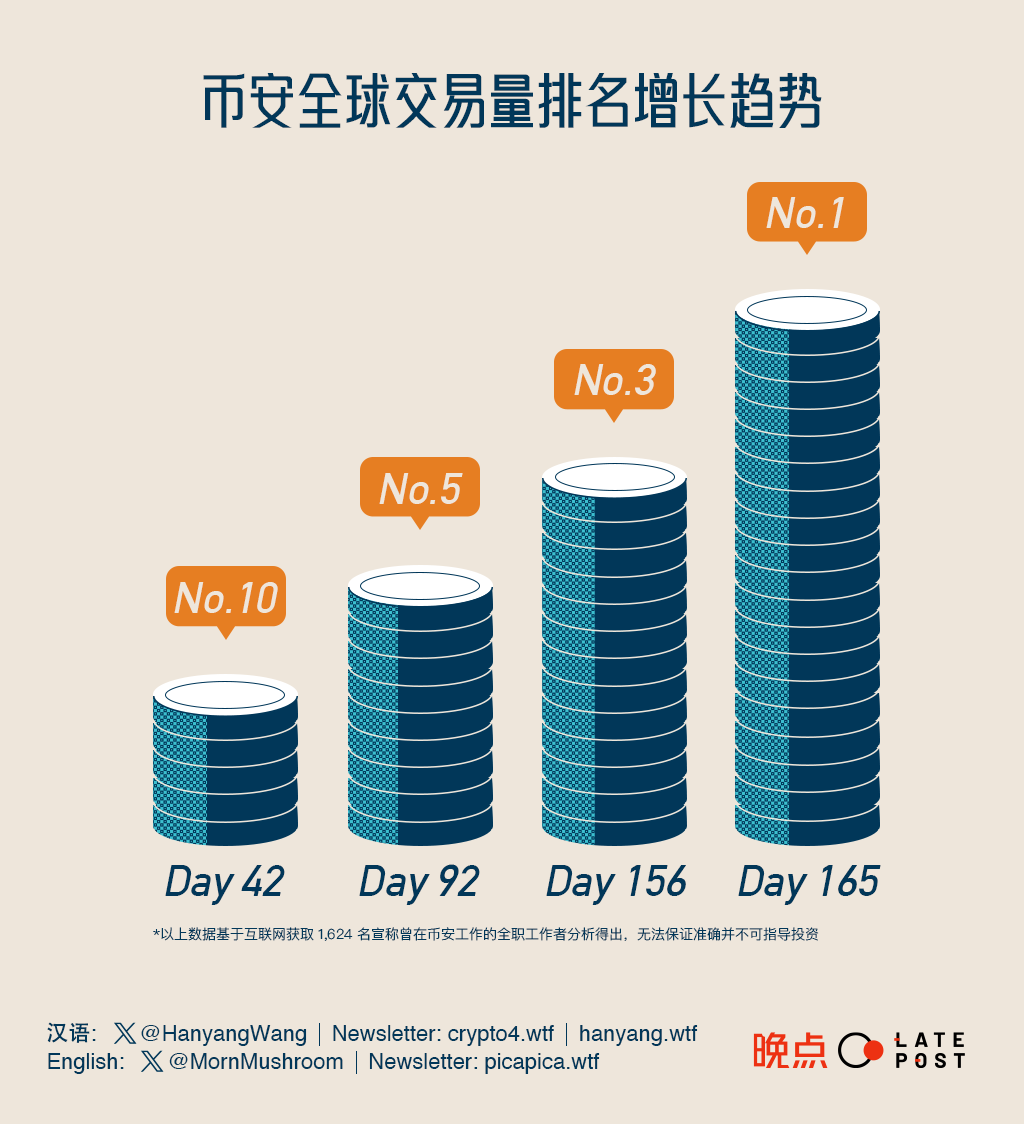
On the 42nd day after the launch of the product, Binance ranked tenth in the world in terms of trading volume; on the 92nd day, it ranked fifth in the world; on the 156th day, it ranked third in the world; on 165 days, it became the first in the world—until now. How does it do all this?

I read almost all the articles about Binance on the Internet in Chinese and English, but I still cant answer my questions about Binance, and I cant even ask key questions through these online information. So I plan to fill in the gaps about Binance through a lot of research and interviews, analysis and organization.

Researching and accessing Binance is not easy. I hope to use all available opportunities and all available information to start this project from a small point of view. With the help of a series of articles, we try to tell the story of Binance as interesting and comprehensive as possible. More importantly, we can encourage more friends to study and analyze Binance, a company that cannot be avoided in the era we live in.

In the first article, lets talk about what kind of people made Binance. Thanks to the help of @paincompiler, he collected the information of more than 4,000 people who work or have worked at Binance from the Internet, and copied it on paper with pencil one by one.

Please note: Not all information we collect may be accurate, nor can it cover all of Binances circumstances.

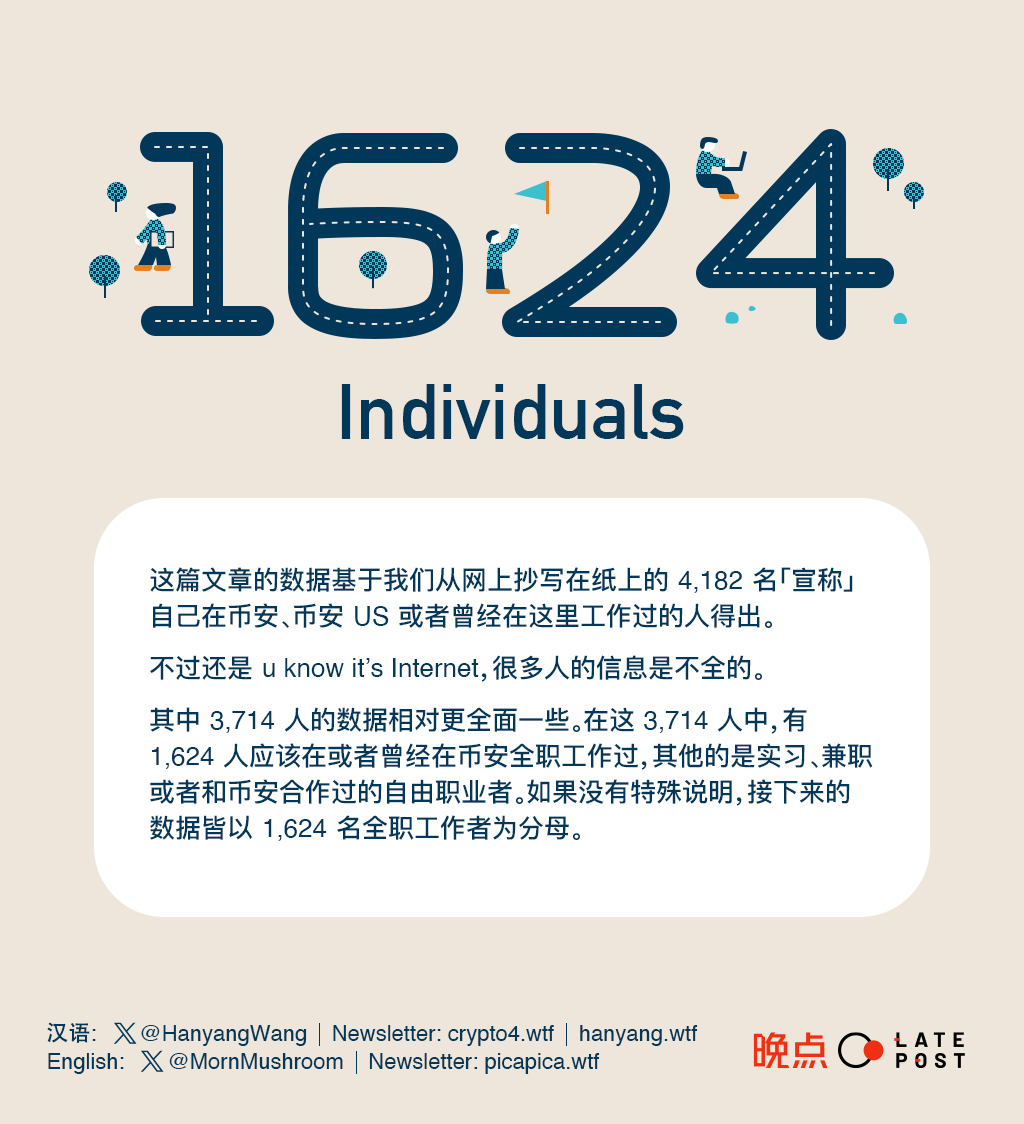
The data for this article is based on 4,182 people we transcribed on paper from the Internet who claimed that they work at Binance, Binance US, or have worked here. Many people have incomplete information. Among them, the data of 3,714 people is relatively more comprehensive. Among these 3,714 people, 1,624 people should be working or have worked in Binance full time, and the others are internships, part-time workers, or freelancers who have cooperated with Binance. Unless otherwise specified, the following data use 1624 full-time workers as the denominator.

Borderless companies: Singapore and the Middle East have the most employees

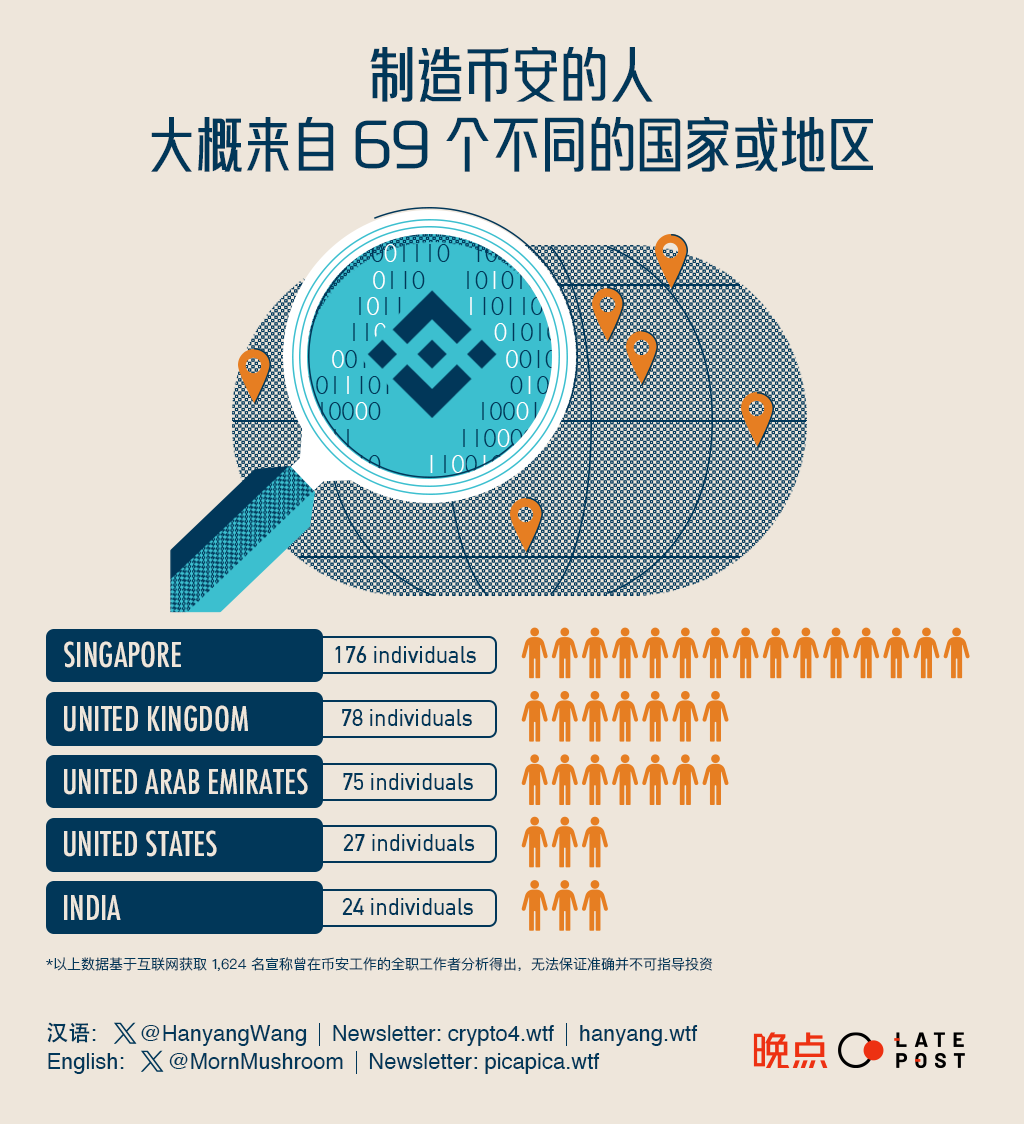
Although blockchain has no borders, blockchain companies have borders. But Binance seems to be closer to borderless than any other company: in our sample, the people who built Binance came from 69 different countries or regions. in:

Singapore: 176 people

UK: 78 people

UAE: 75 people

United States: 27 people

India: 24 people

Similar to your stereotype, Binance has a large number of employees in Singapore. The data in the notebook shows that there is another employee working in the Cayman Islands-I thought this island was only used for company registration.

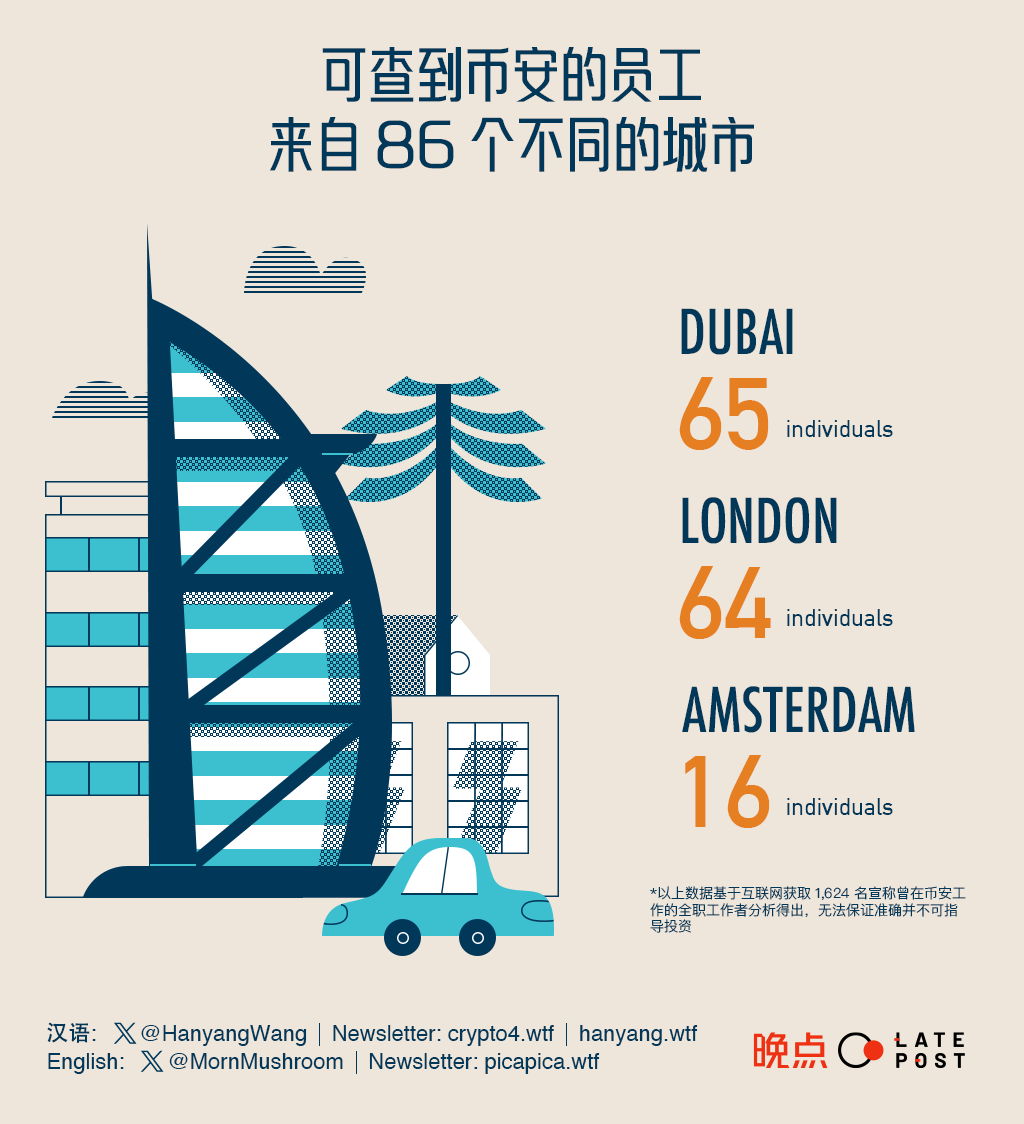
You may ask, what about Dubai? After all, the founders, Changpeng Zhao and Yi He, are both in Dubai—Dubai is the economic center of the United Arab Emirates, but it is a city, not a country. If we were to rank by city, Dubai would be number one. There are 65 people in Dubai, 64 in London and 16 in Amsterdam. In total, these employees are located in 86 cities.

As a company born in China, Binance still has people working here - but the data we collected was only one person. It is not ruled out that Binance employees working in mainland China will deliberately hide their company.

Before Binance, among the famous telecommuting companies, the largest should be GitLab. GitLab is an open source software company that claims to be the worlds largest remote working organization: 2,038 full-time employees and their 358 pets located in 65 different countries.

If we can have clearer information, I believe that the title of the worlds largest remote work organization should be transferred to Binance. But I dont just want to compare the volume, but I want to prove that Binance is indeed a remote working company by comparing GitLab. Many people dont believe that Binance works remotely. They more or less think that Binance is just afraid of supervision, so they say that they have no headquarters and are all remote. Some people also think that the so-called remoteness of Binance is just a common state of multinational companies-but this is probably not the case. Both Binance and GitLab should be considered the largest remote organizations on this Odaily.

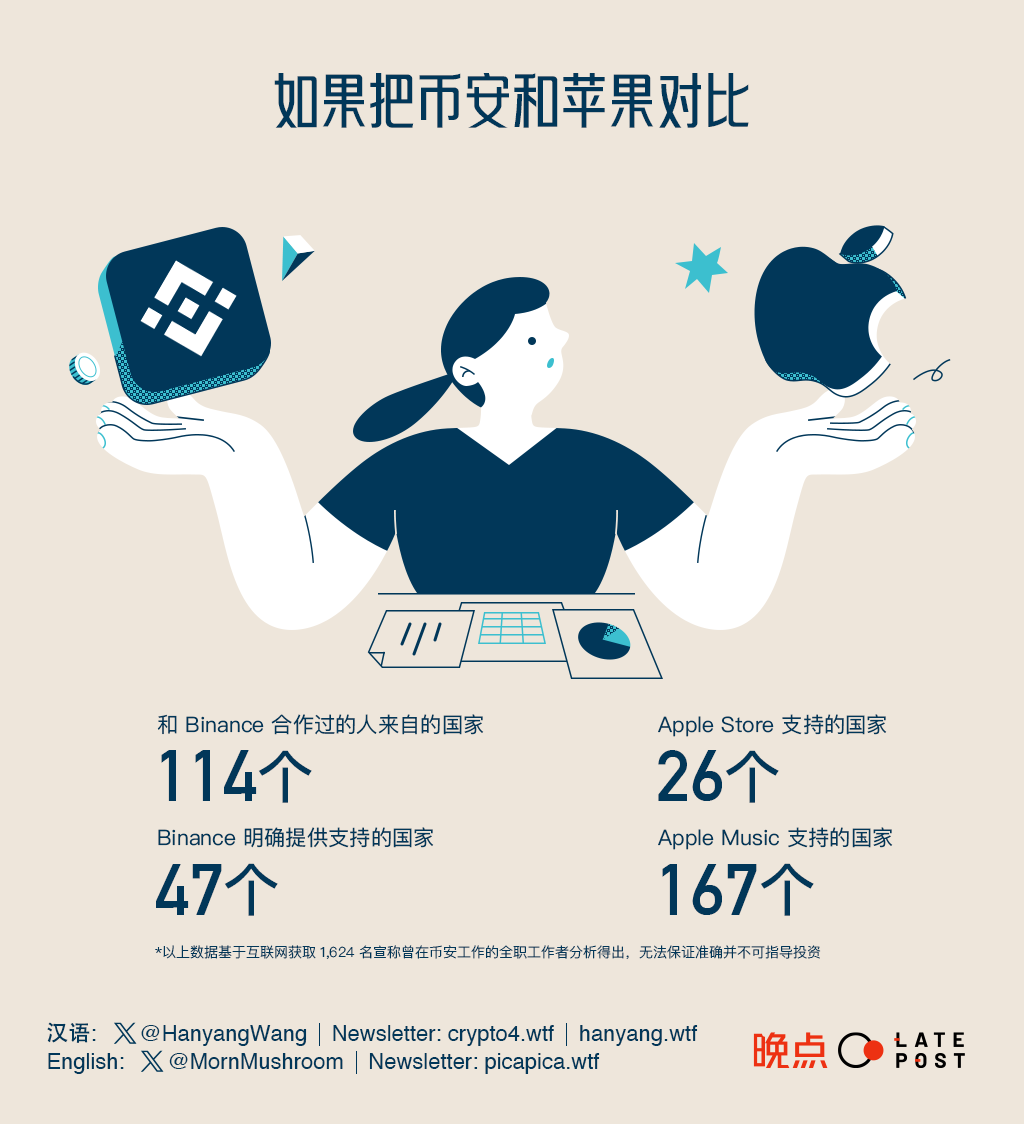
If we look beyond full-time jobs, the 3,714 people in our notebook who have collaborated with Binance come from a total of 114 countries. This is much wider than the Apple Store. There are Apple Stores in only 26 countries or regions around the world. However, Apple Music is available in 167 countries or regions around the world, but only 47 countries or regions are explicitly supported by Binance on the official website.

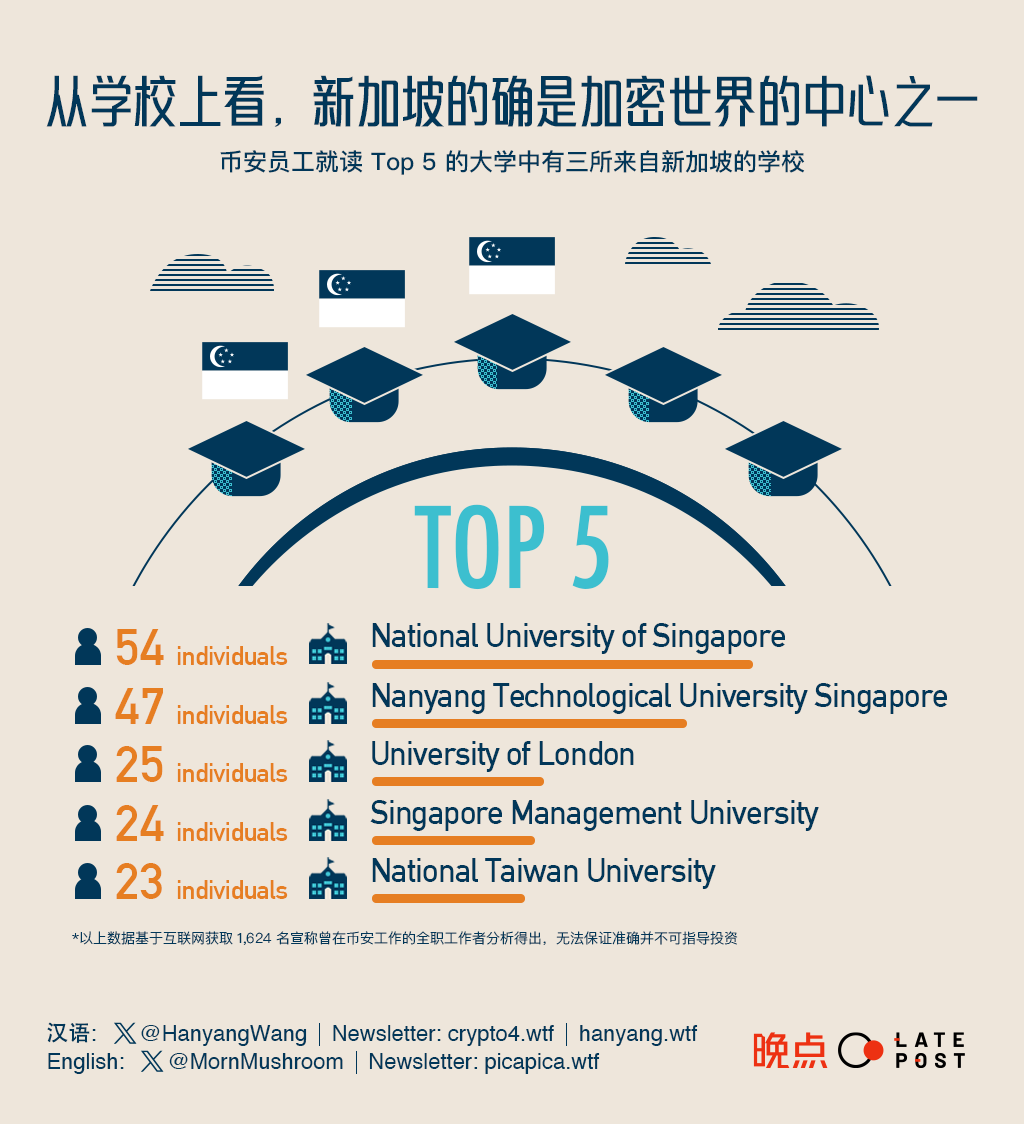
Although the distribution of Binance employees is very diverse geographically, from a school perspective, three of the top 5 universities studied by Binance employees are located in Singapore, which shows that Singapore is indeed one of the centers of the crypto world.

National University of Singapore: 54 people

Nanyang Technological University: 47 people

University of London: 25 people

Singapore Management University: 24 people

National Taiwan University: 23 people

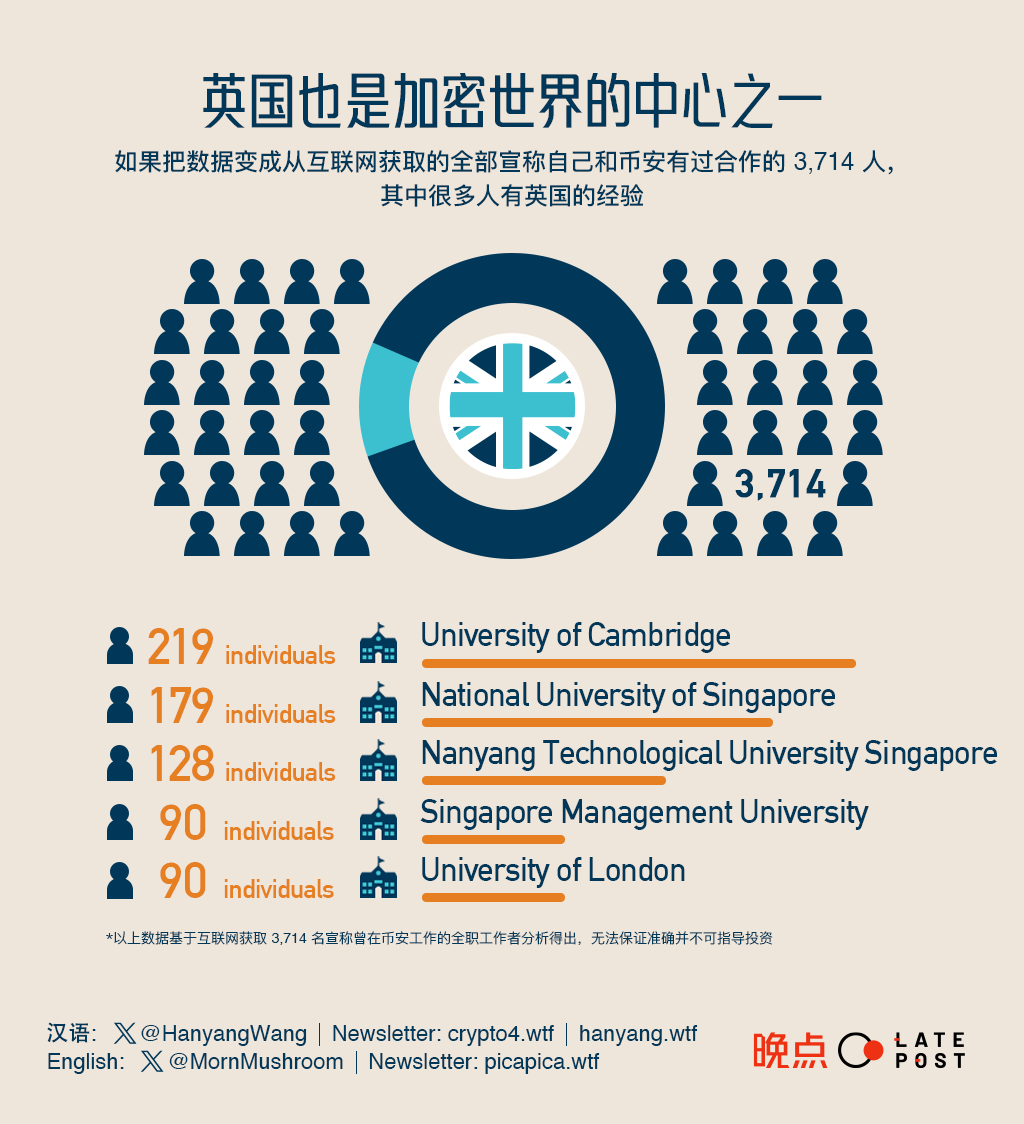
If the conditions are relaxed to all the 3714 people who have cooperated with Binance, there are quite a few people with British learning experience:

University of Cambridge, UK: 219 people

National University of Singapore: 179 people

Nanyang Technological University, Singapore: 128 people

Singapore Management University: 90 people

University of London, UK: 90 people

One speculation is that as a rapidly growing company, Binance’s demand for interns should not be small. As a Chinese-dominated company, Chinese who can speak English are a very ideal recruitment choice. But it is not easy to recruit in China, so Chinese students overseas are very suitable.

There are 170,000 Chinese students in the UK, making it the largest source of students. Binance can give these students suitable internship opportunities. According to my observation, it is more difficult for Chinese students in the UK to find internships and jobs locally than in North America, so more people will flock to blockchain companies that can recruit globally. There are only 50,000 international students in Singapore, and Chinese people account for 1/3. Therefore, the number of interns will not be particularly large.

Changpeng Zhao, who loves Uber, has recruited the most former Amazon employees and considers layout adjustments like an Internet CEO.

A retired executive from Binance told me that Changpeng Zhao is a person who loves reading. In the early years, Binance had a core management group of more than 40 people. Changpeng Zhao would often throw in the books he had read so that everyone could think at the same time, and jokingly threatened that if he didnt read, he would be kicked out.

Most of these books are management and corporate biographies. Among the many companies, Zhao Changpeng likes the biographies about Uber and Netflix. Especially Uber, because the ride-hailing giant faced regulatory challenges similar to those faced by Binance in its early years.

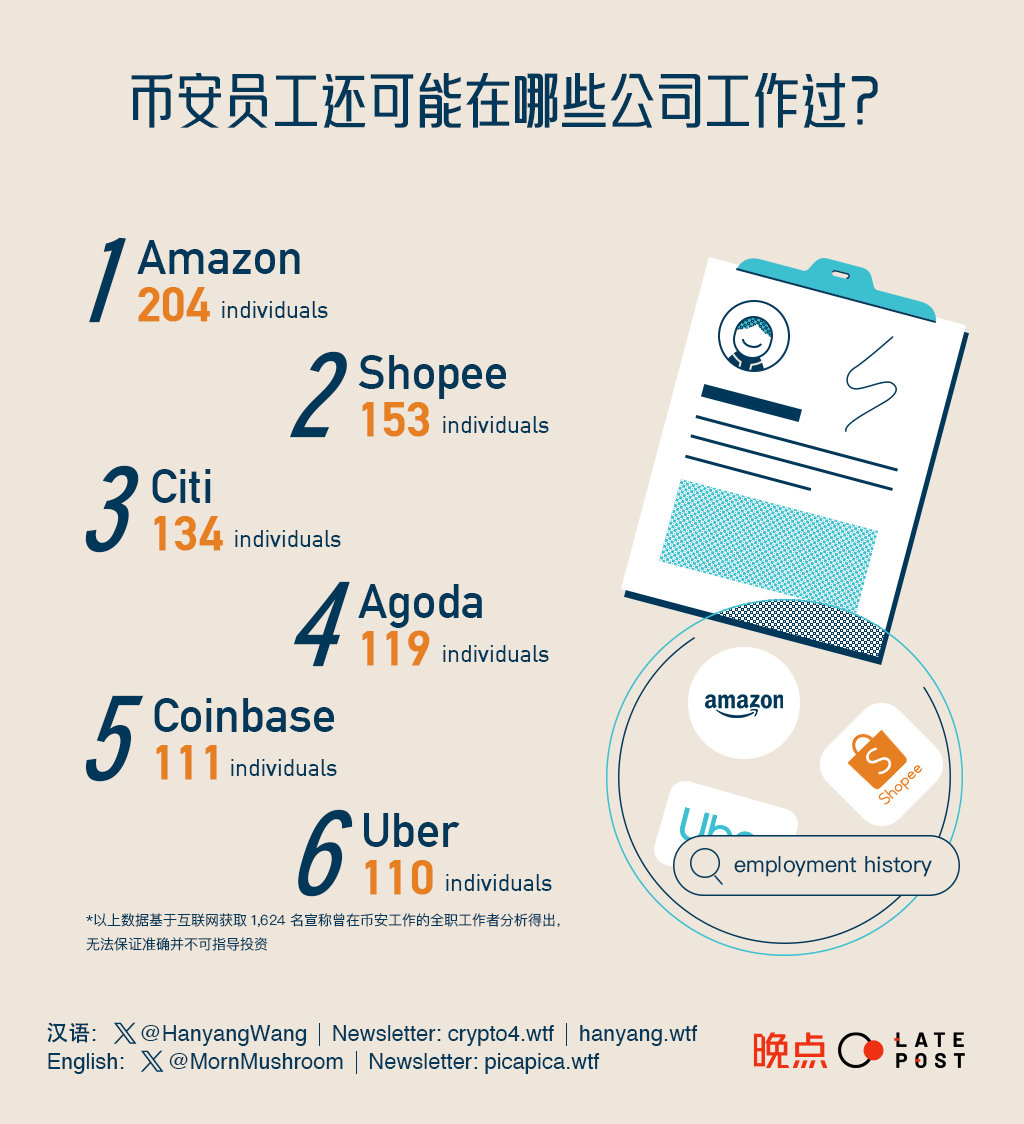
Zhao Changpeng not only read, but also learned and applied it. Later, he also recruited many people from Uber. This is evidenced by our sample of full-time employees: 110 people have experience working at Uber, ranking sixth in our data. The top five are:

Amazon: 204 people

Shopee: 153 people

Citibank: 134 people

Agoda: 119 people (an online hotel booking website)

Coinbase: 111 people (a US cryptocurrency exchange)

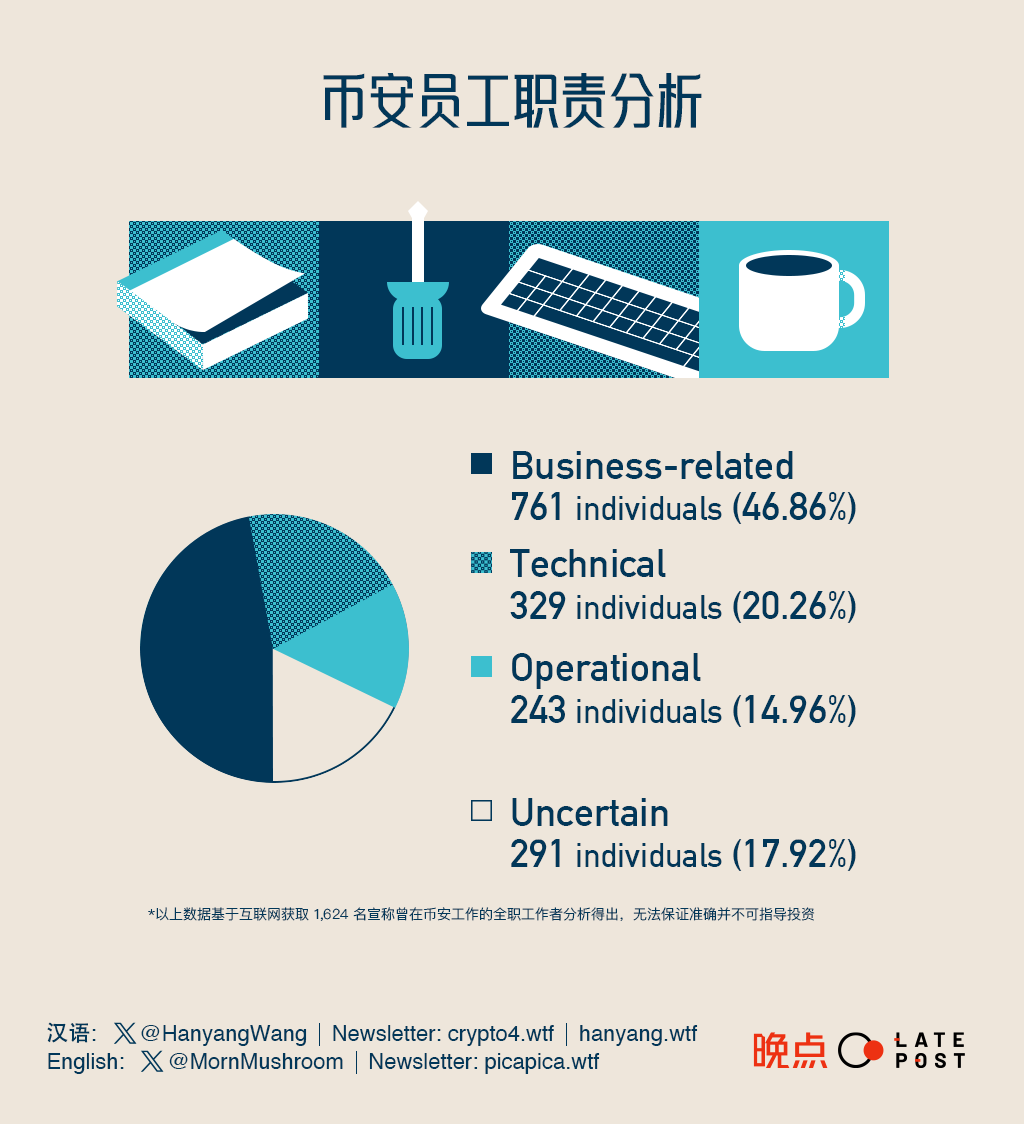
So what do these people do at Binance?

Business related: 761 people (accounting for 46.86% of the total number)

Technology related: 329 people (accounting for 20.26% of the total number)

Operation-related: 243 people (accounting for 14.96% of the total number)

Unsure: 291 people (accounting for 17.92% of the total number)

We were unable to identify the positions of many people because the collected data was not necessarily accurate and lacked many key information. In this limited data set, we can see that nearly half of the positions are business-related, which may reflect Binance’s emphasis on business development, sales, marketing, and strategy—essentially the pursuit of growth and expanding market share.

This leads me to a story told by an interviewee who participated in revamping CMC (CoinMarketCap), a cryptocurrency price tracking site and data provider, after Binance acquired it. At the meeting to discuss the revision, Zhao Changpeng checked the different locations one by one to see if they were suitable for advertising. In the end, Changpeng Zhao asked to remove all the advertisements in very prominent positions on the homepage, leaving only some small places for advertisements, and suggested that the team add advertisements in places where users would not feel them, and put user experience first.

The removed advertisements accounted for the bulk of CMCs revenue, but Zhao Changpeng believes that if the user experience is worse than competing products, the end users will only be lost, and the current income is meaningless no matter how high it is. The final effect is to only retain advertisements in small positions and insert some very smooth advertisements in positions that users are not aware of. But after all, the bulk of advertising revenue is gone, and Zhao Changpeng has adjusted employees KPIs accordingly. This interviewee commented on Zhao Changpeng: He has an overall view and focuses on key points.

More than a quarter of the sample was promoted at Binance

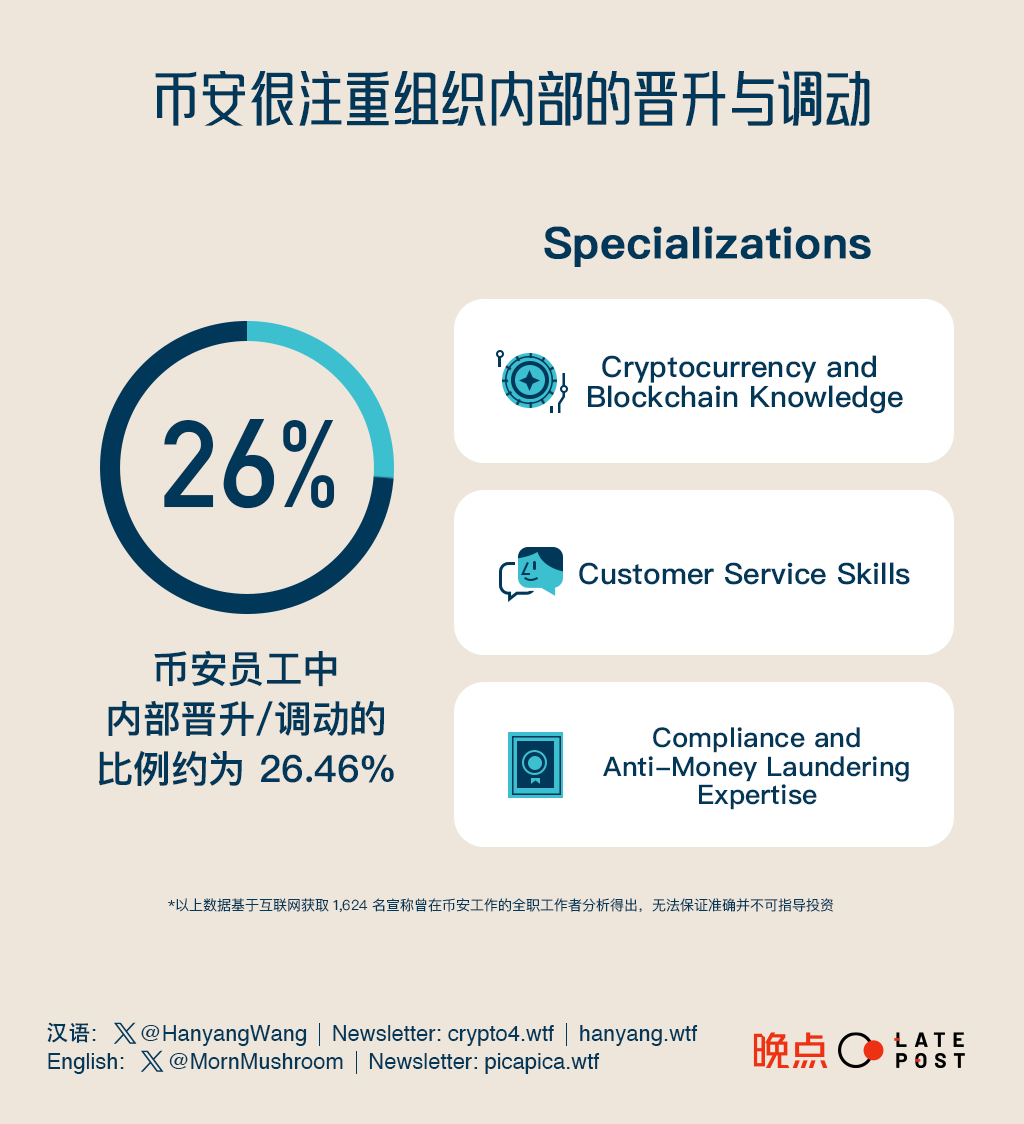
I tried to use the data to determine what industries Binance tends to hire from, and it was unsurprisingly tech and finance. An interesting thing is: through our small sample data, it can be seen that the proportion of internal promotions among Binance employees is about 26.46%. This may indicate that Binance is very focused on promoting within the organization, or transferring employees between different branches or subsidiaries.

Judging from these employees descriptions of their positions, Binances requirements for skills are mainly concentrated in three areas: cryptocurrency and blockchain knowledge, customer service skills, and compliance and anti-money laundering expertise - Binance seems to pay attention to compliance. regulation.

Binance and compliance are a very controversial topic. In most countries, Binance is not compliant. Especially the dispute between Binance and the SEC. Although Binance has been sued by the SEC, most observers believe that this is just a prelude to a more intense struggle, and the real big struggle should still be behind. Moreover, the process of Binance’s efforts to pursue compliance can basically string together the entire history of Binance’s company, which is worth describing in detail later.

This article is just some basic analysis of Binance, and it leaves far more questions than answers.

Judging from the limited data, Binance is an exchange that is distributed around the world and growing extremely fast. How are its employees organized and cooperative? What kind of people manage it and by what specific methods? How does it face growing challenges? What could possibly go wrong with it? These issues await further exploration.

Binance is like a map full of fog of war. I hope that through hard work, we can gradually explore the full picture. Because Binance is destined to become one of the most important companies of this era.

Binance
Welcome to Join Odaily Official Community