See Multichain's ideal cross-chain future through the latest zkRouter
On February 22, the cross-chain routing protocol Multichain announced that it has launched the zero-knowledge proof-based cross-chain infrastructure zkRouter on the test network, and realized the test network cross-chain transfer from Ethereum to Fantom.
As one of the leading projects in the cross-chain track, in order to better meet the growing needs of users for cross-chain activities, Multichain has so far launched a variety of products at different levels. Among them, the asset cross-chain bridge Bridge/Router has now covered 81 blockchains, supports more than 3,000 currencies, sits on a liquidity of 1.93 billion US dollars, and has a cumulative transaction volume of 98.35 billion US dollars, ranking first in market share; news The cross-chain protocol anyCall has also been integrated into leading Dapps such as Curve Finance to provide stable and efficient services in cross-chain communication scenarios.
The zkRouter launched this time is a new attempt made by Multichain at another level outside of asset cross-chain and message cross-chain.

MBI: Cross-chain hierarchy in the eyes of Multichain
Before understanding zkRouter, we need to understand the position of this product in the cross-chain service hierarchy.
In Multichain's view, as multi-chain parallelism becomes the general trend, "native cross-chain Dapps" will also become the development direction of on-chain applications. Different from the widely existing "multi-chain deployed Dapps" -- such as Uniswap, Aave, etc. deployed on multiple chains such as Ethereum, Arbitrum, Polygon, etc. -- "native cross-chain Dapps" will have built-in cross-chain functions, It is no longer necessary to rely on external bridges or routes to complement cross-chain functionality.
To give a simple example, some time ago when Uniswap chose the BNB Chain cross-chain bridge, the governance war was raging. Since Uniswap does not have native cross-chain functions, it must be integrated whenever it is deployed to a new chain. To a cross-chain bridge so that the governance results can be smoothly transmitted from Ethereum to the new chain, this process is time-consuming and cumbersome, while "native cross-chain Dapps" do not need to worry about such problems at all, and only need to call the message cross-chain internally chain function.
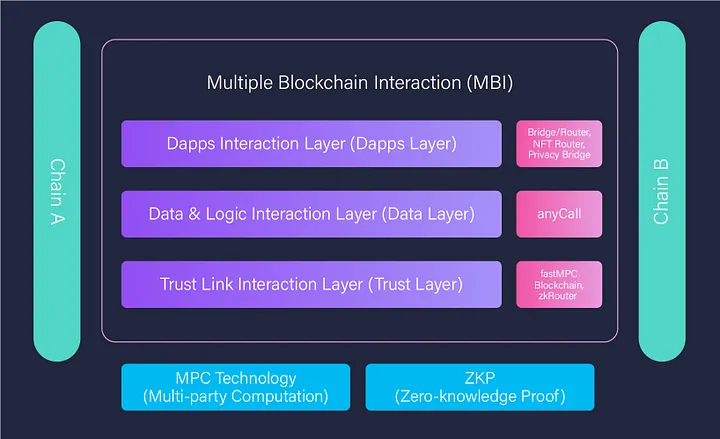
To realize the "native cross-chain" function, it is not enough to rely solely on the combination of applications, but to provide complete support at a lower level. Combining its own years of experience in the cross-chain field, Multichain proposed a multi-chain interaction architecture called MBI (Multiple Blockchain Interaction).

MBI is divided into three layers from top to bottom.The first layer is the "application layer", and the most familiar asset cross-chain bridge belongs to this level; the second layer is the data layer, and the message cross-chain protocol anyCall belongs to this level; the third layer is the trust layer, In addition to the multi-party trust mechanism fastMPC Network, the corresponding product is our protagonist zkRouter today.
In the structure of MBI,For each level from top to bottom, Multichain encapsulates the function implementation that can be called upwards, and shields the corresponding technical implementation details downwards.Developers can build their own "native multi-chain Dapps" based on any of these layers, focusing on the realization and innovation of their application functions, without having to pay attention to the specific implementation of the underlying mechanism.
zkRouter: The charm of zero-knowledge proof
From the perspective of positioning, zkRouter can be understood as an inter-chain trust mechanism built with zero-knowledge proof (ZKP) technology.
ZKP refers to a mathematical proof mechanism in which the prover can convince the verifier that a certain assertion is correct without providing any useful information to the verifier. Due to its mathematically provable properties, ZKP has been regarded by the blockchain industry as the "holy grail" for solving trust problems.
However, because Turing's complete ZKP technology has been in a state of being perfected, and the related development work requires an extremely deep foundation in cryptography, and the development of the supporting SDK is also relatively difficult, so the progress of projects using this technology in recent years has not progressed. Not ideal. However, for Multichain, as a cross-chain service leader with sustainable income, it does not need to tighten the budget like most projects in the bear market, but has sufficient resources to support complex research and development work.
The final result is that, based on the accumulation of theoretical and practical experience, Multichain relies on excellent development resources and rich community strength to launch the inter-chain trust layer protocol zkRouter using ZKP technology based on the research progress of Groth 16 and Plonk.
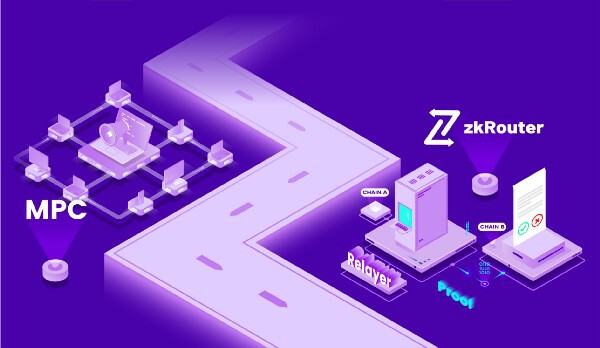
zkRouter belongs to the trust layer in the MBI structure, and its utility is to realize the transfer of cross-chain consensus between multiple chains in a trustless and decentralized manner. There are three main participating roles under the mechanism of zero-knowledge proof - Prover, Relayer and Verifier. Relaying to the target chain, the role of the verifier is to determine whether the ZKP provided by the prover is true. Reflected in the operating mechanism of zkRouter,The prover can be a relay at the same time, and the verifier is the light client of the target chain. The relay node acting as the prover needs to construct a verifiable proof without tampering with the data. The light client serving as the verifier is based on ZKP Prove that the verification of the authenticity of the received content can be done easily and independently.
The characteristics of zkRouter's operating mechanism determine that the generation and delivery of Proof will not have any impact on the credibility of the content, thus realizing the consensus delivery without trust. More concretely, this means that zkRouter can accept anyone as a relay node,Therefore, no matter who deploys and operates zkRouter, it will not interfere with the operation of zkRouter, let alone affect its results.
Multichain added that zkRouter uses an optimized zk-SNARK in its design to generate a concise ZKP, which supports the target chain to verify the proof at a lower cost. This scheme has the characteristics of lower circuit complexity, less storage overhead cost, and better versatility.
In addition, based on the current pre-research of Multichain, zkRouter can realize the consensus transmission of POS and POW, which means that zkRouter can be applied to the consensus transmission between heterogeneous chains, and it also brings more possibilities for the future development of this mechanism.
With fastMPC Network, why zkRouter?
In the previous MBI framework, we can see that in addition to zkRouter, Multichain has another solution fastMPC Network in the trust layer. So, what is the difference between the two? With the fastMPC Network and a mature upper-layer application based on this mechanism, why does Multichain spend so much effort to challenge the complex and difficult ZKP?
From the perspective of operating principle, although fastMPC Network belongs to the inter-chain trust mechanism like zkRouter, the technical basis of the two is different. fastMPC Network is based on multi-party secure computing (MPC) technology, which allows multiple groups of users to use their private data as input to jointly calculate a function, and all users can only get the output of this function and cannot get any other information.
The characteristic of MPC is that it has high computing security, but because the technology contains complex cryptographic operations, the computing overhead is large, and the performance loss is large, so there are often certain performance limitations. However, fastMPC Network has made a considerable performance optimization, which has increased the execution speed by 4-5 times compared with the early MPC 1.0 stage of Multichain.
Looking at zkRouter again, as a technical implementation of ZKP, its biggest feature is that it uses mathematical proofs to achieve cryptographic security, and at the same time unties the trust restrictions on relay nodes, achieving complete trustless state transfer between chains . This also means that zkRouter will have significant advantages in terms of security and work efficiency.
From an application point of view, although fastMPC Network and zkRouter will have certain overlapping scenarios, the natural advantages of zkRouter determine that it has the potential to better adapt to the needs of "native cross-chain Dapps", which is why Multichain will position We regard zkRouter as the core component of next-generation product services.
Looking forward to the future, Multichain will continue to promote the research, development and cooperative promotion of zkRouter in the three dimensions of technology, product and ecology, and strive to make zkRouter serve more project parties and developers, apply it to more scenarios, and provide more and more Fine-grained functional services.
zkRouter does not only belong to Multichain, but the cornerstone of the entire cross-chain ecology
In the many introductory articles about zkRouter, Multichain once said something that stuck with us: "zkRouter has never been the business of Multichain itself, but the business of everyone who agrees with 'native cross-chain Dapps', agrees with the MBI architecture, and agrees with the key components of zkRouter's cross-chain infrastructure.”
In Multichain's view, zkRouter is not just a product of the project, but also a key infrastructure serving the entire cross-chain ecosystem. From a certain level, the significance of zkRouter to the cross-chain ecosystem is even greater than that of Multichain itself.
In December last year, Odaily interviewed Multichain co-founder Alfred Xu. When asked how to view the future development trend of the cross-chain track, Alfred replied that, just as 2020 is the first year of asset cross-chain, Multichain firmly believes that 2023 will be the first year of Dapps cross-chain... In the future, we may be together Witness the gradual development of innovative Dapps such as cross-chain DEX, cross-chain aggregation, and cross-chain lending, and gradually mature, and finally build an innovative and prosperous multi-chain ecology through mutual combination.
After about two months, zkRouter was officially born. This is like a seed planted by Multichain. Although it has not yet been widely adopted in the future, with the increasing development of "native cross-chain Dapps", it may explode with amazing potential in the near future.