






近期链上回顾:没有主线,只有拉扯


- 核心见解:現在のSolanaチェーン上のMemeコイン市場は、「アテンションPvP」と「コミュニティによる有機的成長」という2つの力の綱引き構造にある。前者は有名人による価格操作やホットトピックに依存し、後者は実際のコミュニティコンセンサスとプロジェクトの継続的な発展に依存しており、後者の方がより強い回復力を示している。
- 重要な要素:
- アテンションPvPの慣性:市場は有名人による価格操作に便乗することに慣れており、例えば$JOTCHUAはKOLAnsemの発言により時価総額が約900万ドルに達したが、コミュニティはその「有機性」に疑問を呈している。同様のプロジェクトでも、チェーンによってパフォーマンスの差が顕著であり(Solana上の$WORLDCUPは1200万ドル、Base上の$PITCHは70万ドルに下落)。
- Pump.funの極端な事例:新機能「Pump Fun GO」により、有償の懸賞金投稿が可能になり、$Bountyworkプロジェクトは40SOLの懸賞金でタトゥーを入れるというホットトピックを創出。参加者は最終的に4万8000ドルの利益を得たものの、トークンはその後価値がゼロになり、純粋なトラフィック主導の投機性を露呈した。
- コミュニティ型トークンの回帰:$neet、$troll、$buttcoin、$tripletなどのトークンは410~107日間存続し、時価総額は660万~6500万ドルの間で安定している。これらの共通点は、長期的で自発的なコミュニティを持ち、単一のKOLに依存していないことである。
- キープレーヤーの見解:KOLのAnsemは、健全なMemeコインは有名人による価格操作や素早い売り抜けに依存するのではなく、コミュニティが損失に耐えながら継続的に理念を広めることに依存すべきだと明確に指摘している。市場データ(ソーシャルメディア、取引量、保有者数)こそが判断のシグナルである。
- ブロックチェーンゲーム$KINSの事例:ブラウザベースのMMORPGを通じて信頼を構築し、時価総額4万ドル、保有者数243名からスタート。コンテンツを継続的に更新し、コミュニティ型トークンを統合することで、KOLをプレイヤーとして引き付け、報酬獲得のための宣伝に依存しなかった。
After the ETH mainnet market gradually quieted down, degens have become active again on Solana. Even so, it's hard to pinpoint a clear theme for the Solana market. If we had to summarize, it might be described as "a tug-of-war between returning to the community and attention PvP."
Attention PvP
Since Trump launched his coin, the meme coin market has long been accustomed to relying on celebrity endorsements, hot events, and who has the fastest reaction time.
Everyone is used to it, so even with poor liquidity, people still follow this playbook to find opportunities, creating an inertia around this style of play.
$JOTCHUA is a dog meme that gained popularity among Spanish-speaking and English-speaking user circles in 2021. On January 24, 2021, Instagram user @_kingorange uploaded a motivational poster featuring a rough dog image with the word "JOTCHUA," which garnered over 29,000 likes within three months.
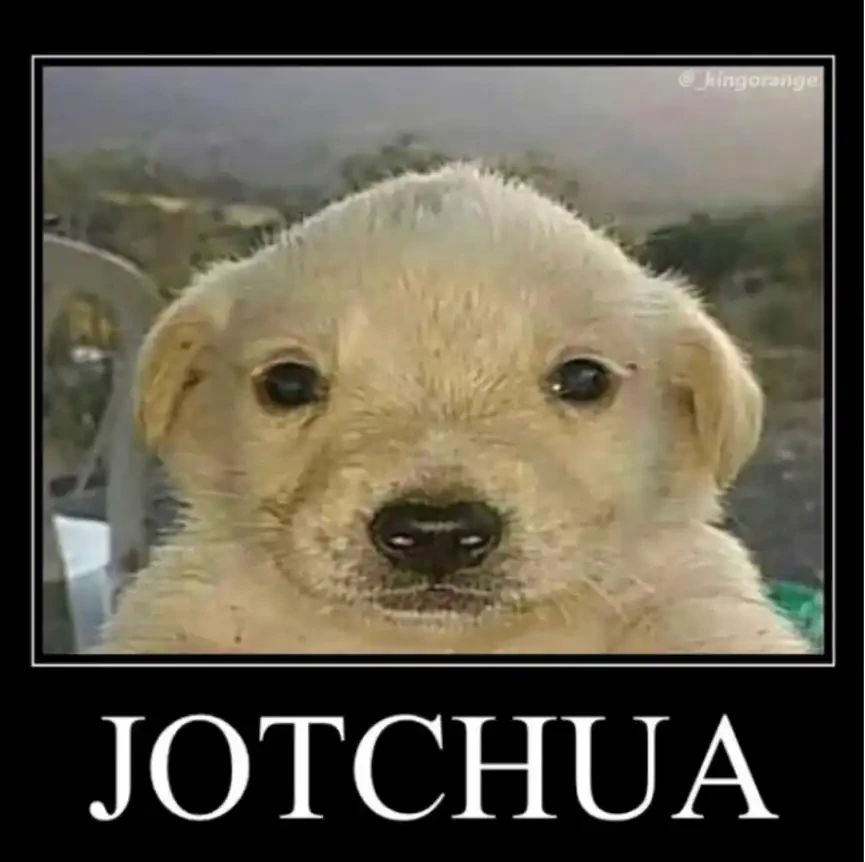
The coin's market cap briefly peaked at nearly $9 million. There is significant controversy within the community over whether the coin is "organic," as its launch did not occur after the meme's creator, @_kingorange, claimed it. It's almost impossible to say that the "claim" was the direct cause of the price increase.
Many players believe this coin is another "setup," or because KOL Ansem claimed on June 9 that he had, for the first time in over a year, returned to buying Solana meme coins, sparking market speculation that his purchase was related to this coin.
The same concept, even the same ticker, but your coin just doesn't pump. The $JOTCHUA on the ETH mainnet was deployed as early as December 2023, with sustained content and a community, but it couldn't compare to getting the creator to come and click a button to claim it.
A similar situation occurred with the World Cup concept. $WORLDCUP on Solana, driven by bonkguy's purchase and long-form analysis, broke through a market cap of $12 million from around $5 million. Meanwhile, $PITCH, a World Cup concept project on Base, has dropped from a peak market cap of about $7 million to nearly $700,000.
Although $PITCH does have its own issues, mainly in communication. The project isn't inactive; it consistently updates, but the dev rarely speaks up, and its X account has been repeatedly banned, leaving it without a new one. Still, you have to admit, without a celebrity shill, similar concepts and gameplay lose out in the battle for attention.
Pump.fun's recent new feature, Pump Fun Go, allows anyone to post paid bounty tasks.
This has indeed attracted mainstream media attention, but unfortunately, it reaches the masses in a negative light again.
$Bountywork, which briefly reached a market cap of nearly $2.5 million. Its dev, @ayushquantt, focused on continuously posting new tasks to generate hype for the coin.
And he succeeded – by offering a bounty of 40 SOL for someone to tattoo $bountywork on their forehead.

An Indian man actually did it, strictly following the dev's typo in the description – missing an 'n', writing the ticker as $boutywork.
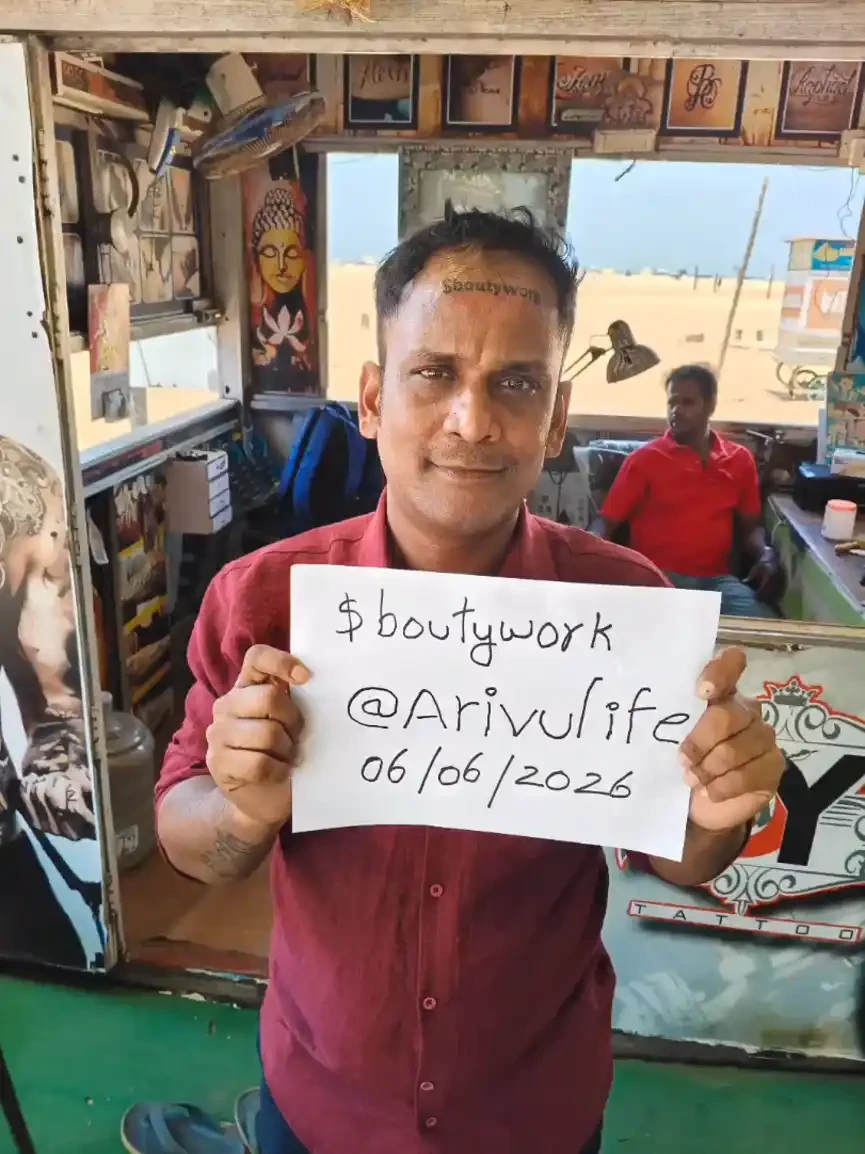
Initially, his bounty application was rejected because the tattoo was missing the letter 'n', and the dev demanded he correct it. Then, someone sent him another $boutywork, launching a new coin with the wrong tattoo as the ticker.
In the end, he still received the 40 SOL bounty reward, plus the income from the new coin's creator, totaling about $48,000.
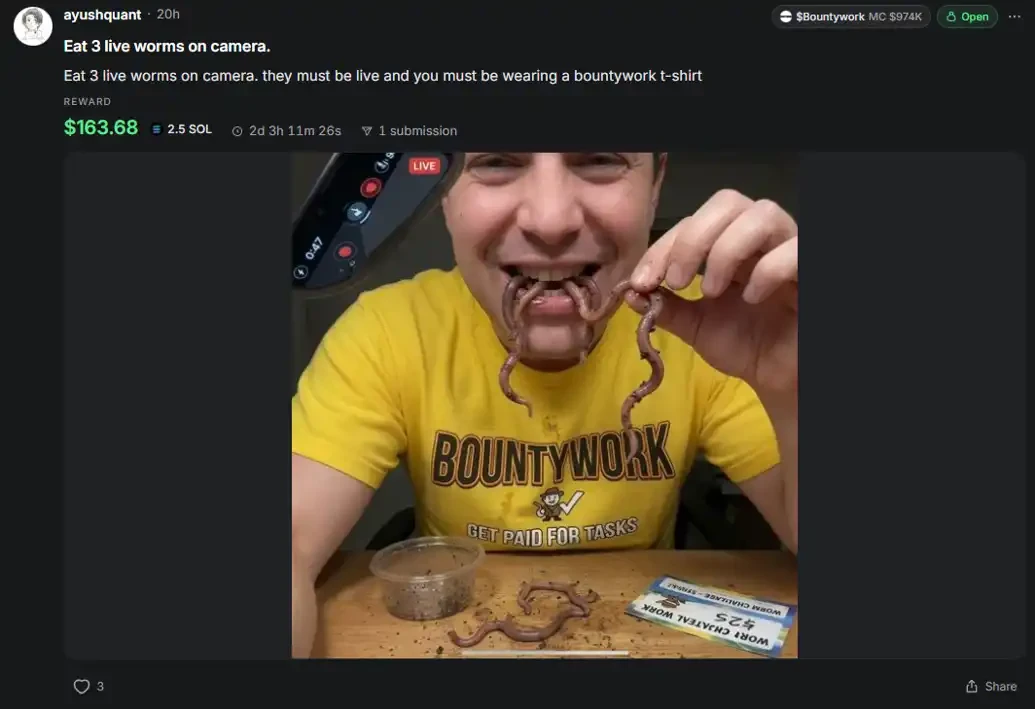
Then, as the event's hype faded, $boutywork has essentially gone to zero, and the $Bountywork dev keeps posting new bounties trying to replicate this "success," like asking someone to wear a $Bountywork shirt and eat 3 bugs on camera.
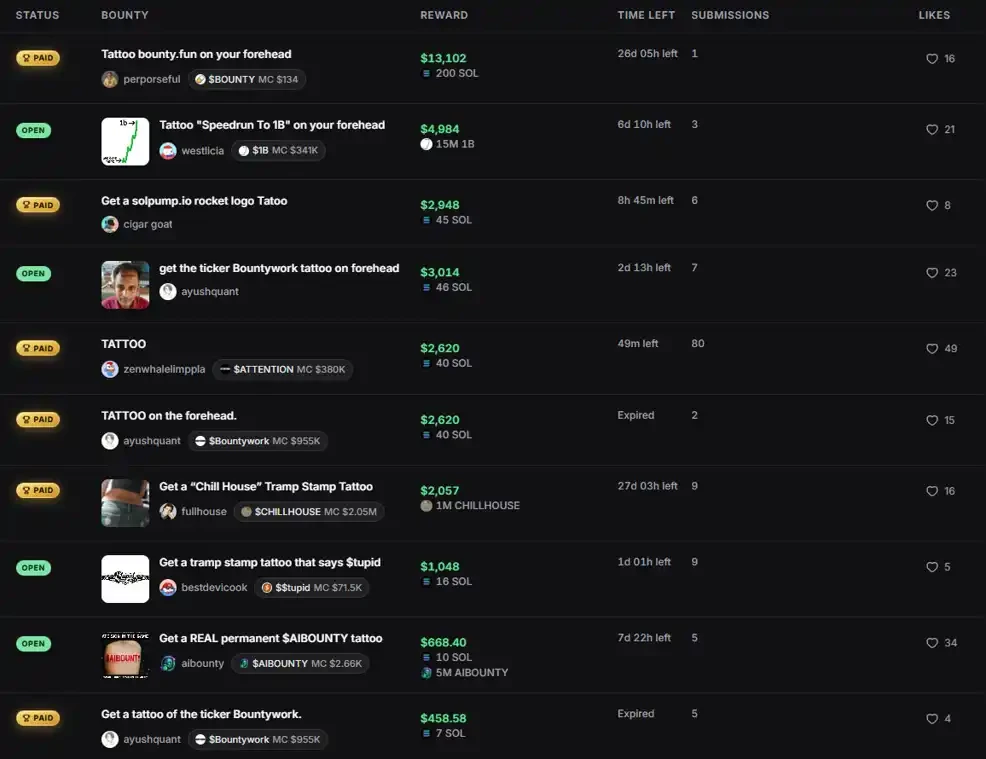
There are quite a few tattoo-related tasks on pump.fun, with some people earning up to 200 SOL for getting tattoos on their faces.
To be honest, it's not much different from the old days on Kuaishou where big shots would give gifts for people to eat raw eggs or chug strong liquor...
The Return of Community
Let's continue with pump.fun's new feature. Almost all bounty tasks are related to creating attention-grabbing events for specific tokens. The only one that might not be treated as a joke is this bounty for $neet – organizing a gathering of people who resist work in New York.
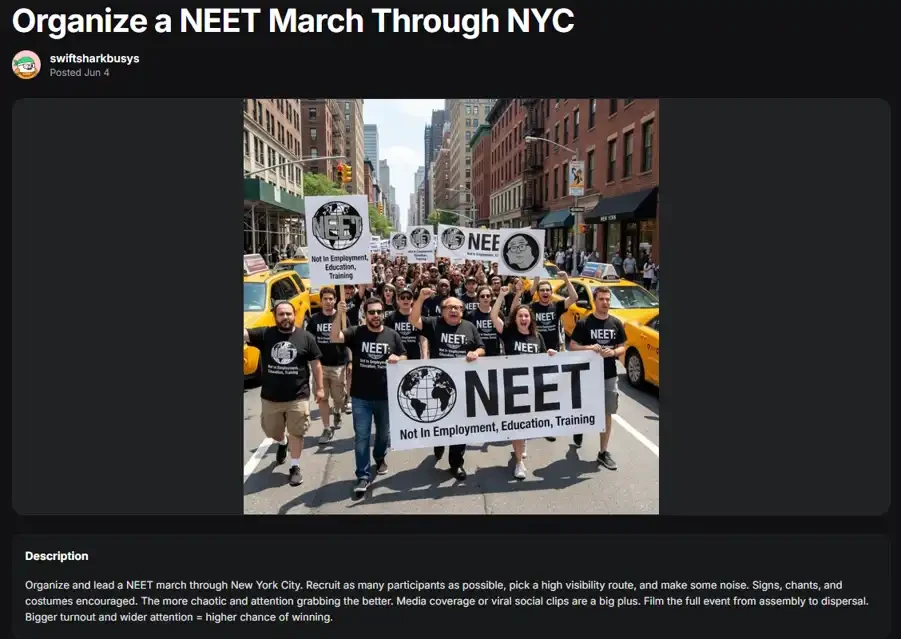
This bounty is paid in $neet, with the reward valued at over $15,000. The $neet community has already spontaneously organized two offline "No Work Gatherings" in the US; if this bounty is completed, it will be the third.
While it's unclear what pump.fun's intention is in supporting community-driven meme coins, their official Twitter often features promotions for community tokens. Although these tokens perform variably – for instance, $chillhouse's price has been sluggish for a long time – the ones the pump.fun team selects are usually quite community-driven and organic.
As for those with relatively stable volume and price performance right now, besides $neet, there are $troll, $buttcoin, and $triplet. Here's a brief introduction to these community tokens' survival status and themes:
- $neet: Deployed 410 days ago, peak market cap ~$51 million, current market cap ~$27 million. The community's mission is to make more people realize that spending most of their lives on work means losing their own lives.
- $troll: Deployed 416 days ago, owns the copyright to the classic Troll meme, listed on Coinbase. Peak market cap ~$290 million, current market cap ~$65 million.
- $triplet: Deployed 107 days ago, is the abbreviation for the most popular breakout character "Stickman Tung Tung Tung Sahur" from last year's viral "Italian Classic of Mountains and Seas." Peak market cap ~$13.6 million, current market cap ~$6.6 million.
- $buttcoin: Deployed 153 days ago, originated from a 2011 joke on a Bitcoin forum, a pun on Bitcoin as "Buttcoin." Peak market cap ~$68.6 million, current market cap ~$27 million.
Mentioning these coins and talking about the return of community tokens brings us back to Ansem. After he mentioned returning to buy Solana memes, someone called for him to just post the CA, promising they would aggressively buy 1% if he did.
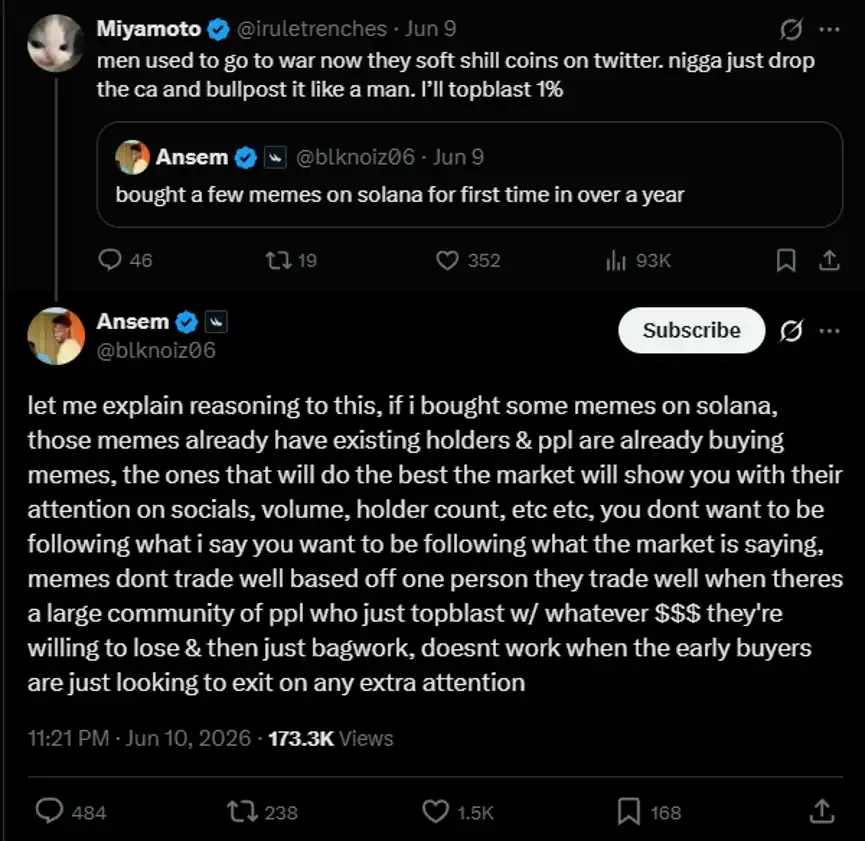
Ansem's response sparked much discussion:
"Let me explain why I don't post CAs. If I buy some Solana meme coins that already have strong holders, the market will tell you which coins are good through social media performance, volume, holder count, and other data. You shouldn't listen to me; you should listen to the market. Meme coins relying on holders who just try to be fast, shill, and wait to dump won't do well. Only coins with a large community where people are willing to endure losses and preach their holdings day in and day out will succeed. A coin dependent on a single celebrity won't work."
In addition to old coins with long survival times and relatively stable prices, a new coin has emerged following Ansem's viewpoint – $KINS.
$KINS is the token for Kintara, a blockchain game. Interestingly, Kintara hasn't driven the Solana gaming sector because its rise wasn't based on its sophistication, but on a standard step-by-step approach to building community trust through action.
Let's briefly introduce $KINS's mechanism. It's an MMORPG playable in a browser. To play, you need 1,000 $KINS in your wallet, allowing you to chop wood, mine, fish, buy houses, fight monsters and bosses, and engage in PvP.
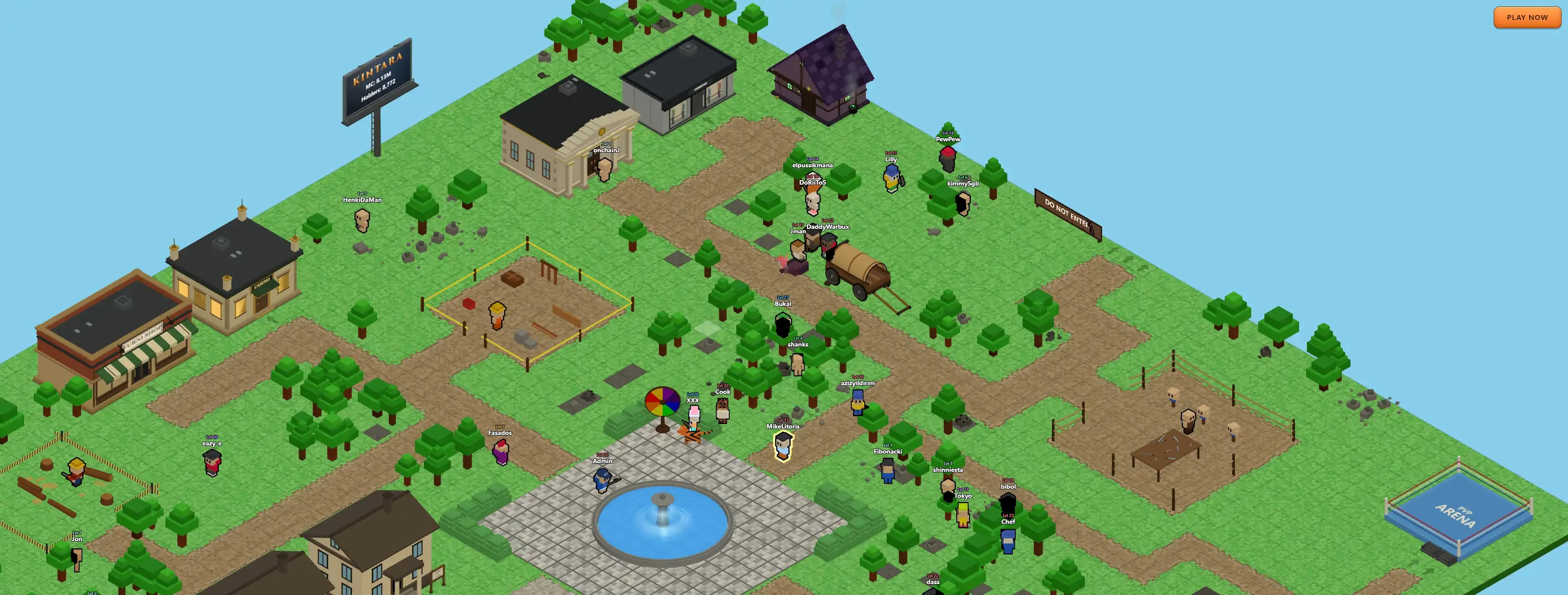
There are no other extra fees in the game, only a reward wheel. If players don't want to spin only once a day, they can spend $3 worth of $KINS for more spins. 50% of this revenue goes to token buybacks and burns, and 50% goes to project maintenance and development.
The core gameplay loop is roughly: collect resources -> craft items -> challenge harder monsters. If players lack resources, they must use the in-game currency "Gold" to buy from other players. Players can sell "Gold" priced in $KINS, with 5% going to the treasury and 95% to the player.
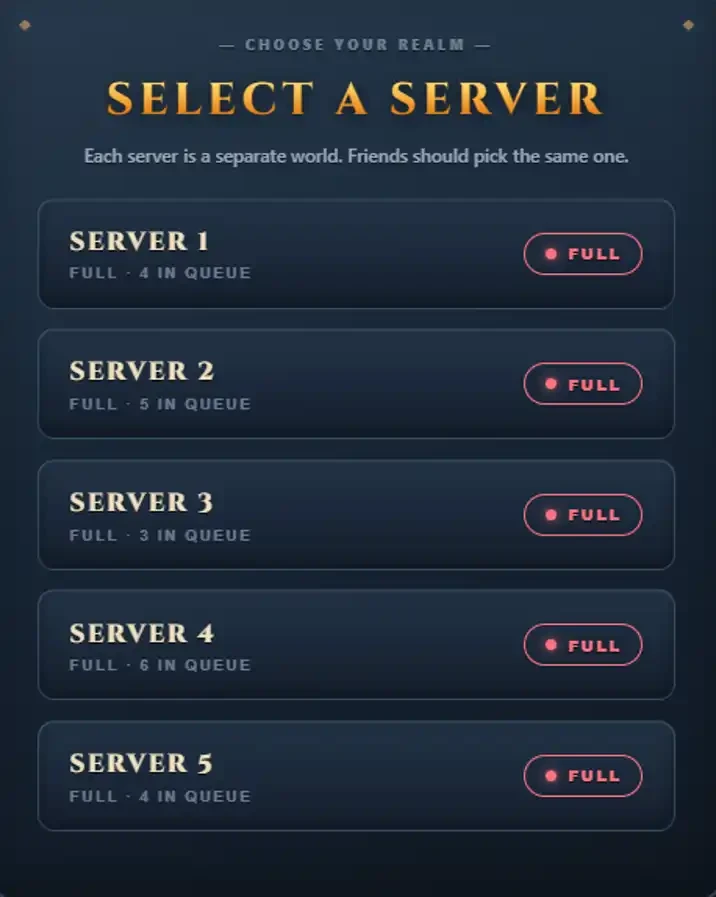
Sounds pretty mundane, and the data isn't spectacular either (only 0.5% of $KINS have been bought back so far). But this project's consistent delivery has built strong trust. Maybe it's because the market is too disheartening, but many players are genuinely engaged, with the number of people fishing in the game increasing daily. The project team has expanded to 5 servers, but there's still a queue...
One player successfully sold a rare mount obtained from fishing for $1,800:
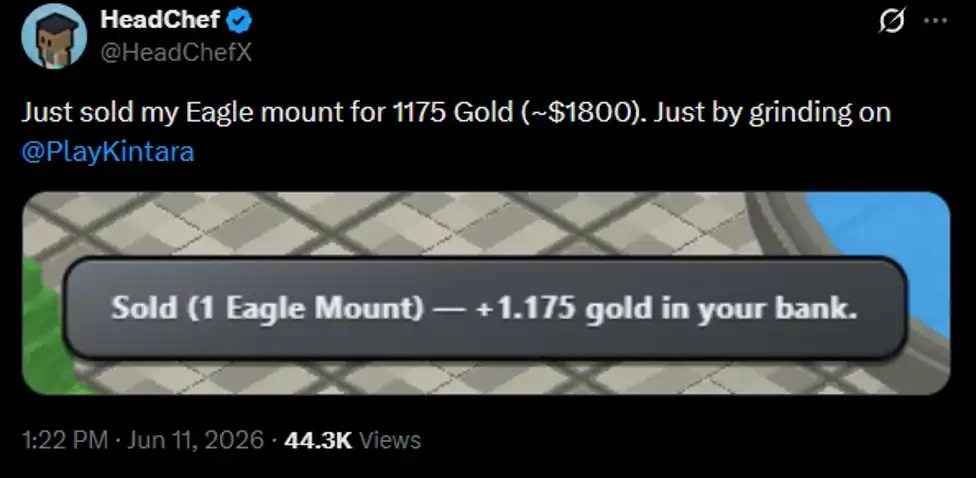
The project team behind this game barely promotes "earning," instead focusing heavily on "how to build network effects and player belonging." For example, integrating various community-driven meme coins or hot new tokens from Solana into game elements, or auctioning off in-game luxury homes.
Another example is promoting World Cup-themed football competitions organized in players' houses:
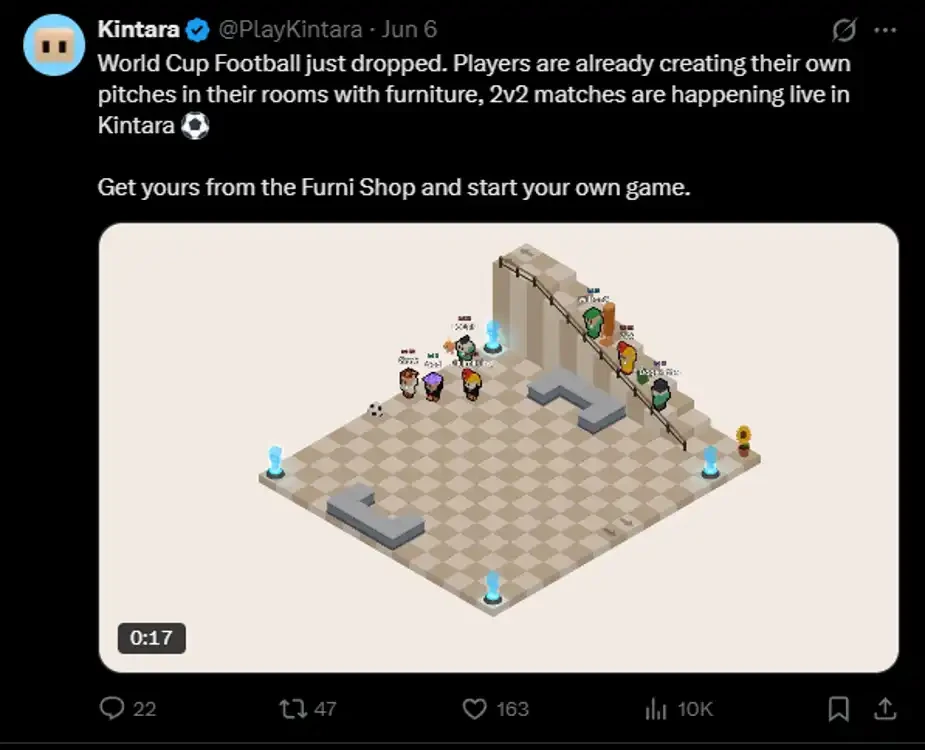
When it was still obscure, with a market cap of less than $40,000 and only 243 holders, this early stage of "unheard and unknown" was displayed on the main map's stats board. Watching Kintara persistently and quickly update game content gradually reassured more people, slowly attracting KOLs like Gake and Ansem to become part of the player base.
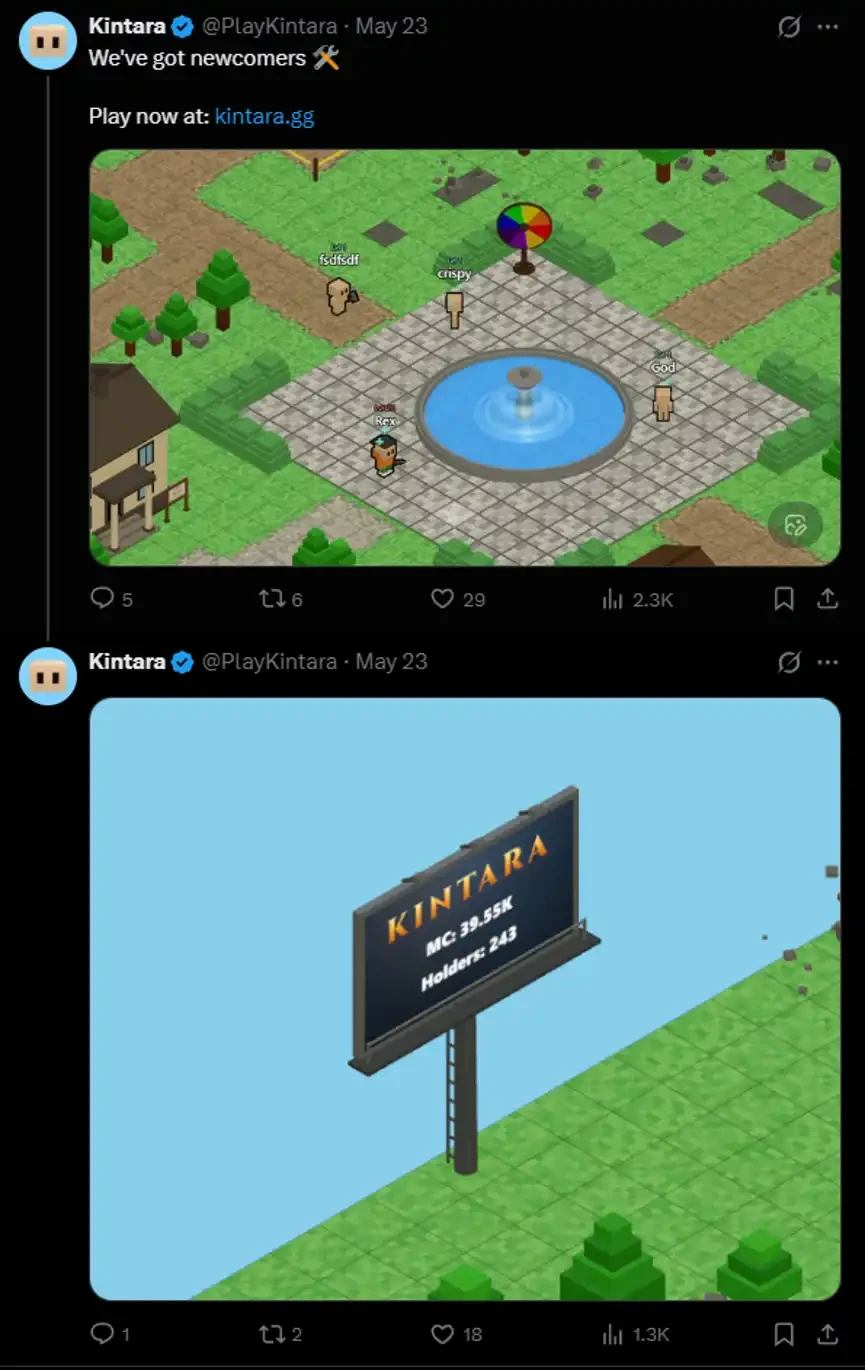
Kintara on May 23rd, like a newborn, silent, empty world
So no one calls projects like this a "setup."
"What are we constantly chasing? Is it a game of mutual trust, or a game of mutual deception?"
This is Trench's recent introspection.
Hopefully, such introspection can continue, eventually leading to a healthier market.


