






什么是 OpenGradient (OPG)? คู่มือฉบับสมบูรณ์สำหรับการอนุมาน AI ที่ตรวจสอบได้บนบล็อกเชน


- ประเด็นหลัก: OpenGradient คือเครือข่ายโครงสร้างพื้นฐานแบบกระจายศูนย์สำหรับการอนุมาน AI ซึ่งดำเนินการคำนวณ AI ที่สามารถตรวจสอบได้ด้วยการเข้ารหัสผ่านสถาปัตยกรรมการคำนวณแบบไฮบริด (HACA) โดยมุ่งแก้ปัญหาการขาดการตรวจสอบ ความล้มเหลวแบบจุดเดียว การรั่วไหลของความเป็นส่วนตัว และการล็อกผู้ให้บริการในสภาพแวดล้อม AI แบบรวมศูนย์
- องค์ประกอบสำคัญ:
- แกนหลักของเครือข่ายคือสถาปัตยกรรมการคำนวณ AI แบบไฮบริด (HACA) ซึ่งแยกการดำเนินการ AI ออกจากการตรวจสอบบนเครือข่าย เพื่อให้ความน่าเชื่อถือระดับบล็อกเชนด้วยความเร็วระดับ Web2
- มีสเปกตรัมการตรวจสอบสามแบบ (TEE, ZKML, Vanilla) ช่วยให้นักพัฒนาสามารถเลือกระดับความเชื่อถือได้ตามความเสี่ยงที่ยอมรับได้ โดย TEE เป็นตัวเลือกเริ่มต้น
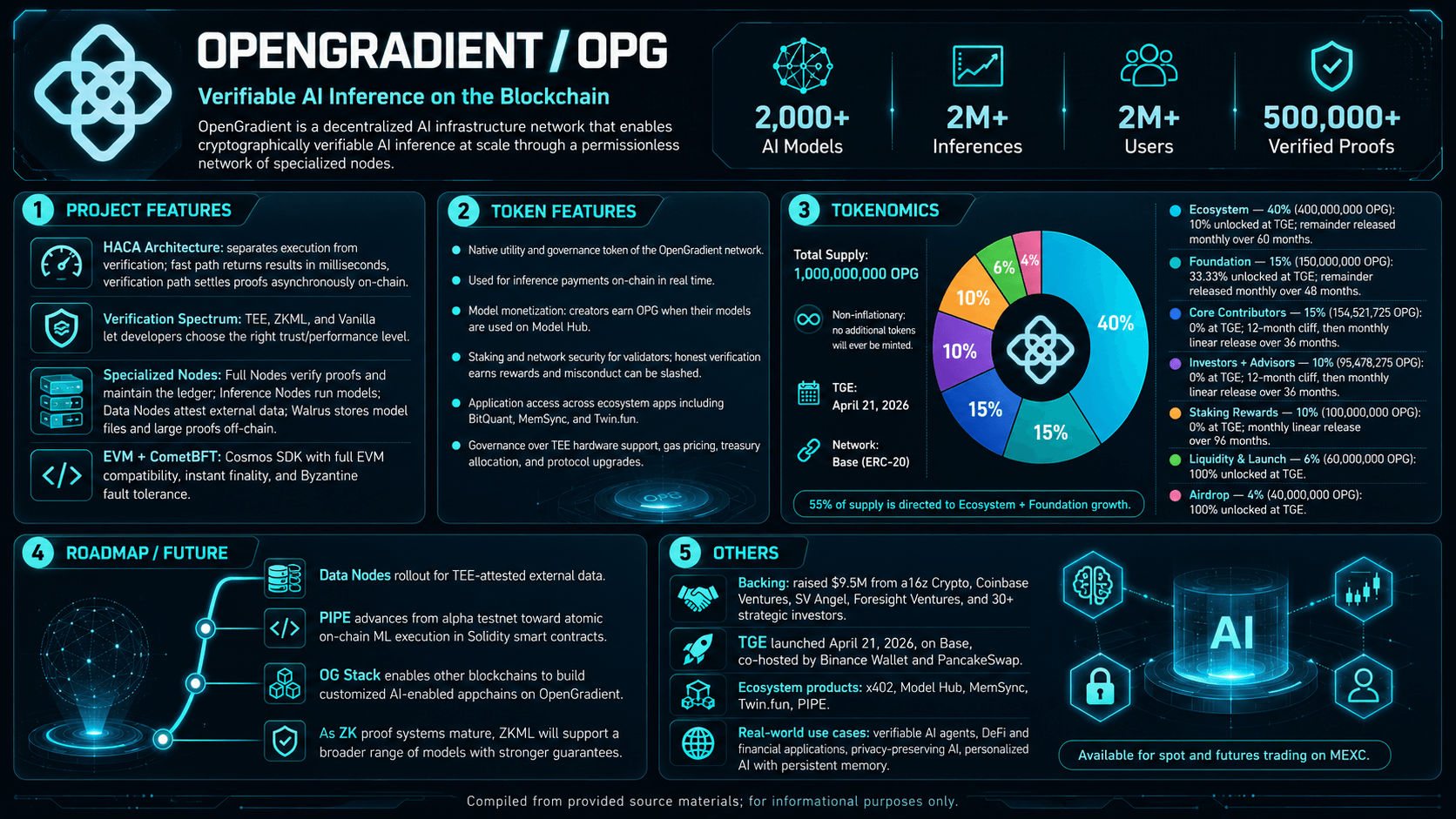
- อุปทานรวมของโทเค็น $OPG คงที่ที่ 1 พันล้านเหรียญ TGE เปิดตัวบนเครือข่าย Base ในวันที่ 21 เมษายน 2026 ใช้สำหรับชำระค่าอนุมาน การวาง Stake การสร้างรายได้จากโมเดล การเข้าถึงแอปพลิเคชัน และการกำกับดูแล
- ณ เวลาเปิดตัวเมนเน็ต เครือข่ายได้โฮสต์โมเดลมากกว่า 2,000 รายการ ดำเนินการอนุมานมากกว่า 2 ล้านครั้ง และให้บริการผู้ใช้มากกว่า 2 ล้านคน
- ผลิตภัณฑ์หลัก ได้แก่ API การอนุมานแบบคิดเงิน x402, คลังโมเดลแบบกระจายศูนย์ Model Hub, เลเยอร์ความจำ AI MemSync และตลาดดิจิทัลทวิน Twin.fun
Every AI decision today relies on a single trusted node and cannot be verified.
OpenGradient is a decentralized infrastructure network built specifically to solve this problem, enabling cryptographically verifiable AI inference at scale.
This guide covers everything you need to know: How OpenGradient works, its key differentiators, a complete breakdown of $OPG tokenomics, and how to buy OPG on MEXC.
Key Takeaways
- OpenGradient is a decentralized AI infrastructure network where every computation is cryptographically verified, eliminating the need to trust any single party.
- Its Hybrid AI Compute Architecture (HACA) separates AI execution from on-chain verification, delivering blockchain-grade trust guarantees at Web2-like speeds.
- $OPG is the native token of the network, powering inference payments, staking, model monetization, application access, and governance.
- $OPG has a fixed total supply of 1,000,000,000 tokens, with its TGE launched on the Base network on April 21, 2026.
- OpenGradient currently hosts over 2,000 AI models, has processed over 2 million inferences, and serves over 2 million users within its ecosystem.
What is OpenGradient (OPG)?
OpenGradient is a decentralized network built for AI inference, where every computation can be cryptographically verified without trusting any single party.
Today, when an AI agent manages a portfolio, approves a loan, or moderates content, no mechanism exists to verify which model version was running, what prompt was used, or whether the output was tampered with.
OpenGradient fundamentally solves this by running models on a permissionless network of specialized nodes, settling proofs on-chain, and making the entire process—from request to response—fully auditable.
As of its mainnet launch in April 2026, the network hosts over 2,000 models, has verified over 500,000 proofs, processed over 2 million inferences, and serves over 2 million users within its ecosystem.
Backed by a16z Crypto, Coinbase Ventures, SV Angel, and Foresight Ventures, with $9.5 million in funding, OpenGradient aims to build what it calls the infrastructure layer for the AI economy.
How is OpenGradient different from the OPG Token?
OpenGradient$OPG Token What it isComplete protocol & infrastructure networkNative utility & governance tokenFunctionHosts, executes, and verifies AI models on-chainDrives payments, staking, access, and governanceAnalogyLike the Ethereum blockchain platformLike ETH, the native currencyCore ComponentsHACA Architecture, Model Hub, MemSync, Twin.fun, PIPE, x402Inference fees, staking rewards, governance votesUsersDevelopers, enterprises, AI agentsToken holders, validators, users
What Problems is OpenGradient AI Trying to Solve?
AI infrastructure is rapidly consolidating into a handful of centralized providers, creating systemic risks for all applications that depend on them.
OpenGradient addresses four core failure points in the current ecosystem:
1. Verification is Impossible
When an AI agent transfers funds, approves a transaction, or provides medical advice, no external party can verify which model version ran, what system prompt was used, or whether the output was silently modified.
OpenGradient solves this by generating a cryptographic proof for every inference (TEE attestation or ZKML proof) and recording it permanently on-chain.
2. Single Point of Failure
If a centralized AI provider goes down, rate-limits your application, or silently changes model behavior, your entire product breaks without any fallback.
OpenGradient's permissionless network of specialized nodes eliminates this dependency by distributing inference across independently operated GPU workers.
3. Privacy is an Assumption, Not a Guarantee
Centralized AI providers can log, analyze, and commercialize your prompts without your knowledge.
OpenGradient's Trusted Execution Environment (TEE) nodes process requests within hardware security enclaves, where even the node operator cannot view, log, or manipulate the data.
4. Vendor Lock-in Worsens Over Time
Proprietary APIs, non-standard interfaces, and opaque pricing make switching providers increasingly costly.
OpenGradient's open, permissionless architecture (offering standard HTTP/REST access via x402 and EVM compatibility) completely eliminates these switching costs.
What's the Story Behind OpenGradient Crypto?
OpenGradient was founded with the vision of building verifiable AI infrastructure, aiming to get ahead of the curve before the industry becomes completely dependent on opaque centralized providers.
The project raised $9.5 million from a16z Crypto, Coinbase Ventures, SV Angel, and over 30 strategic investors.
Development progressed through the testnet phase, during which the network processed over 1 million inferences and served over 100 active developers.
The Token Generation Event (TGE) took place on the Base network on April 21, 2026, co-hosted by Binance Wallet and PancakeSwap, marking the transition to the full mainnet launch.
Core Features of OpenGradient (OPG Token)
HACA Architecture: Separating Execution from Verification
At the core of OpenGradient is the Hybrid AI Compute Architecture (HACA), which solves a fundamental problem: Traditional blockchains cannot handle AI inference because it is computationally expensive, non-deterministic, and slow.
HACA separates execution from verification via two independent paths: a fast path (inference completes in milliseconds, results returned immediately) and a verification path (proofs submitted asynchronously, verified by full nodes, and recorded permanently on-chain).
This means users get Web2-level responsiveness without sacrificing cryptographic verifiability.
Verification Spectrum: TEE, ZKML, and Vanilla
Not all AI inferences require the same level of trust. OpenGradient supports three verification methods, allowing developers to choose their trust level based on risk tolerance:
- TEE (Trusted Execution Environment) – Hardware attestation via AWS Nitro secure enclaves. Overhead is nearly negligible. Default for all LLM inference. Node operators cannot view, log, or manipulate requests.
- ZKML (Zero-Knowledge Machine Learning) – Mathematical proof that a specific model produced a specific output for a specific input. The strongest security guarantee. Best suited for high-risk ML models (e.g., DeFi liquidations, financial scoring). Overhead is 1,000–10,000x.
- Vanilla – Only signature verification, no proof of correct execution. Suitable for low-risk workloads, prototyping, or non-critical inference where performance is the priority.
Specialized Node Architecture
Instead of requiring every validator to re-execute all computations, OpenGradient uses specialized node types, each optimized for its specific role:
- Full Nodes – Blockchain validators that run consensus, verify proofs, manage payments, and maintain the ledger. They never execute models. They can run on commercial hardware.
- Inference Nodes – Stateless GPU workers that execute models. Two types: LLM Proxy Nodes (TEE-secured routing to OpenAI, Anthropic, Google, xAI) and Local Inference Nodes (running open-source models directly on GPU hardware).
- Data Nodes – TEE-protected nodes that fetch and certify external data (APIs, databases, oracles). Ensures data pipelines are as verifiable as inference pipelines.
- Decentralized Storage (Walrus) – Model files and large ZKML proofs are stored off-chain on Walrus, with only the Blob ID reference recorded on-chain. Keeps the blockchain lightweight while maintaining full data availability.
EVM Compatibility and CometBFT Consensus
Built on the Cosmos SDK, OpenGradient is fully EVM-compatible, meaning developers can use familiar tools—Hardhat, Foundry, ethers.js, MetaMask—and integrate via Solidity smart contracts.
The network utilizes CometBFT (formerly Tendermint) for consensus, providing instant block finality and Byzantine Fault Tolerance; the network remains secure as long as less than one-third of validators are compromised.
OpenGradient Real-World Use Cases
Verifiable AI Agents
Every LLM call in an autonomous AI agent is cryptographically signed with the exact prompt used.
When an agent transfers funds, approves a transaction, or executes a trade, anyone can verify the complete inference chain on-chain—providing a full audit trail for regulatory compliance and dispute resolution.
DeFi and Financial Applications
OpenGradient enables financial protocols to run ML models directly within their logic and obtain verifiable results:
- AMMs can automatically adjust fees based on ML volatility predictions (Volatility AlphaSense).
- Lending protocols can recalculate risk scores using verified ML models with real-time price feeds.
- Portfolio management agents can execute actions with cryptographic proofs of their decision-making process.
กระเป๋าสตางค์สัญญาที่ชาญฉลาดนักพัฒนาการเงินลงทุนDeFiสกุลเงินBaseAI


