






Talking about the future of chain games: customizability, identity and social layer


Original title: "The Future Of On-Chain Gaming》
Original title: "
Original Author: Alec Chen, Volt Capital
Compilation of the original text: Overnight porridge, the way of DeFi
The crypto game is still in its infancy. Recent advances in blockchain scalability and infrastructure now allow new types of games to be built entirely on-chain, opening the way for the integration of the crypto-economy and the broader decentralized ecosystem. As crypto gaming grows as an industry, players and developers alike stand to benefit from the economic models, incentive structures, and identity and coordination primitives of a decentralized economy.
Chain games
On-chain gaming is an example of the paradigm shift that crypto brings to traditional gaming. Game design is driven by their constraints. Current iterations of on-chain games are usually turn-based RTS games due to execution being limited by gas costs.0xMonacoOn-chain racing game in Paradigm's latest Capture the Flag challenge
Through advancements in blockchain infrastructure and scalability (such as zero-knowledge proofs and data availability layers), genres such as multiplayer online battle arenas (MOBAs) and first-person shooters (FPS) can now be built entirely on-chain, Thereby unlocking multiplayer online games on the chain on a large scale. The ability to bring highly interactive games on-chain adds mainstream appeal and brings a wider audience to the existing on-chain gaming ecosystem, attracting a generation of young gamers new to crypto.
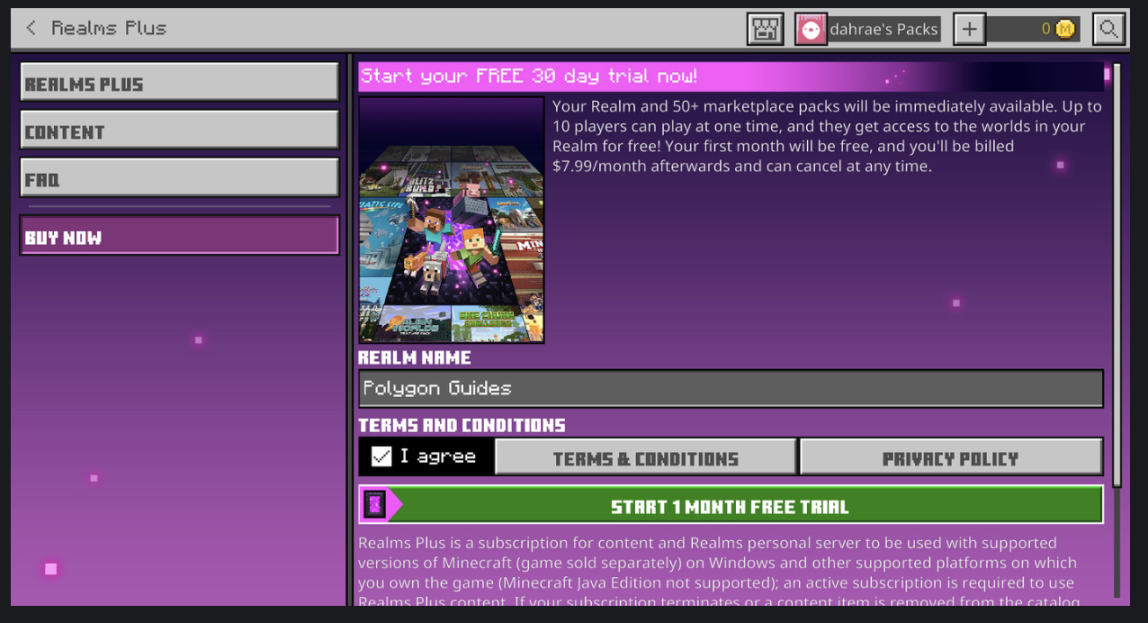
Minecraft Realms: Personal Servers Hosted by Players
Customizability
Customizability
Building games on-chain brings transparency and strong immutability guarantees, while also providing customizability. By turning core gameplay and functionality into a "superstructure," developers can build composable and customizable games as first-class citizens, with a decentralized, community-first approach to development and growth.
In traditional games, modding communities provide players with an organic way to experience worlds outside of the core game. User-generated content (UGC) is a huge revenue driver for games like Roblox and Minecraft, which outsource community management and development to independent creators.
This opens up an interesting new paradigm for game developers; for on-chain games, instead of requiring game developers to maintain "official" game servers, game studios can simply develop the underlying infrastructure (which can be as simple as a smart contract, dictate core game mechanics) and outsource hosting and further development to the community. Indie creators can bring their fantasy kingdoms to life by hosting "private servers" with custom skins, gameplay, and assets on top of the original game's protocol. The community can then deploy the native currency in their private servers for governance and in-game purchases.
In analogy with blockchain infrastructure, private servers can be thought of as a rollup of layer 1 base games, with each server and community having its own token and ecosystem. Similar to the inherent composability and interoperability between rollups that share a base layer, on-chain gaming allows interoperability of player assets and identities in previously decentralized communities.
For example, consider a Minecraft server. Each server has its own unique assets, players and communities which cannot be shared or communicated across servers. And putting gameplay on-chain allows cross-server communication, allowing players to transfer their assets and progress from one fantasy realm to another. The open-source nature of the protocol and crypto facilitates this interdependence, while tokenization enables the community to benefit from the development of the broader gaming ecosystem.
Governance and Community
Bringing games on-chain also provides the community with a toolbox of crypto-enabled governance primitives. Decentralized governance allows players to participate and have a voice in game development: users will be able to participate in game balancing and adjustments, enabling voting and proposals through governance tokens.
Additionally, building on an open blockchain rails can provide players with verifiable ownership of on-chain data and assets. Developers looking to adopt a community-first approach to gaming can facilitate user engagement through on-chain integration, leveraging cryptographic primitives for assets, community, and governance.
On-chain gaming also opens up the possibility of community ownership as a core game mechanic. An example of this might be a community balancing game, where players use crypto-backed governance to tune smart contracts that dictate core on-chain game mechanics. Another interesting possibility is to natively unlock token-backed governance in the game. Players in multiplayer online games have traditionally organized themselves into collectives—"guilds"—to coordinate the achievement of in-game goals.
In on-chain games, guilds can be organized through token-backed DAO primitives, bringing a layer of transparency and digitally native coordination tools to the gaming collective. Building these integrations on the crypto rails also benefits developers; instead of a simulation game where developers have to spend engineering cycles implementing and maintaining governance logic, in crypto they can do this by simply plugging in existing cryptographic primitives, using token Guild system bootstrapped as membership and governance using DAO tooling solutions. This unlocks further expressiveness and customizability for DAO guilds, independent of game designer settings.
Identity and Social Layer
This also has big implications for reputation-based services. As users accumulate reputations under pseudonyms within the online game or the wider digital community, these on-chain metrics, along with a user's in-game identity, can be correlated with identities from other contexts as indicators of authority and trustworthiness.
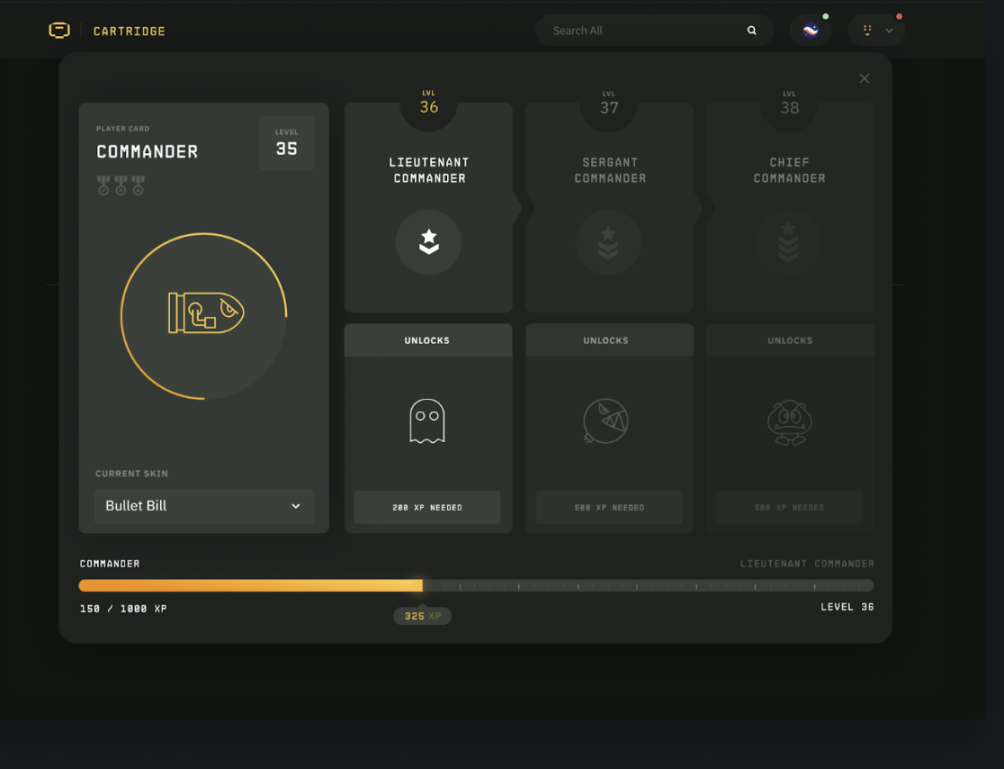
Cartridgeimage description
Mission function - rewards can be obtained by completing missions on the platform
Crypto (Gaming) Wallets
Integration with crypto games through traditional channels is unlikely: due to the resistance of the traditional gaming industry to crypto, such as Valve banning all NFTs and cryptocurrencies on their platform, it seems we have to natively build an equivalent crypto solution. A team working to bridge this gap is Cartridge, the “Steam” of crypto gaming. Users on Cartridge will be able to browse and launch curated crypto games, earn rewards from quests and upgrade their avatars, and interact with friends and the community. Game-specific crypto wallets provide blockchain gamers with these missing discovery and social features: platforms like Cartridge act as infrastructure that connects the composability benefits of crypto games beyond the application layer.
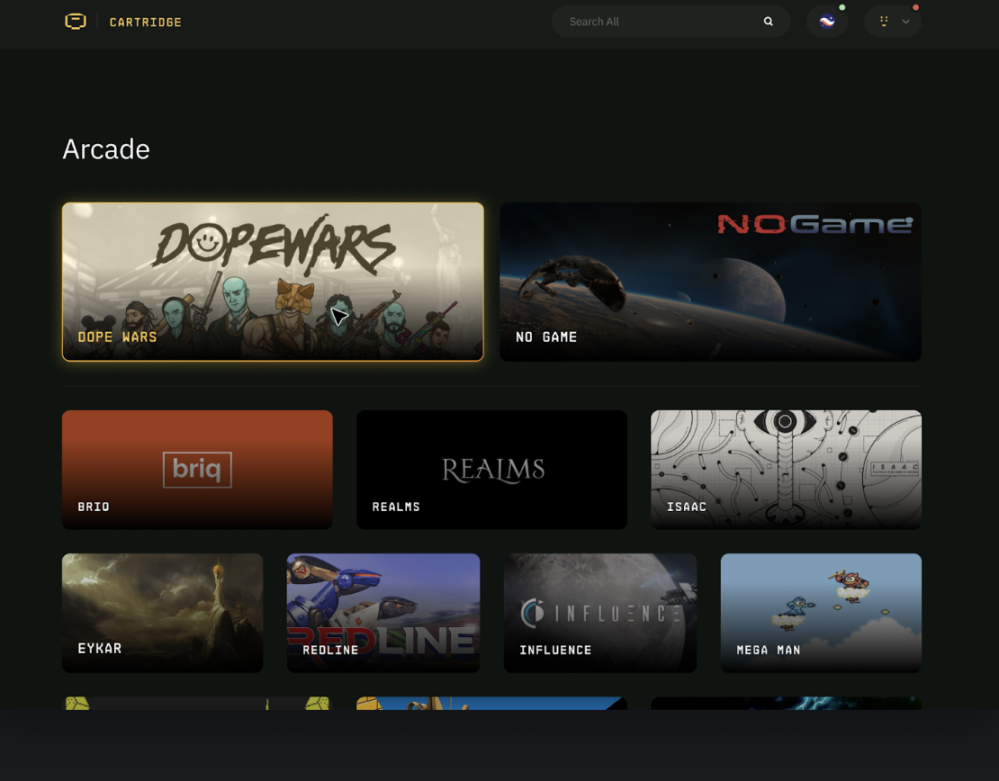
Cartridge allows users to browse and discover new on-chain games
Summarize
Summarize
Platforms like Steam provide composability and ecosystems for games, but can also impose restrictions on players unilaterally, often against community consensus. Decentralized alternatives such as Cartridge allow users to benefit from the core identity, governance, and social innovations of decentralized gaming ecosystems, while preserving free market principles.
Ironically, innovation at the core of gaming built on a decentralized trajectory has led to the centralization of assets, identities, and communities in decentralized gaming ecosystems. Building games on-chain enables composability by default and unlocks new game mechanics and paradigms for developers and users.


